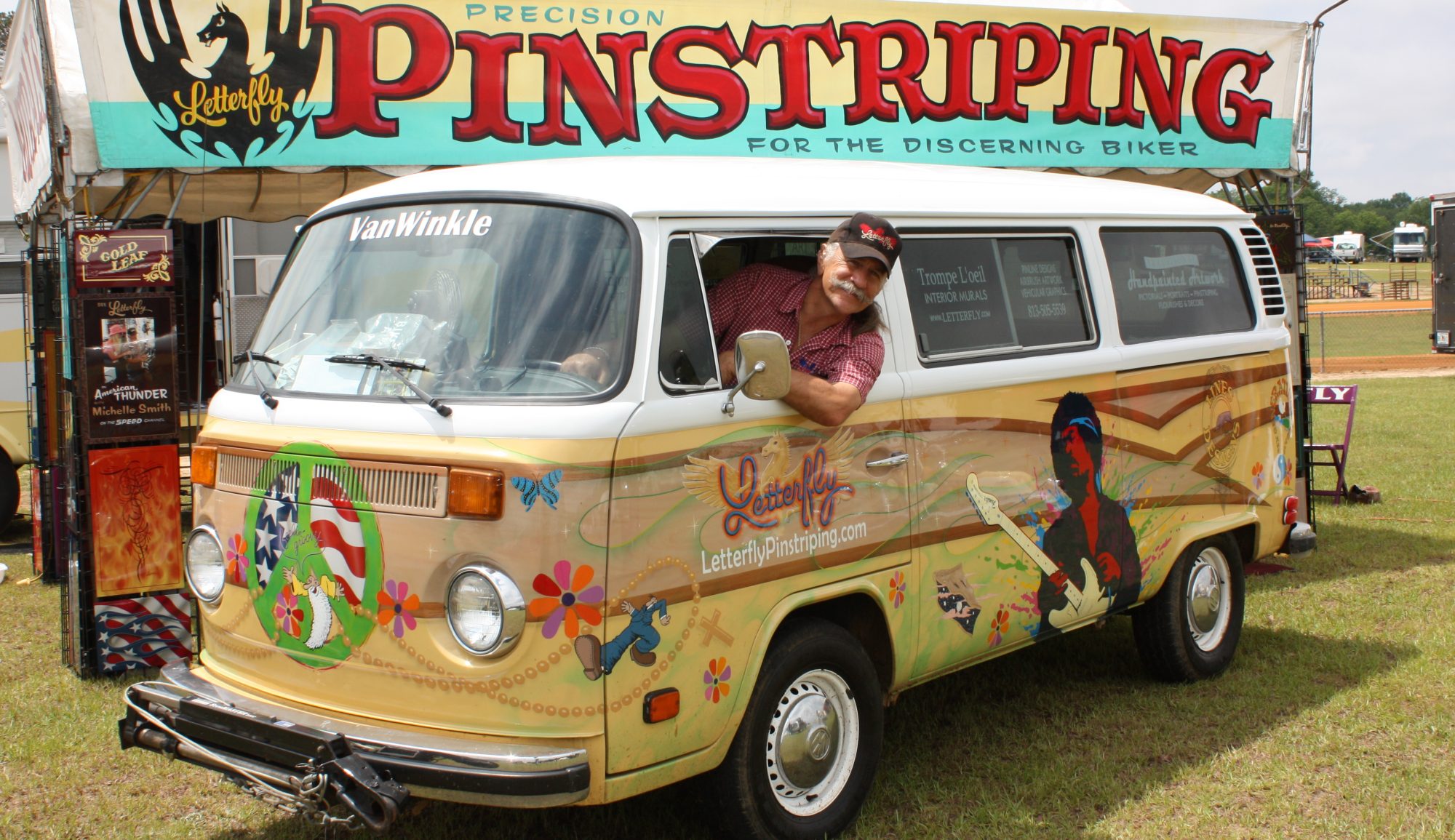
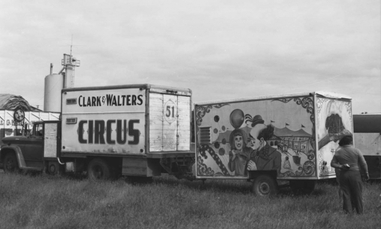
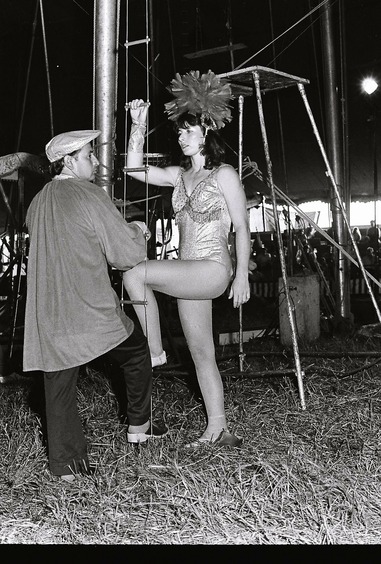
Although initially I started as a drummer for the circus, using my skills with a paint brush occurred even before the first time I played the drums, perhaps revealing the inevitability of this career path. This was further propelled when, after the wreck of my liberty act pony truck, I lost the means to stay with the circus and began to paint as my primary role.
The next summer, I discovered a huge market for hand painted sign and artwork on the fairgrounds. This provided the funds needed to re-equipped myself to resume performing with my six-pony liberty and horse acts. While painting the fleet of Clyde Beatty-Cole Bros Circus in winter quarters, I secured a position performing on the King Brothers Circus, one of three Acme Circus Corporation shows, for the season of 1978. The King Bros Circus had all the admirable features of a medium sized big top circus. I had seen this circus in the past, met most of the personnel, and compared to the hillbilly operations I was used to, from the positive impression received, this first-class circus became a logical goal. When the fleet of the Clyde Beatty Cole Bros Circus was finally complete late winter of 1977/78, I made the trip to Arkansas to begin re-equipping myself to perform.
By this time my parents had purchased a five-acre plot of land in the Ozarks to build a house upon. Part of their motive with this property was to also have room for my animals. With my six-pony liberty act, I had created a wonderful career with a promising future. Now, the startup hurdle was over and the animals were seasoned performers. The package was perfect in many ways. The magnitude of work to get to this place had been rewarding and the multitude of experiences helped me in other ways especially in the relational arena. Now the business of having this batch of ponies as an act settled into finding opportunities, performing on a regular basis and the ongoing maintenance on the road.
Another aspect that made this business perfect was that I had options other animal handlers did not have. For extended periods, I could place them on pasture during the off season, freeing me to pursue sign painting opportunities. I actually credit these ponies with making me a better sign painter. No matter what, they kept right on eating. That motivated me ongoingly to find and secure sign work. The ploy worked. I had the funds needed. Now the time was here to get re-equipped.
My dad joined in my quest and helped me find and buy an old single-axle semi-tractor. When we found one we liked, being a shrewd negotiator, he provided them with a list of what the truck needed in order for us to be able to buy it for that price. When the truck received all the things that my dad insisted be fixed or added, we also discovered they put a new front bumper on it with yellow fog lights. This was a cab-over, the style the manufacturers came up with to allow for a longer load. By putting the driver over the engine, the overall length of the cab was shortened. This one had a bunk too. The cab was both white in color and the manufacturers name was White.
It had what the truckers called the screaming’ meanie Detroit engine, a ten-speed transmission and two large fuel tanks. I had to learn how to operate and maintain this piece of equipment and the men at the shop were very helpful. I learned how to tilt the cab, so I could then walk up to the motor. But I was warned to make sure everything loose in the cab was secure or else something could go through the windshield. I became familiar with all I needed to know on this, my first diesel. When we were about to go, I received some final advice from the men at the truck repair place.
“If it ever sounds terrible, like it is just about to fling itself apart,” I was warned with a sideways smile, “just keep driving it.”
While interacting at that truck dealership, I saw a sign painter lettering a truck. I went over and took the time to watch as he put letters on the door with a curious little brush in a casual, effective way. Soon after he noticed I was watching, some friendly rapport began.
“Watch this,” he began, and then added a sinister twist, “they said it couldn’t be done.”
I watched for something amazing. He loaded his brush with paint, carefully paletting it before bringing it back into the proximity of the truck door.
“I invented a new way to letter,” his brush touched the bottom guide line and went up, making one stroke of the next letter.
“I call this the upstroke,” he revealed while I observed his special technique.
This fortified that there was much more for me to learn in this fascinating field.
The old Fruehauf moving van that a horseman with draft horses had for sale came with an awning, ramp and living quarters. Once the truck place made all the improvements my dad insisted upon, we were ready to go on an adventure in the old truck to retrieve the trailer in Wisconsin.
I know how to travel light. But my dad insisted on bringing far more stuff that was necessary for a whirl-wind trip. He had a bed roll, pillows, his dop-kit, luggage with clean clothes inside and extra jackets. In order to climb into the bunk, he had to move all of that stuff out and onto the passenger seat first. He and his stuff took up more than half the room. I would be confined to the driver’s seat the whole time. Superdog stayed with mom this trip. Once the trip started, we drove day and night to get there.
While driving, I became familiar with the shift sequence of five speeds and then click a button and repeat the shift pattern for the next five. My dad wanted to drive too but had a few problems with the complicated shift pattern so I did most of the driving.
When we arrived at the horse farm in Wisconsin, we spied the trailer right off. At one time it was a moving van. The front was round in the modern streamline style that was popular and state-of-the-art in nineteen fifty-five. The side had two double doors on the main floor, one with a loading ramp for the horses that cradled underneath, and an added RV entry door up over the hitch. The rear of the trailer opened up completely with double doors on the back.
The interior had formed tie cleats in the vertical ribs to secure any load and light plywood mounted between to make flat walls. The only obstacle on the flat wooden floor was the square wheel boxes over the rear axle covering the dual tires.
Bert was a pleasant man. Plump and hearty as a fine example of a healthy dairy man. His draft horse team was both an advertising expense for his trophy business and was also a hobby. While my dad engaged in satisfying his curiosity about the many aspects of his vast farm, I conducted an inspection.
The unit did not have much exterior damage due to rust, as some of these old trailers sometimes have. My dad and I agreed that this piece of equipment would work nicely for my purpose.
Soon after hooking on to it and discovering that everything worked, we headed out. The plan was to stop by St Louis to see my sister’s family and break up the jump. While pulling the Fruehauf, my mind began percolating on how I was going to rack the interior and what materials I would need. Arriving in St Louis, we spied a salvage building material place and purchased plywood, planks, conduit, 2×4’s, tanks, a shower stall, barrels, etc. to rack the interior and establish the infrastructure. While parking in a neighborhood close to where we could visit family late on a Friday, we saw something else compelling.
We found a pleasant shop in an old store front with “Signs “on the façade, where signs were being hand lettered inside. Intrigued with the caliber of the gilded work on the large plate glass windows, we went inside.
My dad is naturally both inquisitive and curious about most everything. The owner took time to answer all his questions. I made a visual assessment of the physical layout and characteristics of this business, with special interest in what was used for handling the projects going on. An employee was at the painting easel finishing up a gorgeous sign. This provided me with an opportunity to watch his technique. When finished, he took his kit, said good night to the boss and left. As the conversation between my dad and the shop owner continued, we learned about snapping.
Although a paid employee, during weekends his painter would secure work in the neighborhood and put the money in his pocket. This is an ethical gray area because of the competition factor. This behavior is referred to as snapping because the itinerate sign painter snapped his straight guide lines with a length of string and a piece of chalk.
My dad had obviously taken an interest in my vocation and was encouraging me. Each situation to observe others at work in this industry revealed tid-bits of information and remained an ongoing focus for my ambition. He then asked the owner about his recommendation for my aspiration to become a sign painter. His advice was clear and simple. The best way to learn was to get a job working under someone who could teach the skills. There were several kinds of sign men, ranging from the billboard and pictorial men to the creators of fine gilded work on glass. They were considered the epitome of the tradesmen. With his encouragement, I had a goal, but for now it would have to wait.
Back at my parent’s new place, I got busy unloading the materials. I began building what I had envisioned, getting this trailer ready to haul all the aspects of the pony and horse acts, and to work out of and live in.
A bulkhead already existed between where the horses stood and the step up to the living quarters over the fifth wheel hitch. I would not need all this floor space so I installed an elevated shower stall even with the floor of the living quarters. Underneath was ample room for the stakes and poles for the awning. I placed two fifty-five-gallon drums side by side for water storage and welded a hose fixture at the base of each for a gravity feed outlet. I lashed an old tank from a water heater in the upper corner of the wall against the roof as a reservoir for a gravity feed shower. To get the water up there, I used a hand operated drum pump in one of the water drums.
With the high ceiling inside, I had the room to make a huge shelf for hay storage over where the ponies would stand. Between the wheel boxes in the rear, I built a box stall to back the horse into and a bulkhead to separate the rear section for additional storage and a bunk that went the entire width for my groom. I still had the steel steps from the previous truck and by making a small stand for the base of one, had access to the living quarters door over the hitch. The curved front of the trailer provided a challenge for making my bunk conform to that graceful shape. Careful cutting resulted in a piece of plywood that conformed to the interior wall. Underneath, I fashioned a desk and wardrobe closet.
Racking the interior and getting equipped was handled quickly well in advance of the time to open on King Bros Circus. When the improvements were complete, I was ready to load out and begin my trip to Florida. I thanked my friends at Shiloh for the use of their farm for the previous year and bid my parents adieu. With everything loaded I began the trip.
This was the first time entering the sunshine state with livestock. I didn’t know about the requirement for health papers to enter Florida. I was turned around at the agricultural inspection site to go get the proper paperwork prior to entering. I went to a veterinarian’s office near a stock yard, the tests were performed and I was again, on my way.
At that stop was the first time I fed them in the trailer. I put the feed bags on the ponies and suspended a feed tub in front of Bingo. In order for him to eat out of the tub, I dropped one of the cross-ties. During warm weather, I traveled with the side door open. As I prepared to get back on the highway, fortunately I looked in the rear-view mirror and saw Bingo trotting alongside the open door of the trailer. Without the cross-tie to prevent his movement, he had the ability to jump out of the trailer. Because the outside check was still fastened, even though he was on the ground outside, he was still tied to the rig. I am so grateful to have looked at the moment I did. I don’t even want to think about what could have happened if I had driven away not knowing.