
The Move

During the years of evolving in his profession in Springfield, Ohio, my dad became aware of how rapid graphic technology was developing. Changes were taking place with photography, film making, sound technology and education. His beloved boss was retiring and that would change his position in the hierarchy. He recognized a possible opportunity. He desired additional education to augment his skills with new audio-visual knowledge. That meant change.

The family moved to Bloomington, Indiana as I entered junior high school. Dad attended classes at Indiana University. The move into a compact home in a neighborhood with a dense population of kids also required us to ride a bus to school.

Moving away from the environs of childhood in Ohio at a tender age, we had to make new friends in another town. This disruption frustrated our meager attempts to fit in. The home situation remained frustrating and my sister and I realized being associated with John was a detriment. As we advanced through the grades, we formulated a way to stay far away from him and be safe. When Paula and I passed one another in the hall at junior high school, rather than acknowledge each other, we remained anonymous in an effort to avoid the risk of association. We would resume being fast friends at home in safety.

At that time, I was on fire to become a good drummer. The music department at IU provided me with an opportunity to take lessons from a great drumming college student. After my junior high school classes each Thursday, I went over to the IU campus to take my lesson. Afterwards I met dad, who was working in the graphics lab. He would show me what he was doing with photography and sometimes set me up in an empty darkroom with an enlarger and show me how to make my own prints.

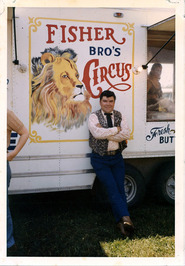
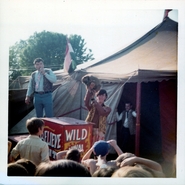
By this time my circus producing abilities matured. By summer I would put on an even larger production, adopting the name my dad and his friend Fred used many years ago; Spark Circus.

I began building cages for chickens, rabbits and the turtles I accumulated. While I painted promotional signs, Paula began making hats and necklaces out of packing peanuts and paper bowls. The neighborhood kids were curious about what we were doing and were recruited one by one to help. Soon we had two crews; the boys helping me with manly activities and the girls making prize and craft items under Paula’s watchful eye.

The masculine duties were pounding stakes into the ground and setting up and climbing the center pole we erected in the backyard. Stretching a rope tight enough to walk across became a challenge that required accumulating ever larger stretching-devices. We practiced Indian dancing routines, acrobat tumbling and hanging upside-down from the trapeze bar on the swing-set. We rehearsed these acts until we achieved an admirable level of perfection.

thumbnail 2

During the girl’s production of a mountain of prizes, Paula would pause to rehearse one of the skits she created. We had learned about skits on family vacation. The Lutheran church had a family summer camp near Lakeside, Ohio. While there, mom and dad would compose a clever skit and the entire family would act it out in front of the others. Paula had begun writing stories in her Pinfoot the Pony comics. Now inspired by our family vacation skits, she created routines for her peers to perform.

One routine Paula created for our circus utilized a chorus line of her girls pointing in rhythm, one at a time, and then changing their pose and repeating a cute-over-there dialog that ended with all of them falling in a heap.

Thanks to an abundance of Beatle wigs and a neighbor kid with a buzz haircut, the circus had a barber shop skit that began with a very furry head and ended up with a faux surprised kid with a bald noggin.

All this rehearsing united us on circus day when, like a real show, all of our equipment and our big top (a converted army surplus parachute) was marched, carried or pulled to the vacant lot next to the local swimming pool to be set up. We arranged the set-up to occur in the morning by our team of kids, followed by presenting five shows. The activity brought the entire neighborhood together. My circus benefited the community pool and produced a considerable profit for my investment. It also gave me the idea for a career path to pursue.

Family Vacations

Every summer, our family took two vacations, one to the sand dunes area near Lake Michigan – either Ludington or Muskegon, just to relax and the other was a road trip to a different destination. We started these camp outings with a borrowed tent packed into the family station wagon. Once together at the national park, after setting up on our site, we then marveled at the other camping configurations. Sleeping on the ground only happened once. This ordeal was not something my mother savored or wanted to do again and that introduced the idea of finding a travel trailer.

Once home, they researched the best camping trailer to purchase and began a search for a good used one. There were many to look at. Frequent short trips around the area included a foray to look at an old trailer. We had to go along, I’m not sure why. They finally did find one to buy. An Airstream trailer that could house us all.

Mother often asked a question at the end of the day, “What did you enjoy most about today?”

On that particular day, all three of us answered in unison, “Not having to go look at another trailer.”

Equipped with this Airstream, many faraway destinations became achievable in comfort. Dad made several improvements to the trailer over the years. Our trips took us to places we could not have seen without it. We camped near the New York World’s Fair, Colonial Williamsburg, and attended the Centennial of the battle at Gettysburg. One trip took us to see cousins in faraway Connecticut and one year we even made it to the Smokey Mountains.

The Newspaper Business

When my brother became eleven, he secured a paper route, on which I helped. This gave us responsibility, income and introduced us to some of our neighbors. John finally found a safe way to interact with others as he provided this service to his customers. Rather than becoming more social, I became adept at rolling my papers so I could throw them while pedaling my bicycle along my route to accomplish this duty in record time. The element I did not like was collecting the money at the end of the week. That part required that I become social and interact with others. One week I failed to collect enough money to pay for my papers. Instead of my payment envelope containing the full amount, I wrote an angry note to the man who collected the money. When I returned from my paper route that day, he was waiting with my mother in the living room.

“David,” my mother asked, while the man looked on, “what does this note mean?”

“I don’t know,” I sheepishly replied.

“You agreed to do every part of your responsibility when you took this paper route didn’t you?” She inquired and then added, “This note isn’t very nice. Is it David?”

“What are you going to do about it?” she asked. 

I turned to the man who had been waiting with my mother and apologized, “I’m sorry,”

I said, “I will go and collect all the money tomorrow after school.”

The Chemistry Set

What began as a Christmas gift to encourage my scientific aptitude expanded when I found the opportunity to augment the chemical contents on the university campus. The ability to purchase additional ingredients at the chemistry building expanded all my possibilities. Research revealed the components found in explosive formulas. Once acquired, I began conducting experiments that were not listed in the entry level chemical science handbook. 

I discovered a recipe for making a contact explosive. The mixture was stable when wet but when the concoction dried, the directions stated that, “any slight movement” would trigger an explosion. Perfect. I began to follow the instructions, first making a soup of the specific chemicals listed and then running the concoction through filter paper. After discarding the paper cone filled with chemical mud into the trash, I carefully poured the filtrate onto layers of paper towels intended for this purpose. This would be my unstable situation once dry. Now to wait.  

After school the following day, I went back into the basement for the obvious next step. My dad was in his darkroom. Taking a yardstick, I stretched it out in front of me to tap the now dry paper towels. Nothing. Another tap. Nothing. Disgusted with the whole attempt, I crumpled up the paper towels and threw them into the trash. KABOOM!!! Hearing the noise, my dad peeked around the corner to see what had happened. Apparently, I was supposed to keep the chemical mud in the filter paper that I had discarded.  

In the coming years, I would hear the story over and over of what he saw. With the words of a storyteller, he would crisply describe the visual snapshot of a room filled with smoke and a little boy with eyes as big as saucers.   

“A surprised Oh Boy, expression filled his face,” he would say with delight. 

Racing

During the many excursions throughout the Midwest while working as a supply pastor, my dad frequented a particular Dog n’ Suds drive-in along the way. He repeatedly entered their drawing to win their contest. Can you imagine his thrill when he discovered he had won the prize? And what a surprise we had when he arrived home with a gasoline powered go-cart in the back of the car!

Since dad was a fan of the Indianapolis 500, he soon infected all of us with the racing bug. Occasionally on Saturdays, the whole family went to a vacant parking lot where we created an oval track between parking pylons on which to race. We had the time clock that he used in the dark room to time each other. With each contestant, the procedure was always the same. We would first take a warm-up lap, and then after crossing the start/finish line, go full speed and drive three timed qualifying laps.

My older brother had compromised motor skills. He and my sister used caution as they drove their best. They were no match for me. I learned to put the accelerator pedal flat against the floor the entire time I was in the cart. I learned how to drift and slide around the corners, resulting in the fastest time of any kid who drove that cart.

My dad’s exuberance for racing took him to the Indianapolis 500 several times. In his duties, back in Indiana as a supply pastor, he had met the famous driver Johnny Rutherford and his wife. Dad was privileged to be the minister who baptized their daughter. This led to a friendship with a true gentleman of racing that led to several outings with the Rutherford family that my parents enjoyed.

One story dad loved to tell took place during one of the rare excursions away from the children. The wives were in the backseat of Johnny’s new Lincoln enjoying their freedom from motherhood for a while.

Dad asked Johnny, “how can you possibly drive around a curve so fast?”

John explained that every car had a set or a speed that a tight curve could be effectively negotiated. He explained that his Lincoln had a set of about sixty-miles per hour around a tight curve. He proceeded to demonstrate on the expressway while negotiating the exit and entrance ramps of a cloverleaf. In the midst of the turn, Johnny signaled to my dad to look at the speedometer. The ladies in the back seat were chatting, unconcerned about what was going on. As my dad peered over to look, he noticed that the gauge on the dash indicated sixty miles an hour.   

Piano Lessons

As we grew, our mother began to give us piano lessons. One at a time, we strained to sit erect, hold our hands out straight over the keys, with fingers curved just right, but not look at them. We learned to read musical notes, as we performed the practice exercises and attempted to play the appropriate keys in perfect time and in rhythm. Between lessons, there was regular practice at the piano that seemed worse than torture. This routine advanced our sensitivity to sounds, coordination and our ability to sight-read. We also had deadlines for recitals held in the big music hall on campus. A foundation in music with dexterity and discipline was being established in our young minds. 

After much deliberation, Paula and I found an audience with our mother.  I was designated as the spokesman.

 “Paula and I have both decided,” I proclaimed, “that we are no longer going to be taking piano lessons.”

Our mother paused for a moment and composed her response:

“Your father and I have both decided,” she then exclaimed, “that you are going to continue to take piano lessons.”

Our fate had been determined.

Although our mother continued to provide us with music lessons, John, not being physically coordinated enough to learn piano, became better at singing. He became a regular in the church choir and years later, he went on to enjoy singing with area barbershop quartets.    

When John discovered the private world of the comic book, he found relief from his social frustrations. Superman overcame all evil. The fantasy of an unstoppable hero gave him something to believe in. John began studying and collecting ten-cent comics. He soon became an authority on the history of each character and all aspects of the subject. John found his bevy of superheroes to believe in, live vicariously through and admire.

The TV show “Batman” became an obsession for John that sometimes interfered with his other responsibilities. John was needed at choir practice on Wednesday nights and this schedule conflicted with him seeing this popular show. At the end of one cliff-hanging episode, Batman and Robin were in a pickle that there seemed to be no way out of. John could not imagine how or if they were ever going to get out of that one, and did not want to miss the next exciting episode. The following week, he waited until the show came on, watched them get out of the scrape, and then rushed to church to join the rehearsal underway. He was fifteen minutes late and received a quizzical look from mother but as he sang, he was satisfied that his heroes were safe.

Revenge

Although watching the kids tease my brother at school, in the Boy Scouts, and at Sunday school, caused contempt to form in me, on another level, I knew it wasn’t right. What they did wasn’t fair. I felt powerless to do anything about it. There were too many of them. But one day, I recognized an opportunity to turn the tables on their rude meanness. 

My chance came one Sunday morning while at church. All of the children were assembled in the chapel before Sunday school. The boy sitting directly in front of me was mercilessly teasing and taunting my brother, who sat in front of him. During a time in the program when we all stood up, I stealthily removed the chair from behind that rotten instigator. When the signal was given to sit back down, that kid landed on the floor.  

Though that significant victory was short lived, John’s presence was a constant source of frustration for everyone. Events of our childhood were punctuated with a series of mishaps caused by his lack of coordination. He fell once during an important trip to a notable church event where my father was being honored. Having split his lip, John became the focus of that entire outing. One moment we were at the sanctuary. The next moment we were at the hospital where he received stitches.  

On another occasion, John went through the glass storm door at home instead of opening it first. That disaster required another hospital visit. Events like these kept John elevated as the central focus of the family’s attention.  My frustration went unacknowledged. Personal fantasies of eventual grandeur became a constant deviation for me. 

Homecoming Displays

As a child, I observed endless activities taking place at the nearby fraternity and sorority houses. Once a year they built elaborate displays to celebrate the annual Homecoming festivities that culminated with a football game. These displays depicted the university mascot, the tiger, doing a variety of things to their rival, and any number of other motifs thought to improve the morale of the school. Current events and popular songs also became themes. The “Purple People Eater” referred to the popular song of that time. Another clever idea was a huge cow straddling a simulated barb wire fence entitled “udder disaster.”

Not to be outdone, I imitated these efforts by building a homecoming display in our front yard. The first one occurred when I was six years old. I made a simple crayon depiction of a tiger, the Wittenberg mascot, on a large cardboard box. DaveHomecoming6

I learned to assist the college kids when their displays were being dismantled so I could drag building materials home for my use the following year. Gradually, I learned to sculpt chicken wire into the shapes of characters and stuff the holes with colored crepe paper. Each year my display became more sophisticated. Gradually my striving became mechanized, illuminated and by the time I was eleven, had an accompanying soundtrack that repeated a little ditty that Mom suggested and recorded the three of us singing: “Oh, hang ‘em up to dry, oh, hang ‘em up to dry, Ohio Wesleyan, Hang ‘em up to dry.”  This recording played all weekend alongside my display of a mechanized tiger with a washtub.Eat-The-Pie-On-Ear(s)-4-dupe

Being bitten with the drive to create, paint and a dose of insatiable curiosity, my energy focused on a variety of personal ambitions. I explored the neighborhood in search of insects for my science fair project, salvaged components for my annual homecoming display, tree house or fort and developed components for my summertime circus production.Aim-In-Fer-Victory-5

Like most little girls, Paula liked to play with dolls, toy ponies and aspired to compose stories. She once drew a comic strip with a pony as the main character. But she did not understand how to draw the hoof and ankle of a pony’s leg.  That did not stop her. She simply made the lines of each leg go down to a point, and “Pinfoot the Pony” was born. She made several adventure comics books during her young career as a cartoonist with this clever equine personality.

We discovered a litter of kittens born in the window-well of a nearby fraternity house. This started our relationship with “lucky” the cat, who became part of the family. Later, our childhood was blessed with her four offspring we named “Salt, Pepper, Sugar and Cinnamon.” After having the litter of kittens, Lucky’s personality turned anti-social and sour. So, she was sent to a local farmer who needed a mouser on his farm and we kept one of her kittens. Pepper became a source of joy for the whole family for many years. 

Mother loved singing and rose early to practice. After school, Mother was either teaching piano, voice lessons, or rehearsing for another upcoming opera. We had to be quiet while inside the house, so we learned to invent our own creative activities.

Dad planted a garden in the back yard every summer. One year I was delighted to find a herd of caterpillars devouring his parsley. I disclosed my discovery at dinner. My dad waited until I had gone to bed before thinning out my crop of caterpillars. The few that remained became plump. Then they found secluded places to attach themselves and transformed into a chrysalis. He knew about my interest in insects and found three one-gallon glass jars and placed a stick with a chrysalis in each one. Three jars, one for each of us to take to school.

In the spring of that year both John and Paula’s butterflies were born in their classrooms. Mine never did. I found out later that during the dead of winter my teacher had stupidly placed my jar on the steam radiator to keep it warm. You would think that a teacher would know that this organism was created to withstand the rigors of winter outside without any need for her help.

A year later, while in third-grade, the principal of the school came into our room, had a brief talk with our teacher and pointed directly at me and signaled for me to come with her out into the hall. Out in the hall, I saw two other students waiting with puzzled looks on their faces. We were taken to the gymnasium and given paints and brushes. We were then instructed to decorate the background scenery for an upcoming school play.

I became filled with creative delight as I immersed myself in this large project. At the end of the school day, I returned to my class room to find all my school mates crying. The television in the corner of the room revealed the reason. That day in Dallas, while I was painting, a sniper had shot and assassinated president Kennedy.

4th Lutheran Church


Our introduction to formal routine began early. Once a week, we were dressed in our Sunday clothes, with combed hair and shiny shoes. We walked with our mother a few blocks to a large grey limestone church. This church was filled with ornate carvings, a high arched and trussed ceiling with tall stained-glass windows depicting Jesus performing various miracles and praying in various settings. Our dad was usually away on Sunday making a guest appearance as a supply pastor at another church across Ohio or Indiana.

We sat in slippery wooden pews and fought to stay awake during the service. I learned to recite words of dogma with the rest of the congregation.

Words like exalt, repent, diety, beget and redemption were repeated often. I never knew what they meant but I learned to say them. The teachings did not come with an explanation. I had to guess. Do something today for an eventual payoff. I had trouble making sense out of the dynamic at the church. I had trouble relating how any of this could be good. The preaching was about brotherly love, doing good deeds for others, or the miracles that Jesus performed and forgiveness. I wondered; what about now? I was conflicted. I sat in Sunday school with the same kids that picked on my older brother.

After church, we changed out of our Sunday clothes. Then we had a treat. In the living room we would look at the Sunday newspaper funny comics. John learned to read first. I admired his ability to look at each panel and know what the characters were saying. All I could do was to look at each panel, study the cartoon image, make a guttural sound like I understood what was depicted and then go to the next panel. As the result of studying the Sunday Comics, I developed appreciation for cartooning as a form of storytelling.

Years later at church, I was selected to be an acolyte. Acolytes are the small people who assist lighting candles at the beginning of the ritual. Near the end of the service I would climb the secret staircase that went to a landing where a long rope hung. It extended through the floor to the bell tower above. When a bare light bulb came on, that was the signal for me to jump as high as I could and grasp the rope. My body weight pulled on the rope to get the massive bell up in the tower to move. After several attempts of jumping and pulling on the rope, the bell gained enough momentum to start clanging. This was coordinated with the end of the service. Hallelujah

We grew up during an ideal time. The fifties enjoyed the momentum of post war prosperity. Our urban, university campus neighborhood in Ohio provided the ideal environment in which to grow up. The neighborhood was dotted with fraternity and sorority houses, the central chapel, class and administration buildings always had something going on.

College kids were admired and considered “cool” with their Packards, Ramblers and Nash automobiles. Another admirable trait we noticed was cigarettes. Paula and I used to light the hollow stem of a dried lily and pretend we were smoking. The right mix of interesting features to explore on the safety of campus led to resources galore for the active imagination. These observations transformed into constant play.

Our two-story clapboard house was one of a curious accumulation of older wood, brick and stone homes in various architectural styles and arranged in neat rows on Woodlawn Avenue. Street lights and maple trees lined all the streets near Wittenberg University. Our home was made warm by our loving mother and fun by our dad.

Our living room was tidy, furnished with nice pieces of furniture from the old country and paintings by my great grandfather. Over the mantle hung an oil painting of an autumn woods scene with a babbling brook running through. This was painted in the 1920’s. The vista was pleasant to look at, spurned imaginative thoughts and wonder about the magical scene pictured.

A full-size grand piano dominated our living room. There was plenty of room underneath for us to play. In the safety of the piano, colored blocks in various shapes could be arranged and stacked in any way we pleased. Lincoln logs expanded our architectural options. Later, under the piano became the designated spot to set up the electric train. I fondly remember playing under the piano in my youth.

Many of the features in our home promoted fascination for children. A tropical fish tank in the fireplace was the focal point of our living room. The living room was also where the family gathered on Friday night. Dad was home from his travels. After dinner we enjoyed an evening together. The family gathered in front of the black and white TV and we got to know Red Skelton, Jack Benny, and Lawrence Welk while eating popcorn and drinking our allotted one bottle of pop per week.

History was made during that period. We saw astronauts land on the moon, heard the Dr. Martin Luther King speech I have a dream. And we discovered the phenomenon of the Beatles on the Ed Sullivan Show. While pondering the Beatles as we sat there, our dad complained about how long their hair was.

Every year we saw the television movie “The Wizard of Oz.” I still shudder to this day when I remember the part when the wicked old witch showed up on the screen. Paula and I would crawl behind the couch to peer around from behind while we continued to watch. When mother noticed, she asked; “would you like me to turn it off?” To which we screamed, “Noooo!” From behind the couch we continued to watch the movie in safety.

Our festivities concluded with a piggy-back ride where dad hopped and galloped each of us around like a horse. The ride trekked outside, around the house, back inside and up the stairs where I was flopped into bed. When the giggling finally subsided, I went to sleep with a big smile on my face.

Each night at bedtime mother would recite a poem after tucking us into bed.

As she descended the stairs, we heard; “good night, good night, far flies the light.”

Then she clicked the hall light off.

“But still God’s love, will shine above, making all bright, good night, good night.”

Dad engineered a project to expand the size of the house. He enlarged the basement, remodeled the kitchen, dining room and added the master bedroom. The huge steam shovel that came to the backyard to dig the massive hole become a source of fascination and wonder for the children in the neighborhood.

Our improved kitchen included a dining area on the main floor. The kitchen cabinets were of a white “pickled” wood finish and the central location of the main sink capitalized on the view through the glass on the back of the dining room area, a feature my parents included in every house from that point on. Fascination with fish seemed to be an obsession. Two guppy tanks sat on the island counter that divided the kitchen and dining room and tanks for breeding guppies also populated the basement. 

Our father was a strict idealist, a perfectionist with whatever task he was immersed in and difficult to please. Dad was deeply involved in his work and with projects around the house. His stickler characteristic facilitated admirable results for his efforts, but frustrated us with his observation and remarks about our adolescent attempts. Not noticing emotional needs, our dad’s constant dissatisfaction with our best work developed into a frustrated, bereaved defiance. The feeling of being misunderstood and less than esteemed, combined with the frustration of our older brother’s behavior that promoted distance and an apathetic outlook on life.

My father was relentlessly creative, adventurous and driven, always adding one more task to the moment he was in. His already busy schedule stayed full, establishing an ongoing need for his mantra; “hurry up or we will all be late.” A strict perfectionist is perhaps the best way to describe him and his expectation for me. This characteristic set up a positive quality for his creative output, yet manifested a frustrating inability for me as a child, to ever measure up.

He had started building a large train layout, painstakingly built to scale with brass track to showcased his perfectionistic tendencies. This filled the new enlarged room in the basement. His love for trains had been encouraged by friends from his first church assignment. As I grew, he noticed my genuine interest in playing with trains. Seeing my interest, he realized it was not appropriate for me to play on that beautiful layout. So, his scale layout was dismantled and sold to make room for me. He supplied me with toy track sections I could play with. I filled that big table with my versions of a layout. This was evidence of his big heart.

Following in his footsteps, I became creative, fun loving, and driven to produce. Due to the frustrating dynamic in our family, having a handicapped older brother and the negative attention he received in our neighborhood, I avoided becoming social.

Kindergarten compounded the chaos, especially on the very first day. Being dropped off by my mother at school was pure terror. I saw only a few recognizable faces, the same ones who hated my brother.  I settled into a resigned routine of compliance. Immersed into that adolescent humanity increased my tendency to withdraw. Although reluctant socially, I had an inner desire to reach out to others but could not seem to act on it. Something seemed to have my voice.

The inclination to create artistically showed up early and my mother noticed my gift.

One day upon returning home from Kindergarten, my mother asked, “what did you do in school today?”

I flatly stated, “Oh, the teacher made us paint something,” and casually handed her the paper I had been carrying.

She gazed at the watercolor painting and was amazed that it looked like a bowl of fruit.  She knew then that I saw more of what was around me than the others.

I became a creative dynamo and was encouraged with sketch books, painting classes, piano lessons and hobbies in the workshop. I also exhibited the perfectionistic tendencies of my dad.

As we learned our ABC’s I discovered the way to spell Hi. I soon adopted the pattern of secretly drawing “Hi” on the chalkboard. This became a habit that I extended to most papers, walls, my school supplies and eventually, in text books. One day the teacher reprimanded me in front of the whole class.

“Knoderer,” she pounded her fist, “If I see another “hi” around here on something, you are going to be in big trouble,” as she pointed at me.

All that did was motivate the rest of the class to begin marking “hi” on everything they could think of. 

                 I decided to not walk with my brother to school and expose myself to the concentration of kids who consistently teased him. The walk to and from elementary school became somewhat of a daily horror.

I recall one morning seeing in the distance ahead, a circle of children taunting my brother John, who spun around extending his clarinet case at arm’s length as a weapon. I later learned that in preparation for the walk to school that day, John closed the lid of his case on a drawing compass with the sharp metal point extending out. If contact had been made with any one of the harassers, an impaling injury would have occurred. There was no justice in childhood. John was all alone, just trying to fit in. He had few friends. I being like the rest, avoided him.

Play Time

Paula received the usual gifts for a girl, a Barbie doll, fabric to make doll clothes, games and toy kitchen cooking stuff. John received a belt tooling kit, games of which he was especially fond and books about math and music, along with socks. To encourage my creative tendencies, I received a heavy package that contained an Erector set. Inside were pieces of structural metal, bolts, axels, gears and a motor that could be configured in countless ways. This aggregation of building components would facilitate many projects. I also received a seed planting kit, socks and many how to draw and paint books.

Crayons, paints and sketch books were abundant in our home as creativity was encouraged by our parents. Even though she had dolls and girl stuff, Paula liked boy stuff too. All in all, the foundation for happiness was alive and well in our home and the relentless creativity coming from our loving parents couldn’t help but be contagious.

During our frequent one-on-one, Mother taught me to pause and review something special from the recently viewed movie, event or story I had read. She then invited me to select and share with her my favorite part. Little did I know at the time that I was being groomed to become a seeker of goodness, pursuer of positivity, and appreciator of what the original artist or author intended.

As children, we had an ambition to play outside with toy trucks. Our father cleared out an ivy bed next to the garage so my sister and I had some dirt to play in. A short retaining wall separated the terraced back yards and made a perfect highway for our vehicles to travel upon. As our village in the dirt took form, made from accumulated findings, Paula assumed being in charge of paving the roads that threaded through our town. By heaping up dirt and smoothing out the top with a slurry coat of mud, Paula perfected the process of paving the roads that threaded through our miniature town. Paula earned the nick-name “mudder” at the same time! As we grew, the pattern of conjoined creativity expanded to include a variety of productions, the first of which was a backyard circus.