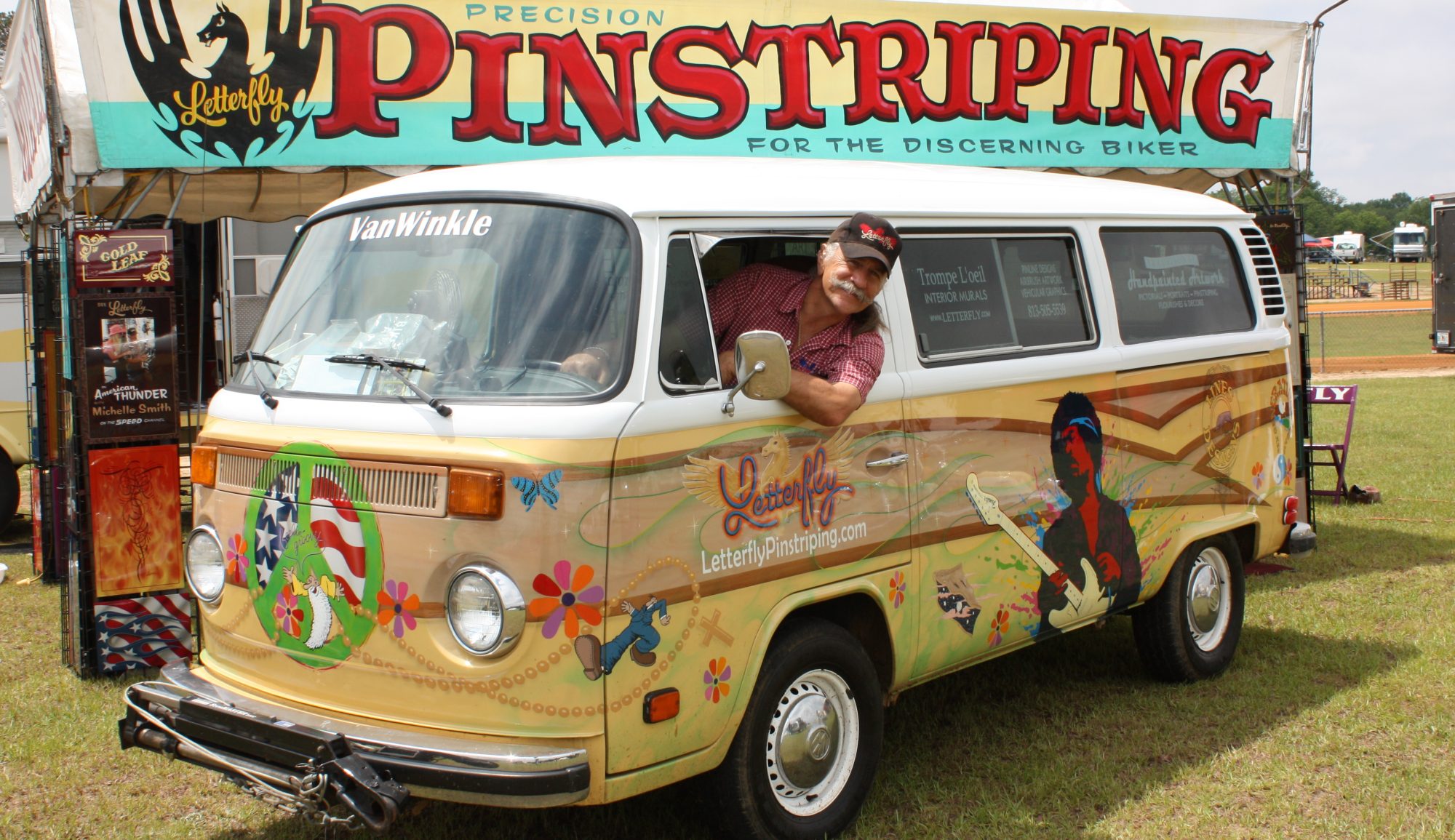

New Ambitions


The original purpose of a side show was to give the crowds something to do when they arrived on the lot. A hundred years ago the crowd would follow the circus street parade to the show grounds and then stay all day. Other patrons came on special excursion trains that had them on the grounds an hour or two early. Others simply made a day of it. The circus during the golden era represented the place to go the see amazing things that included not only exotic animals, strange people and attractions of all kinds but also modern innovations such as electric lights, refrigerators and automobiles. The traditional side show had advertising banners along one side of the midway with exaggerated hand painted depictions of the attractions inside. 

During the first two seasons of Fisher Brothers Circus we had no banner line in front of the side show. A banner line is a set of these canvas advertising signs set up on the midway.  As the side show manager and the show painter, I was aware of this. I recognized yet another creative opportunity I was ideally suited to fill.

With the expectation of a longer season and a winter in south Texas, the show stayed out much later that year. We traveled across Illinois, Missouri and Arkansas during late summer. September took us across Kentucky, Tennessee and by October we were in Louisiana. At one town the show was set up near the old civil war battlegrounds where old earthen trench works were still intact. By November the show was playing the bayou country of Louisiana headed toward Beaumont, Texas. Then we headed south into the Lone Star state a little each day. 

South of Houston, the show played Navasota where I met a canvas fabricator and commissioned several double-decker banners and an entrance banner, enough to make a 70-foot banner line. I paid a deposit and made plans to return to pick up my order when the season was over. Part of my ambition for the upcoming winter was to paint this set of banners to complete the appearance of the sideshow. 

The objective when placing paint on canvas for show banners is for the end result to be pliable, because it must get folded and packed away daily. By following the proper procedure, the canvas will not get soaked with paint and get stiff and crack when folded. The procedure involves sizing the canvas first. Sizing begins by using a special mixture of starch and water to soak the canvas in prior to painting. The fibers of the fabric are filled with liquid size to ensure that only a portion of the paint permeates each fiber. While painting the banner, the artist keeps the canvas fibers at proper saturation point by periodically wetting the back side of the canvas with a water hose. This keeps the fiber and sizing pliable so the paint adheres more like a dye than a paint. This is an old circus banner painting trick.
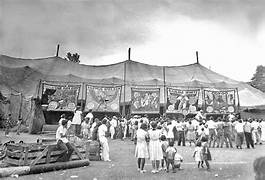
78 Side Show bannerline

The strategy of painting a banner is to design the work so that the canvas receives only one coat of paint on any one area rather than the usual system of painting the entire background first. Then place the sign work and imagery on top of the painted background. That way, it creates an accumulation of two or three coats in some places and that makes the banner stiff because the canvas has too much paint on it. This can be avoided by laying the entire design out with chalk on wet canvas first, and then start by cutting in the background around the subject areas and work from background to foreground. 

While the show played the final towns on the route, I began to visualize how accomplishing this monumental task could be done over the winter. But first, I had plans that included a trip to Hugo, Oklahoma to talk to Bob Grubb, buy ponies in Indiana, commission the building of a calliope in Danville, Illinois and visit my parents outside of Chicago.

Billie had a turkey in the oven in the cookhouse ready to serve on Thanksgiving Day at the next town. Our morning jump was hampered by a freezing rain that coated every windshield and made the roads slippery like a sheet of ice. Each circus truck had to stop occasionally to scrape the ice off the windshield. After driving only a few miles that morning, the decision was made to scrap the remaining route to find a place to park the entire fleet for the day. We found a large gravel parking lot and parked the fleet, then set up the cookhouse and had our turkey dinner in this cold area of respite. The next day the roads were clear and since the season was over, as the rest of the fleet began the trip south, I went north, first to Navasota to pick up my preordered canvas and then headed to talk to Bob Grubb about training a horse act.

Aspirations for the future would keep me busy. In Hugo, Oklahoma I began to talk with Bob about creating a pony act. He revealed the strategies involved with my ambition. I found out about attempting to put together a matched set of ponies, assuming responsibility for their care and transportation was a lot of work.  Undaunted, I would find with Bob’s help training them to perform a precision routine and learning presentation skills of a circus performer would rocket me into a whole new chapter of circus life.

Drummer (part 2)


I was obsessed with becoming a better drummer as I began my sophomore year. I had taken lessons at Indiana University and practiced every day during the previous year.

                Bloomington High School had a gifted band teacher who motivated his students to pursue music as a career. At the beginning of the year Mr. Traub placed me in the band room during an hour the classroom wasn’t being used so I could practice and he monitored my progress. He noticed my improvement and by mid-football season he started me through the ranks. I was placed in the marching band as a tenor drum player and by the beginning of the second semester I was the first- chair snare drummer for the Symphonic Wind Ensemble. This was the equivalent of joining the college orchestra.

I met Karen while in the band that year too. She was an aggressive red head. She knew what she wanted. I had been a sheltered, reclusive and socially clumsy kid. A whole new world opened to me. Karen always had something in mind and she knew exactly what to do. After school and all summer long, she taught me all physical aspects of relationship between the sexes. Eager to be with her, I would do almost whatever she wanted me to do.

This university town had no jobs for a fourteen-year-old because of the abundance of college students. It was early summer when the Deggeller Shows brought a bunch of carnival rides to the university campus for the Fun Frolic. I was there early looking for a job. Despite this not being a traveling circus, it did qualify as show business.  I got a job helping set up the Merry-Go-Round, working with a man and his son with whom I became friends. Together we worked and eventually hung the last horse on the ride. We then started to assemble the kiddie rides. Unloading the specially-shaped steel components from trucks with broken bulb glass on the floor revealed an interesting contrast to the form of show biz I was familiar with. Behind the scenes, I was seeing the amusement business as it really was. Once the rides were ready, I returned home to clean the dirt and grease off of me. I was told to return the next day, so I must have done a good job.

When the festival started, I ran one of the kiddie rides. My job was to stand at the controls, welcome the patrons, and make sure they were settled into their seats before turning the switch to start the ride. If no one was waiting in line, I gave my passengers an extra-long ride. I was grateful to have employment for the week and it filled me with a feeling of accomplishment.  Karen hung around while I worked, but something was clearly bothering her.

“I think it’s terrible,” she wailed, “that you work all the time.”

Her inability to empathize with the value of this opportunity combined with a feeling of frustration that grew in my gut. This strong sensation literally reached up inside me and grabbed me much like the reaction that took my voice when I watched bullies pick on my brother. Karen maintained this negativity all the time I did my job. She insisted that I take a day off and accompany her around to all the rides. Reluctantly, I did what she asked.

The next day, I explained to my boss my plans to escort her around the festival grounds instead of returning to my post. When I returned the following day, I discovered my job had been filled. I learned two valuable lessons on one day; never let them discover that they can get along without you, and career always comes before girlfriend.

While excelling at math, John learned the machine language computers spoke. At Bloomington in high school, he wrote elaborate programs using punch card sequences that would solve mathematical problems. He understood and developed a mastery of complicated systems using binary code.

My father’s climb through the ranks and his ambition with newly acquired graphic skills landed him a job in the Lutheran synod offices in downtown Chicago. The family would move again, this time to the suburbs of a sprawling metropolis. My family moved twice during my high school years. First to Bloomington, Indiana so Dad could expand his skills at Indiana University with a second Master’s Degree. Then, two years later to Chicago, Illinois so he could fill an important role downtown. He used the Airstream to move the bulk of our possessions, with the exception of the piano.

John graduated from high school as the family moved from Indiana to the Chicago suburbs.  John stayed behind and began his college years at Indiana University. The students were older but still mean to John. He chose to withdraw and excel academically. He took classes for many years until exhausting the curriculum. From there he launched his career as a computer programmer.

All the summer school college students eventually went home. A short window of opportunity existed so I started looking for a job. I went into the Lucky Steer Steak House. The boss asked me if I could start immediately. He then showed me the dish room with hundreds of dirty dishes piled up to the ceiling. I started immediately. Three days later I was cooking steaks. Dad learned of and appreciated my ambition. He was busy moving the family’s belongings to Chicago with the airstream and waited for the last minute before taking me with him.

I arrived at our new home late at night and slept a few hours. The next day was my first day of school. In the morning, I was dropped off early in front of an unfamiliar school. I received my class assignments at the administration office at Arlington Heights High School. I searched up and down the hallways for the room numbers on my list, and finally gave up. I could not find them.

Not knowing which way my home was, I had no options. Frustrated, all I could do was sit down on the front steps of the school while the classes were going on. A friendly counselor saw me from a distance and came to sit down next to me to find out what was going on. He looked at my admissions card and he too realized that I had been given room numbers that did not exist. Confusion at the Chicago school system started with this debacle on my first day and spiraled down from there. As I entered my junior year, the tainted perception of my new school and surroundings bred a new-found apathy and defiance.  Expecting the same positive experience that I enjoyed in band in Indiana, I soon realized that Fritz Shmoyer, the band teacher, was incompetent and simply coasting along on tenure. He was apathetic about his job and didn’t encourage any students. Because I made this comparison, I knew he was a slug and began my defiant response to his pathetic efforts.

Fortunately, John stayed in Bloomington. Paula and I were relieved that none of our new colleagues would ever know about our brother, but we found a new set of frustrations. The big city pace of suburban Chicago, the dysfunctional school system, and the beat among our fast-paced peers had its own mix that led to a new exasperation for myself and Paula. 

Also fortunately, the art department at my new school was outstanding and far better than any previous art classes. Mr. Pink became an advocate for my ambitions. He encouraged my emerging skills and created many artistic opportunities for me.

Play Time

Paula received the usual gifts for a girl, a Barbie doll, fabric to make doll clothes, games and toy kitchen cooking stuff. John received a belt tooling kit, games of which he was especially fond and books about math and music, along with socks. To encourage my creative tendencies, I received a heavy package that contained an Erector set. Inside were pieces of structural metal, bolts, axels, gears and a motor that could be configured in countless ways. This aggregation of building components would facilitate many projects. I also received a seed planting kit, socks and many how to draw and paint books.

Crayons, paints and sketch books were abundant in our home as creativity was encouraged by our parents. Even though she had dolls and girl stuff, Paula liked boy stuff too. All in all, the foundation for happiness was alive and well in our home and the relentless creativity coming from our loving parents couldn’t help but be contagious.

During our frequent one-on-one, Mother taught me to pause and review something special from the recently viewed movie, event or story I had read. She then invited me to select and share with her my favorite part. Little did I know at the time that I was being groomed to become a seeker of goodness, pursuer of positivity, and appreciator of what the original artist or author intended.

As children, we had an ambition to play outside with toy trucks. Our father cleared out an ivy bed next to the garage so my sister and I had some dirt to play in. A short retaining wall separated the terraced back yards and made a perfect highway for our vehicles to travel upon. As our village in the dirt took form, made from accumulated findings, Paula assumed being in charge of paving the roads that threaded through our town. By heaping up dirt and smoothing out the top with a slurry coat of mud, Paula perfected the process of paving the roads that threaded through our miniature town. Paula earned the nick-name “mudder” at the same time! As we grew, the pattern of conjoined creativity expanded to include a variety of productions, the first of which was a backyard circus.

Did Picasso Start This Way?

Harried and disheveled, she encircled the house.  The green and yellow mid-length sundress, in style during the fifties, was a blur.  A stiff, fall breeze brought with it, a nip and spiked urgency in her current task.  Along the perimeter, she noticed that the painters had left ladders leaning up against the house, and one near the front porch.  Paint spotted canvas tarps spread over the bushes flapped in the frigid wind.  She stopped momentarily to review the scene. She noticed a warm shade of parsley colored paint. Redecorating began to cover-up the weathered white clapboard siding. This was my parent’s first house; the color promised to transform their purchase into a warm abode they could happily call home. 

But nothing was going as planned with the painting project. Words of discouragement and frustration were not necessary as anyone could see the disappointment in mom’s eyes.  For the workmen didn’t show up when they said that they would. And the removal of the old peeling layers of paint didn’t meet her husband’s approval.  

Unfortunately, he was initiating a mission congregation for the Lutheran church.  His job came first. He would be away all day.  To add to his wife’s frustration, she had three children in diapers.   

Sometimes mother thought that nothing was worse than managing the innumerable home improvements without father. At other times she didn’t seem to mind. As it was becoming clear, it would be longer than they said before the painting was finished. As she had these thoughts, her white canvas tennis shoes gingerly stepped around things the painters left out in the open. Her ongoing property management review was a source of frustration at the end of each day. 

Behind the single car garage, mom found the painting crew wrapping up.  These men had full gallons and, a few half buckets of paint, rags, stir sticks, jugs of solvents strewn with empty cans of every shape and size. 

The taller of the two workmen rose slowly from his squatted position in the proximity of a bucket full of thinner. He washed his large brushes at a leisurely pace. This act commenced the final act of his workday.  His white coveralls were spotted with paint. He paused from what he was doing and looked up as my mother approached them.  His attention was clearly focused on his impending departure.  His short partner had a dark mustache, curly hair with a receding hairline and a soggy cigar stub in his mouth that had been there all day.  Sitting on the tailgate of their old pickup truck, he gently manipulated his brush back and forth in an old towel; evidence that they were knocking off early. 

“You men make sure you put all of this paint away somewhere,” Arleen pleaded. She made a sweeping gesture with her hand that held a large safety pin.  They displayed the deer in the headlights look as she spoke.  Her tone was urgent and peppered with annoyance. Partly because this job wasn’t done yet. 

“Yeah, sure lady,” the short one offered, as he exchanged a look at his partner. 

“I’ve got young children here. I don’t want them getting into this paint,” she continued as she surveyed the painter’s inventory. 

A loud wail from a baby pierced the quiet afternoon and my mother veered back to the house.  Moments later, the workmen were in their truck rolling down the alley. They had left their supplies right where they were, so they would be handy the next day. 

My dad’s quick pace up the front steps occurred prior to dusk that day. His pressed shirt was tucked in and had a special fold on either side that was still crisp at the end of the day.  Every hair was held in place with Vaseline hair tonic and his oxford shoes were highly polished.  Well-groomed and beaming, he was anxious to share with my mother how his church activities had progressed that day.  When he found her sobbing in a heap, his demeanor changed to caring concern. My mother was emotionally spent. She was normally optimistic and filled with sweetness and gratitude for life.  She had reached her limit.  She simply did not know what else to do.  The regimen of processing diapers, managing the household and pursuing her musical career had taken its toll on her patience. This day threw her into a sobbing heap. 

“What’s going on honey?” dad inquired. 

Not feeling fully in control, all she could do was point to the backyard. 

He quickly left to investigate.  Behind the garage he found us and what a sight this must have been.  My older brother had found a fascinating pastime.  He was very observant after he learned to walk.  He had watched the workmen slowly paint the outside of our house. And as a result, he had something to share with me. So, I had willingly followed and crawled along behind him to see the amazing sight. 

I was amazed.  The backyard held a vast inventory of liquid color.  My brother found a six-inch paintbrush and proceeded to show me what he had observed earlier in the day.  Holding the brush, he demonstrated what he had seen the workmen do. He dipped the brush to the hilt in the paint.  I was proud he had a command of this profession at such a young age!  With paint dripping down his fingers from the brush held high, he looked for a suitable canvas.  Apparently, my giggle of approval inspired him and I was selected to receive a thorough coat of green paint.  The brush strokes were deft, effective and stimulating and soon I was fully covered and barely recognizable. 

My brother had spills and drips across his lap and paint all over his hands, arms, bottom and feet when my father discovered us.  I proudly displayed a complete coat of paint that would have made any artisan proud.  My dad secretly smiled at what he had found: a colorful disaster. 

My father settled into the inevitable clean-up. He tried but failed as the family disciplinarian.  His careful qualities were appropriate now.  He took solvent and rags and began the procedure. His heart went out to his little sons and the mischief they had created.   

As time passed, remembering the event became a source of humor for my family.  Not only was this a funny point in our lives, the event imprinted me positively.  In hindsight, I have plenty to be thankful for. My brother was thoughtful enough to introduce me to the joy of painting.