
Bigger Better Brighter

The first season of the 1971 Fisher Bros Circus was a huge success. Mel and BK even took off mid-summer for a few days and returned with a new Suburban truck and a Holiday Rambler trailer. The old Chevy panel truck that had been used to pull their travel trailer was replaced with this fancy Suburban and the panel truck began to pull the generator trailer. 
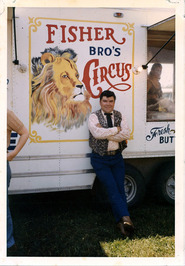
51 FBC1 2

During the tour, the raggedy old big top was replaced with a new large tent. Same with the side show. The 20×30 tent was replaced with a 30×50 tent that allowed for other additions. Inside the bigger tent I had room for the elephant to be on display. This provided a boost in attendance and an opportunity to sell peanuts. Other attractions were steadily added during our lucrative season in Michigan. 

We acquired some caged monkeys. Among them was a green, dog-faced baboon who we named “King Kong.” King Kong helped with the opening procedure of the side show.  

Before the big show, Melvin would stand on the platform in front of the side show tent and announce, “Ladies and Gentlemen, you are going to want to bring the children up close to see this very special attraction… right here, right now that is absolutely free!” 

Boisterous best describes the fourth of the Silverlake children. With a passion for old westerns, Melvin dressed the part. Perpetual boots and a cowboy hat were augmented at showtime with a gun belt, string tie, bandana and an exotic fur vest. 

He could recite classic lines from film stars of the genre he loved and often did when he entertained. With the help of a sixteen-millimeter film projector, he loved showing us western movies up against the side of the ticket trailer during the occasional Sunday evening after a matinee only.     

Melvin took a wide stance that included his face flanked by dark shiny hair that imitated Elvis and infectious enthusiasm. This demeanor was perfect in his role as host of the circus. His interactions with crew and staff resulted in enthusiasm that permeated throughout. At show time on the side show platform this exuberance served well as the audience got caught up and responded to his calculated charm. 

“Since there is still plenty of time before the doors open for the big show,” he continued, “And in an effort to bring a little entertainment out here for you, while you are waiting, we are going to bring King Kong right out here for everyone to see.”
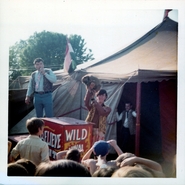
54 King Kong 1971

I waited inside the tent at his cage for the right moment in Melvin’s presentation, I snapped a leash to his collar and led him out at just the right moment. Kong jumped on the ticket box responding to the facial expressions of the crowd with some expressive behavior of his own. Kong jumped up and down and showed them his teeth. King Kong proved to be a real crowd pleaser and effective to drive patrons inside to see the attractions. 

The result of receiving a percentage of the side show revenue was an incentive for me. I fashioned flags to dress up the front and lettered Believe It or Not on an old bally cloth.

After that summer in Michigan, we headed south. An interesting cross section of the circus industry had come and gone. Performers, friends and fans had visited and wished us well.  The sister show – Clark & Walters – closed early. They returned the equipment to Indiana and some of the personnel showed up on Fisher Bros including Ralph the mechanic. The show meandered south and west before returning to Medora. When the season ended in the fall, we contributed ideas and plans for improvements.  

Once back at winter quarters in Medora, Indiana, the combined equipment for both circuses packed that hilly place and a brief reunion of personnel began to swap stories of the season’s highlights before leaving for the winter. 

At the seasons end, with my portion of the proceeds from the side show, I purchased a GMC pickup from Ralph the mechanic, made plans to travel to Elkhart, Indiana to see how RVs were made and buy supplies needed to build my own camper. Then I returned to my parent’s home to begin building my special camper that would open up into a bandstand for my drums.

I also set out to learn another skill that would make me a more valuable showman. Torchy, a retired aerialist asked me what it was that I was going to add to my repertoire that winter.  

Out of the blue I blurted, “I’m going to become a bagpipe player.” 

She knew a couple in the Chicago suburbs of Wheaton that used to troupe and now had a music store. She made a phone call. Yes, they could get me a set of bagpipes. With Torchies help I began to plan my attraction for the side show. 

During a phone call to my parents to announce that I would be coming home for the winter, I asked my mother to find me a bagpipe teacher. That winter, among my many projects, I met Scotty regularly over the next two months. Scotty taught me how to play Gaelic melodies on the Chanter. I learned special fingering techniques and how to blow and squeeze the air bag with my arm to maintain constant pressure. He also instructed me in how the reeds in each pipe were tuned and maintained. Scotty also suggested a great way to build a storage box to protect my pipes.  

I still remember his last comment; “Ya got de guts kit, larnin’ de pipin’ for da bally hooin’.” 

At my parent’s house out in the garage, I set up my workspace. I cut two by twos to length and created a series of interlocking notches and glued and screwed the entire skeleton together for my bandstand/camper. The finished skeleton was then lined with paneling, insulated and covered with corrugated aluminum. Windows, a propane system and a bunk over the cab was installed. The entire back of the camper was designed to lift open to create a large area for my drums. This was to ensure that I would be out of the weather and have greater visibility while playing during the show. 
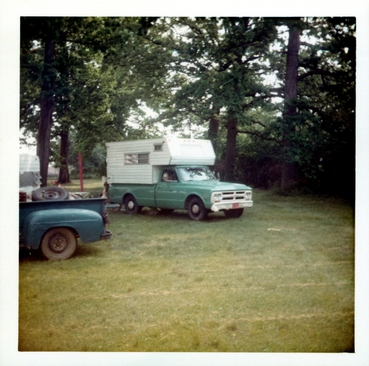
67 First Camper

By February, I had completed my camper/bandstand and drove over to Michigan to visit Bev. I met her the previous summer and stayed in contact. I showed her family what I had accomplished. While enjoying snowmobiling and holding tightly to my girl, I saw huge snowflakes drift down to transform this beautiful country I knew from warmer days.   

After our togetherness, I drove to visit friend Hayes in Clarklake, and then on to Medora. 

Winter quarters consisted of a block building dug into the side of a hill with a large area inside for the two elephants named Norma Jean and Dixie who were in the back. These two stood for long hours chained in the barn. In order to cope, they developed an animated swinging behavior using their entire bodies, swaying side to side. Trigger, the five-footed horse, was also tied next to them. He developed the same habit of swinging in order to avoid getting bumped. The front half of the barn housed bundles of canvas from both shows, piled high along one side, and there was a central work area for construction projects. 

This is where I began painting signs, banners, and ticket boxes during the cold weather. On warmer days I worked outside on the new popcorn trailer and then lettered all the doors of the trucks. The second season of the Fisher Bros Circus appeared in sharp contrast to the ragged upstart of just a year ago. As the opening date loomed closer, the new canvas, seats and improved trucks promised to produce a better all-around show.

The Same but Different

The cycle of erecting, tear down and consequent load-out of the tented city drove equipment design that had, over the decades, become a testament to efficiency, durability and simplicity. Portable cookhouse tables, easily assembled components of bleacher seating, platforms that placed an entertainer in front of and above the crowd combine with simple tent poles, stakes and rope, lots of rope. The specific way rope is used and threaded through rigging blocks were unique to the circus and the knots used to secure the guys, lash jump ropes to the poles, were a manner of hooking specific rigging up inside the tent had evolved from the era of sailing.

Using vehicles and attractions to funnel the crowd past enticements was a developed art. The showmen were masters of the science of opportunity as crowds made their way toward the big top.

I became aware of efficiency. I sought to achieve economy of motion during the daily set-up.  Each day the 20×30 tent was spread, poles unloaded and put in place and the stakes were driven. Then the tent went up and the rest of the attraction put into place.

I couldn’t keep a wrist watch working. No problem on a circus. Every day was a routine. Responsibilities drove the day. Near showtime, the activities of the concession department served as the only time piece needed. It coincided with the crowd arriving. The midway was the receiving area. With patrons present we opened the side show and the snake show up for business. For a quarter they could see the unusual attractions inside of what we called the Believe It or Not Show. The tent housed “Trigger,” a five-footed horse. We also had a five-legged cow, a midget bull, and a llama with curious ears that were another wonder of nature.

The Snake Show was in a big box truck that had a two-bunk sleeper in the front that I shared with the big top canvas boss. The large snake was kept in the back. The patrons would climb the stairs that led into the back of the truck where they would look down into a pit to see the enormous python on display. Because of the configuration this was called a pit show.

We were awakened daily just before sunrise to start the trucks and begin the trip to the next town. The big top and crew went first. I loaded the animals into the back of the elephant truck and then coiled the picket line and loaded the stakes while Melvin loaded “Dixie” the elephant. We were ready to begin our trip out of town. I rode shotgun.

We started the trip in the dark. The terrain was revealed as the morning light exposed the surrounding area. This was a special way to start each day.

The rolling countryside of southern Indiana softened gradually as we went north between flat fields. Sprouts of young crops were punctuated with barns, silos and tree shaded dwellings. The communities that had sprung up at the crossroads were our target. Each little town had similar characteristics but arranged with details in different ways. Noticing nuance became a source of fascination for my observant eye.

The days of small town mom and pop businesses of all types had impact because they exerted a personal relationship with their community. Integrity thrived. Although each day was routine, the ever-changing scenery during the jumps to the next small town revealed interesting sights, quaint communities and spectacular natural beauty. We traversed most of Michigan next.

Upon arrival at the next showgrounds, the process of laying out the big top and the arrangement of ancillary equipment had begun. Each morning, the steady rhythmic, metallic sound of sledge hammers hitting steel stakes was heard. The performer’s rigs arrived and they parked adjacent to the performer’s entrance. They had to wait for the big top to go up. While they waited, they visited with one another and the children on the show would play.

The side poles that held up the outside edge of the tent were going up and it created a bowl out of the tent. This was an opportunity for the crew to go underneath to put in the quarter poles. Dixie, the work elephant, wore a tug over her shoulders with chains attached to each side that joined behind her with a hook on the end. When needed, she was guided into position under the canvas and this hook was secured to a loop at the base of the first quarter pole. As she pulled the bottom of the pole, the canvas slowly rose into the air.

This style of setting up a tent was called push-pole. This process was repeated until all the quarter poles were in place. Thus, the elephant was part of the team. 

The cookhouse was usually set up first and by about ten o’clock, the big breakfast meal was ready to be served. The signal was then sent to come and get it. For decades, most circuses had a flag that was run to the top of the cookhouse tent to signal that the morning meal was ready. We had no flag but the shout flags up, went out all over the lot to inform those working to come and eat.

Each day became a steady rhythm of activities. Inevitable situations arose that required immediate attention and became the punctuation of the day. Mechanical breakdowns, drivers getting lost, local municipal hurdles and other uncontrollable situations threatened the rhythm of the show. 

The weather played an interesting role. Rain would render the need for a creative solution to provide comfort for the audience. It also forced other considerations during load out and could create difficulty with moving of vehicles off the lot. Wind was our least favorite.  No matter what was happening, the circus trudged forward with determination.

The circus personnel were intriguing. Traveling throughout the country with this diverse group of people provided a constant mix among ever changing situations. A feeling of family was felt in each new place. The epic tale of our traveling populous was often more interesting than the performance.

Family Vacations

Every summer, our family took two vacations, one to the sand dunes area near Lake Michigan – either Ludington or Muskegon, just to relax and the other was a road trip to a different destination. We started these camp outings with a borrowed tent packed into the family station wagon. Once together at the national park, after setting up on our site, we then marveled at the other camping configurations. Sleeping on the ground only happened once. This ordeal was not something my mother savored or wanted to do again and that introduced the idea of finding a travel trailer.

Once home, they researched the best camping trailer to purchase and began a search for a good used one. There were many to look at. Frequent short trips around the area included a foray to look at an old trailer. We had to go along, I’m not sure why. They finally did find one to buy. An Airstream trailer that could house us all.

Mother often asked a question at the end of the day, “What did you enjoy most about today?”

On that particular day, all three of us answered in unison, “Not having to go look at another trailer.”

Equipped with this Airstream, many faraway destinations became achievable in comfort. Dad made several improvements to the trailer over the years. Our trips took us to places we could not have seen without it. We camped near the New York World’s Fair, Colonial Williamsburg, and attended the Centennial of the battle at Gettysburg. One trip took us to see cousins in faraway Connecticut and one year we even made it to the Smokey Mountains.