Hugo, Oklahoma

 The winter of 1973/74 found me in Hugo, Oklahoma as the understudy of Bob Grubb, who had a background of performing with circus liberty horses for many years. Now he was going to begin with my ambition of a liberty act of my own. Out of the original ponies purchased the year before, four matched up nicely. Once introduced to this group, Bob began to observe the minute distinctions that existed between them and comment about what he saw. He began to name them, handle them to find out about their temperament, and begin to visualize a logical sequence for them to assume.
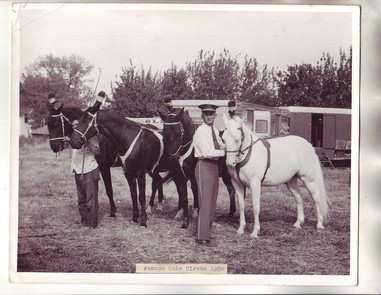
bob grubb

      He named “Buster” first, who had the most handsome conformation and attitude of the whole group. I named “Buttons,” who had the color of a new penny, after a favorite first grade teacher. “Tex” had a long back and Bob had a concern about his being juggy, whatever that meant. “Teddy” was a willing animal but seemed frail compared to the others.        

Tie stalls were rigged for the comfort of the ponies in the ring barn at the fairgrounds, and my camper and trailer were parked nearby. Anticipating this project, Bob had his ring curb already installed in the central area of the barn and was eager to begin the training process. We quickly adopted a regular routine. After chores and breakfast every morning, training took place.        

The result of Bob’s teachings and the universal attitude among the community of animal trainers around the circus is that the animals always come first. As I woke each morning, the first thing I did was go into the barn, grab a foot tub, fill it with water and offer each pony a drink. When they had their fill, it was time to feed. Nose bags received a scoop of feed each, a blend of oats and sweet feed. The ponies anxiously nickered and cavorted in anticipation, as I slipped the strap of each nose bag over their ears. The animated scene transformed as each pony became content to chew the sustenance that now hung conveniently under their lips.      

 Now I could retreat and fix myself something to eat. In the interest of efficiency, I developed a way to fix a Hearty Breakfast and only have to wash four items when complete. First, I would boil a potato in the coffeepot. When cooked, I would mash it in a frying pan and move it out to the edges. In the middle I put a few strips of bacon. A pot of coffee would then get prepared in the coffeepot and I would break two eggs on top of the mess in the frying pan. When the food was ready I would eat it right out of the pan. After my meal I only had to wash the coffeepot, one coffee cup, a fork and the frying pan. Then it was time to get the chores done before Bob arrived to begin training.      

Bob arrived each morning with an agenda that was clear to him. As I watched, one at a time, Bob would gently coax each young pony into a sequence of actions at the end of a tether rope or lunge line. The pony was first encouraged to walk around the ring, out against the curb. Bob was constantly talking to them with a gentle demeanor that proved to be very effective. “Walk,” “git up,” “there now,” “whoa,” “come in line,” “good boy,” were all soon part of each ponies understanding and my verbal repertoire. 
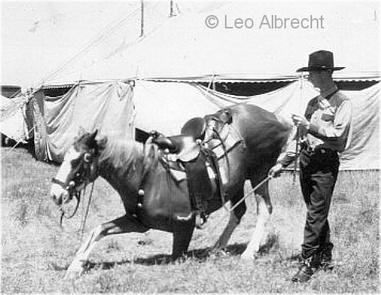
Stevens52BobGrubbTrickHorse1

       The whip was used to communicate with each animal as an extension of his arm and was only used gently as an aide to help push or suppress forward motion when needed. Introducing each animal to the whip involved letting them get acquainted by seeing, sniffing and getting touched all over with it. A variety of specific body gestures like pseudo semaphore signals accented with these extensions became a big part of communicating and asking for a variety of responses from each pony. Bob was careful to not scare the animal needlessly and was quick with a verbal reward or a lump of sugar when the youngster responded willingly to his cue. As the days went by, each pony began to grasp what Bob was teaching and the lunge line was discarded. Soon, two ponies were working together in the ring. Only three weeks into the process, the whole group of four was in the ring.      

 Repetition teaches. The sessions were at the same time each day, every day of the week except Sunday. The result of this consistency was a tremendous amount of progress in a short time. Also fortified with another form of reward was when they provided the correct response, we would often simply end the session. The behavior and understanding each equine accumulated soon proved his technique as being very effective. Those hours of observing the tedious training process were to prove valuable when it became my turn to do the training.

        The most important concept for any liberty horse to grasp is something that is not seen when the audience watches them perform, and that is to stay in the ring. This is taught by; never allowing them to have the experience of being outside of the ring or, when they do jump over the curb and go out of the ring, make sure they have a negative experience while on the outside to cause them to desperately want to get back into the ring. Bob had a rope barrier elevated around the outside of the curb, at shoulder level to a pony, for them to run into if they did jump out of the ring. My job was to be the bad guy. During one point in the training, one of the ponies got the notion planted in his head that he was going to go somewhere else and would jump out over the ring curb at the same place in the routine every time we rehearsed. I was on the outside of the ring and with a whip in my hand. I would yell, chase and swish the whip in an effort to strike terror into the heart of this cute but misbehaving equine. The moment the pony jumped back in the ring, I stopped with the terrible animation and Bob was quick with an assuring word. He appreciated the fact that I was there and he didn’t have to be the bad guy. I was learning how these little guys would become predictable and how important it was to interrupt negative behavior before it became established.

      Another important response to have firmly established with each animal is to halt whenever asked. This is especially important if the horse should become rattled, because from a halt, the trainer has a chance to personally connect, calm down and reassure the horse. I couldn’t believe it; here I was, in a dusty ring barn with aspirations of glamour and excitement, taking “Functional Relations 101” from an old cowboy, learning functional strategies that would prove to be helpful in many arenas later in life.

        The circus ring is a special, highly regarded, almost holy place. In my role as drummer for the circus, I served in a capacity that complimented the other performer’s efforts. Now, as I assisted the training of my ponies from outside of the ring, I looked forward to the time that a rite of passage of sorts would occur placing me in the limelight for the first time. Not only would the duties as the trainer of the ponies be passed to me but also the transition of contributing to the show from the bandstand to graduating as a performer and working in this revered circus ring. I still recall the moment when the time came for Bob to have me join him in the center of the ring. At first I stayed behind him, as he demonstrated how to encourage them through their paces, allowing the ponies to get used to me. Then the time came for me to hold the whips while Bob instructed me, first from standing behind me in the center of the ring, and soon thereafter, from outside the ring. This was the beginning of a long, rigorous and rewarding experience.

        As I look back, I realize the ponies were God sent, and an opportunity for this teenager to become functionally relational in the midst of being intensely emotional, perfectionistic and self-sufficient. Ponies don’t understand anger and erratic behavior. Very little representational communication means anything to them. Progress was only made with kindness. The ponies forced me to become functional, aware and consistent with my behavior. This must be the source of the term “having horse sense.” The animals learn through intentional repetition and functional consistency. For the sake of becoming a good horseman, I became proficient with my behavior around them, even though relationally with people, I still remained reluctant, isolated and often frustrated and angry. Over time, this role as a pony trainer became a segue that facilitated my connectedness to others.

No People Like Show People

It takes many people to move a circus. Years ago, labor was plentiful and cheap. This made possible the Golden Era of the giant railroad circuses to emerge. They transformed an empty grass field into a magical tented city each morning. 

Melvin Silverlake promoted personnel from the tiny town of Medora, Indiana which was home of their winter quarters.  Jack Brock, the canvas boss came from Medora. He had been recruited a few years earlier for the Clark & Walters Circus where he learned the ropes of handling the big top and was now going to be in charge of tents with Fisher Brothers Circus.  

Jack’s mother owned a local tavern. That little tavern supplied many circus workers. One, a little man named Elmer enjoyed drinking White Port. He was recruited along with the rest of his family. Elmer’s posture was droopy and stooped over. He had a slouch hat covered in dirt. His coveralls were dirty and he sported a perpetual beard. His heavy mountain accent seemed to make every word he uttered undistinguishable. Guttural syllables flowed as communication between his role as an assistant to the canvas boss.  

Elmer’s wife Janie had a steely face, wild wooly red hair, squinty eyes, few teeth and an appetite for chew tobacco. She helped BK in the cook house. Willie was their son age 12 who proved helpful with the side show. Their daughter Judy was age 8 and had a crooked arm as the result of being broken but never being set. Bunks for the entire family were at one end of a refurbished school bus. 

Mike Gaska was an elderly performer from Mexico who had an offbeat manner that always connected with the audience. He dressed as a trampy clown wearing a minimum of makeup. His act consisted of seemingly struggling with juggling clubs and rolling hoops. He had a little dog that would sit up and steal the show. Later in the show Mike’s plate spinning act added sizzle to his silly. If the circus had a heartbeat, the steadfast rhythm that drove the lifeblood of the show would be Mike. He was always present, sometimes patiently waiting with a pipe clenched between his teeth as he watched the progress of the show while waiting for his turn to perform.   

He had a visual way of communicating and radiating kindness. He always provided encouragement to others whenever needed.  Having been around the Clark & Walters Circus, he was considered family to the Silverlakes. Mike lived in an Airstream trailer with several little dogs. During set up he pulled the electric cables, hoisted the light chandeliers in the tent and set up the midway lights as he maintained the light plant. 

As the show ended each night, the crew began dismantling the seats and making room for the pole and seat trailer to move into the tent on the heels of the crowd. Virtually everything was loaded while the rig was under the tent with the exception of a few side poles and two center poles that were holding the tent up. Mike Gaska waited patiently to lower the lighting chandelier, thus allowing the workers the last remnants of the remaining light. When the pole truck moved out he lowered the lights. This created elongated shadows of the remaining workers and Dixie the elephant, who arrived to pull the remaining center poles out. Standing near the only raised portion of the edge of the tent, Mike was seen holding the lights in the opening as the elephant emerged rapidly, pulling out the two poles as the canvas mushroomed behind her. The air would whoosh out and the tent gently fall to the ground. As the crew began to untie the knots from the guy ropes on the stakes, they threw the ropes on the tent. Mike would walk with the lights and load them onto the generator trailer. Then he coiled up the cables.       

  Emma Duke was the wife of the circus agent and the mother of BK. Emma put on full clown makeup daily and dressed in big shoes, a funny wig and a colorful costume. At the beginning of the season her camper pulled the generator trailer. She often showed up in the performance and her colorful presence would fortify the premise of circus. She presented her gags and sometimes acted as part of a duo with Mike Gaska, to reinforce the funny clownish elements of the show. 

The 1971 season of the Fisher Bros Circus began with me on drums and just an amplified record player. Every hand on the show was expected to be useful. During the show many people came and went to cue the record player. Whoever was my assistant was responsible for the song changes for each act and inevitably preceded each musical selection with an unnerving needle scrape across the grooves of the LP disc. This would follow with the scratchy music of the song playing to accompany the act. 

One week, a man claiming to be a musician and a magician was hired. The amazing Marquis had a reed organ that looked like a suitcase on legs and a drinking problem to boot. When inebriated it became difficult to sync with his music. Changes supposed to accent segments of the acts became sloppy. One especially sloppy episode involved him falling off the bandstand in the middle of a song. When Melvin rushed over to help him get back on the bandstand. I yelled an indication of my frustration with, “leave him down there” 

But when sober, George Marquis was an amazing hypnotist who could do his act with up to a dozen people from out of the audience. To this day I remain amazed at his antics. He made post hypnotic suggestions to each of the volunteers. He would suggest that the volunteers became hot, or were standing on an anthill, or viewing an inviting aqua colored swimming pool with no one watching. This would produce a variety of amazing and often comical behaviors. George only lasted a few weeks before his career on the show abruptly ended. Thank goodness, a professional traveling organist with her own pickup and Airstream trailer showed up on our lot and filled the position he left behind.  

Marie Loter had a full Hammond B-3 organ with a Leslie speaker system mounted in the truck cap on the back of her pickup. She was set up for this kind of job as she came from a circus family and had relatives on many other traveling circuses. I helped her back this rig into the big top each day and set my drums up alongside. We were the band for the show and became good friends. Between shows her television would be on in her Airstream trailer with coffee percolating. Marie would tell stories of the adventures she had on other shows. 

Harry Haag Jr. was cousin to the Silverlakes and was the last remnant of another circus family. His grandfather had a mighty show at the turn of the century until 1938. He had a huge old school bus with a horse trailer behind it. Once parked, his family tumbled out. With his wife Pat, they had three daughters; Cheryl, Kimberly, Ruby and one son named little Harry. In addition to the four kids were dogs of all sorts and one large pony. They were here to add to the show in any way they could.  

Cheryl was a pre-teen with big feet, who soon had her single trapeze act in the show. The entire time Cheryl was in the air performing, Pat was seen standing in the back door looking up, while acting like the concerned mother. Kimberly had aspirations to be an animal trainer. With this goal in mind, she would often place one of the dogs on the roof of the horse trailer and entice the canine to jump down into her arms. Her dad was our mechanic who would take time to teach Kimberly how to lunge the pony and get him to do some basic liberty work. Ruby was small but seemed to always have a smile on her dirty little face. Little Harry was still in the crib that set alongside the bus.   

Mister Clean best described Bob Walker who arrived on the show with his wife Sandy and their two boys. This muscular man helped Jack and Elmer with managing the big top. They lived in a travel trailer pulled behind their car. The healthy and optimistic attitude of this family raised the attitudes of everyone on the show. Sandy had a creative streak and expressed an interest in my decorative painting accomplishments 

A few weeks into the season, a red and white school bus arrived on the lot to join us. Inside was a family of performers, mom, dad, and two daughters. The Michael family had an outstanding juggling routine. The girls did aerial acts. The parents did a comedy act called the Senzanys that was an addition to the show. As the drummer and announcer, I witnessed every accomplishment of every act. 

Prior to the comedy act, Dennis was positioned as a stooge up in the seats appearing to be part of the audience. When Lynnie made her entrance as an overstuffed nurse clown entering the circus ring, Dennis began to laugh. In addition to being loud and boisterous, he acted drunk. As soon as this was established in the mind of the audience, he received a challenge from nurse Lynnie to come down into the ring to assist her. Dennis would then come down from the seats in a hilarious way and enter the ring that exaggerated his drunkenness. These antics were followed by classic examples of slapstick reminiscent of the days of vaudeville with some folksy circus clowning thrown in.  

One morning while moving my drums into position near the big top, I had the opportunity to observe one of the girls interact with her mother. 

“Mom, I had a dream last night about being on a bridge that went up into the sky and the wind was howling and blowing,” Mandy announced, “And the raging waves of the sea kept rising up trying to get me” 

“Oh, that’s an interesting dream,” Lynnie, her mother, responded, “There must be some hidden meaning in such a scenario.” 

“What’s a sce-na-ri-o?” she carefully plodded out this new word. 

“Oh, you know, the story line,” she would add, “The sequence of all the events going on.” 

“Oh, yeah,” Mandy agreed, “Probably my scen-a-rio means that a secret good fairy keeps watch over me and that is why there was a magical bridge to take me over the sea.” Mandy continued, “And there was this cat with a silver mane but he was a house cat, and when he blocked my path I told him to move out of the way” 

While I overheard this interaction between mother and daughter, I waited for the inevitable reprimand, such as I would have received at my parent’s home for having such wild imaginative thoughts. But none ever came. Instead, her mother remained encouraging. 

  “That seemed to be a scary dream,” Lynnie offered, “I’m glad that you made it safely through” 

“Oh mom,” Mandy replied, “You’re silly, it was just a dream.” 

The big top was soon up and I began to erect my drum platform and move the components of my kit into place, thinking about what I had just witnessed. 

The cookhouse was for telling stories, or in my case, listening to the sometimes-fascinating tales of life on the circus. The daily dining experience became a time of wonder with plenty of new families. The stories were referred to as jackpots. The tour progressed and occasionally traveling performers would stop by enroute to other destinations to visit and rest their animals. 

Mike Gaska’s brother visited between his Shrine Circus dates that had him busy crisscrossing the country. While on the show, Mike’s brother Oscar volunteered to perform his balancing act that started with a one finger stand. This was the first time many of us saw this amazing feat.  

Our guests were always invited to join us in the cookhouse where the jackpots were exchanged. Some of the old timers remembered the horse and wagon days and told tales of the ongoing rigors that were part of life on a mud show. During these conversations I gained much road wisdom. 

This unique society has unwritten laws, closely guarded secrets and traditions that reflect highly regarded values. Ideas like “finish your act no matter what,” “the show must go on,” and “animals come first,” were foremost. The unifying response to the occasional calamity that was an inevitable part of this lifestyle was to stick together. Everyone would work in response to anything that threatened the momentum of the show.  

I applied these observations to my personal life. This environment gave a reclusive teen, a place to shine and evolve past the issues that threatened to block the essence of my greatest gifts. As this quality entered my focus, clarity and courage began to reveal a bright future. 

I had an opportunity to experiment with disclosing some of my thoughts to Lynnie that summer. She listened patiently to my ideas and, true to form, responded with encouragement. The result of this opening for personal disclosure was the beginning of developing my ability to reveal my innermost thoughts. I had an audience for secrets, dreams and creative ambitions. Lynnie became a close, cherished friend and confidant. She became a muse who appreciated everything creative and proved it with the life that she lived. 

At the end of the summer, the Michael family left the show so the girls could start school. Melvin encouraged them to meet George and Lucille Cole and become marionette puppeteers in the Chicago area. I would see them on another show in a couple of years. In the meantime, I became a pen pal with Lynnie, who remained a source of encouragement and became instrumental in my life.  

I found these special folks who made up the colorful spectrum of the circus like family. Each individual made their unique contribution to the traveling community, each with their vast and varied backgrounds. Their gifts rounded out the show. We all had aspirations for the future, a longing to become better at what we did. That seemed to be the common denominator for circus folks, to become greater as we went along. 

John Herriott

As I headed south toward John’s ranch, I reviewed the plan for the year ahead; maintain rigorous practice with both animal acts prior to the circus festival, compete for the first time in front of the leaders of this industry, and when complete, spend the entire winter season of January, February and March at River Ranch, the luxury RV Resort. After the winter season, I resume practice with the animals to prepare for a five-week circus tour in Canada in the spring. When the tour was complete, return to Michigan where the horse and mule spend the summer on a farm while I paint for the Elliott Amusement company. I would also attend the Blue Bird rallies I had been invited to.

I drove day and night into progressively warmer weather. My thoughts reviewed the immense privilege of working with an admirable series of animal trainers; Bob Grubb, Evy Karoly, Vi Hopkins and Chuck Grant. Now, I get to work with one of the circus greats, John Herriott.

John was born into a traveling circus family, the son of Milt Herriott, an all-around animal trainer. Milt taught his son how to train and handle elephants, horses, camels, llamas, zebras, mules, ponies and other exotic critters. John’s specialty became multiple-horse liberty acts. The Herriott’s performed on both railroad and overland touring shows such as Cole Bros. Circus, Barnes and Caruthers Olympia Circus, the Circus World Museum, Hoxie Brothers Circus, Al G. Kelly and Miller Bros. Circus and a few more. The Herriott’s became renowned in circusdom.  John became effective in the circus ring presenting liberty horse acts and elephants along with other exotic lead stock. His marriage to a tall blonde from Sharon, Pennsylvania produced four daughters.

Years ago, as a teenage drummer on my first big top show, I sat in the cookhouse tent and listened to the fantastic tales that abounded. I heard one story about a family on the Hoxie Bros. Circus. They produced a beautiful display for the show that included every member of the family on a horse. All six members of the Herriott family presented talented circus horses and their display filled all three rings. They wore exquisite wardrobe and performed in unison. The concept of a family that worked in harmony with each other was foreign to me because I came from a dysfunctional family. Although I never worked on the same show with the Herriott family, years later I became acquainted with all of them at an assortment of wintertime functions in Sarasota, where many circus folks live during the off season.

The long, slow trip south allowed plenty of time to review this fascinating livelihood I had found. I came from a contemporary urban culture. As an enthusiastic teenager, I found a completely different society on the circus. Rich with tradition, I was eager to learn and assimilate all I could. My curiosity, dedication and regard opened doors into this interesting way to live one’s life. Certain unwritten rules of the circus actually interfered with being completely accepted into their society. I would always be regarded as an outsider. Regardless, I became attracted to the specialties of the highest regarded of the performers; the riders of the high school horses.

Weary of the long drive and eager to get there, late at night, the last fifty miles took me through the foggy, ghost-like, dimly lit, palm tree-lined interstate highway that threaded past Tampa. The muggy weather was in contrast to the blustery winter weather experienced at the start of this trip. A glowing luminescence on the horizon hinted at the coming dawn as I moved closer to my destination. In the early morning light, my rig found its way down familiar two-lane roads.

Upon arrival at the Herriott home the livestock was unloaded after I pulled down their long driveway. The horse and mule were happy to get out of the trailer. They had stood inside for three days. They couldn’t contain their enthusiasm as I led them through a gate to enjoy freedom and the green grass of the pasture. They kicked up their heels and frolicked at first but soon found the distraction of nourishing green grass.

I arrived at John’s home the first of December. I had plenty of time to receive coaching and rehearse the acts prior to the circus festival.

One morning, the year before, Mary Ruth asked me to go on a trip with her to ride a horse. She was considering a big saddlebred as a gift for her husband. When we got to the farm and found him banging his foot against the stall door, I had some concerns about the horse. Although I rode the horse and did just fine, Mary Ruth didn’t ask me what I thought. She made the decision to get that horse. A year had passed.

 By now, John had trained his big horse to do an admirable march and passage. Our daily routine became working and training our horses together. We both prepared for the International Circus Festival competition which would commence shortly after the holidays.

The result of our intense training would be that these animals would work well.

Standard procedure for living with circus animals is: the animals come first. First on the agenda, while they were out on pasture, was to rig up two tie-stalls underneath the lean-to on the outside of John’s barn. John took me to the building supply salvage yard. I bought three sheets of used plywood – gray from the weather – and three fence posts. At one end of the lean-to, in an assigned area, I planted the posts in the ground and secured the plywood between the barn wall and the posts. I now had two tie-stalls. Rings were also installed to hang water, feed buckets and hay bags. I parked the trailer in the lineup of other equipment, hooked up my water and lights, settled into my living quarters and got some rest. Later in the day, the livestock were introduced to their new stalls, fed, and bedded down.

The activities began on the Herriott ranch early every morning. John had an eight-horse liberty act in training, a big Clydesdale and a little pony that did a big and little act, Henry, the miniature donkey and the big saddlebred he named American Jubilee.

Soon, my daily routine harmonized with all the activity at the ranch. This let me maximize on the opportunity to learn as I watched all the training taking place. When my turn came to use the ring, I rehearsed my acts in the round pen, the same size as a circus ring.  I choreographed my horses’ movements into a sequence that would become the routine I use at the circus festival. I also ran Betty the mule through her routine.

             After the morning feed and muck-out detail and the training sessions were complete, we had fun. John and I both had a saddlebred horse to ride. We saddled up our handsome sorrels and rode them up and down the driveway. We asked our horses for various movements and gave them exercise in the warm Florida sunshine.

When it came to the march, his horse A. J. had an amazing reach I envied. We worked on achieving finesse with our cues and encouraged each other with our progress.

The routine with Betty the mule became a comedy act with me acting like an old prospector. This act was an expanded January act, a routine that appeared as if the animal was outsmarting the trainer with a liberty routine combined. I had been composing patter to support the premise of my mule appearing to defy all my requests. I kept having ideas for more comedy to include and in this environment with John, opportunities for additional inspiration were rich.

One day I asked John, “how would a guy go about putting a hind-leg walk on that little mule?”

John thought for a moment and replied, “I think I would check her down good and tight. Then slap her on the side of the neck and see what happens.”

When I did exactly as he suggested, my mule stood on her hindlegs as upright as a candlestick.

Now that Betty had the idea, I began to develop her hind-leg walk.

As John’s season loomed, he had an idea that would benefit me. He referred me to the idea of meeting Dorita Konyot, a local retired performer and horse trainer whose family brought Dressage to this country. He knew I would receive the advanced riding instruction I sought from her.

The weeks passed. Each day was productive. The bond between us grew. I was able to share tidbits accumulated from experiences with trainers in Michigan and John shared aspects he learned from his father. We enjoyed mutual improvement with our high school horses and our time together.

With each day, a heightened anticipation grew among his family members due to the upcoming holidays. His daughters, now mature circus performers, had husbands and kids of their own. They came from all over to visit to John and Mary Ruth. Soon his family activities included decor and treat preparation as the ladies transformed their home into a fantasyland of holiday happiness and joy.

My dad loved Christmas. Growing up in Ohio, I was familiar with the standard holiday tradition of colored lights on the house, a layer of white snow outside, carolers singing on the front doorstep, special cookies, hot chocolate and the excitement of Santa bringing gifts. The family Christmas morning of my youth was a magical time with plenty of gifts and excitement, now just a memory. In adulthood, Christmas became just another day. Here at the Herriott household I was about to experience a special holiday.