The Birth of A Name

Superdog and I concluded our exploration of this wonderful yet mysterious place and set our sights toward other locations that offered adventure and the opportunity to earn a living painting signs. I had a small footlocker with some interesting items stored inside. Among them were some antique railroad lanterns with colored glass lenses that Hayes has given me. To lighten my load, I wanted to leave this stuff here at winter quarters until spring. Then, I had more room inside the bus for comfortable living.  

In the center of the winter quarters was a low structure with a corrugated metal awning on both sides with a few bunks inside for the working men. The Ponderosa had a mysterious energy, although only lightly used during the dormant winter. I placed my trunk in an out of the way place along one of the porch roofs for safekeeping. My plan was when I returned to paint the fleet, I would retrieve my belongings.

My love for horses influenced the selection of territory in which to make a living. I aimed the bus at an affluent area of South Florida, a mecca of horsemanship, for my quarry that winter. My concessionaire contacts from the Michigan carnival lived in Boca Raton and wanted some painting on their motorcycle. After saying goodbye to Billy and promising to return when the circus was ready to decorate, Superdog and I jumped into the bus and headed down the road. It was Christmas time.

The miles began among agricultural symmetry, morphing into urban sprawl and gradually became a vast rangeland dotted with puffs of palmetto thicket. South Florida provided a labyrinth of highways with a highly concentrated population. The destination proved to be a wealthy area with an abundance of Christmas lights that seemed out of place without snow.

I found Jack & Sid, decorated their motorcycle with a cowboy sitting by a campfire in the desert and was treated to an evening of fun at their favorite bar. With the help of my hosts, I then received an interesting lead that took me to the Polo Center of Boca.

On the outskirts of designer neighborhoods with terra cotta tiled roofs, geometric shaped windows and driveways with shiny status symbols parked in the midst of sculpted and landscaped terrain lay a large area with several specially manicured grassy playing fields. Thundering horses with aggressive riders competed for the thrill of the chase and elusive victory. Most of the time this place was dominated by mundane routine that accompanied taking care of horses, tack and lawn. I then met the boss. My skills were needed at the large scoreboard and the box seats in the grandstand.

As the tedious process of rendering names filled my day, there was ample time to mix with the riders to quiz them about their unusual vocation. As they described the dangers and the frustration of interacting with other men on horses and the penalties of not adhering to strict protocol, they saw the lengthening of my face and the quizzical expression followed by wondering why any of this could possibly be worth it. I then received an explanation.

“There is nothing in the world that compares to the brief moment, by chance, of actually being in front of all the horses on the field, going hell-bent for leather while on-line with the ball,” my polo playing friend explained.

“Closing in rapidly toward the target with fresh adrenaline coursing through my veins and at just the right moment I swing the mallet with everything I’ve got,” he continued, “I hit the ball and then watch it sail downfield and go through the goal as the crowd goes wild.”

“That,” my good-natured friend explained to me, “is what makes it all worthwhile.”

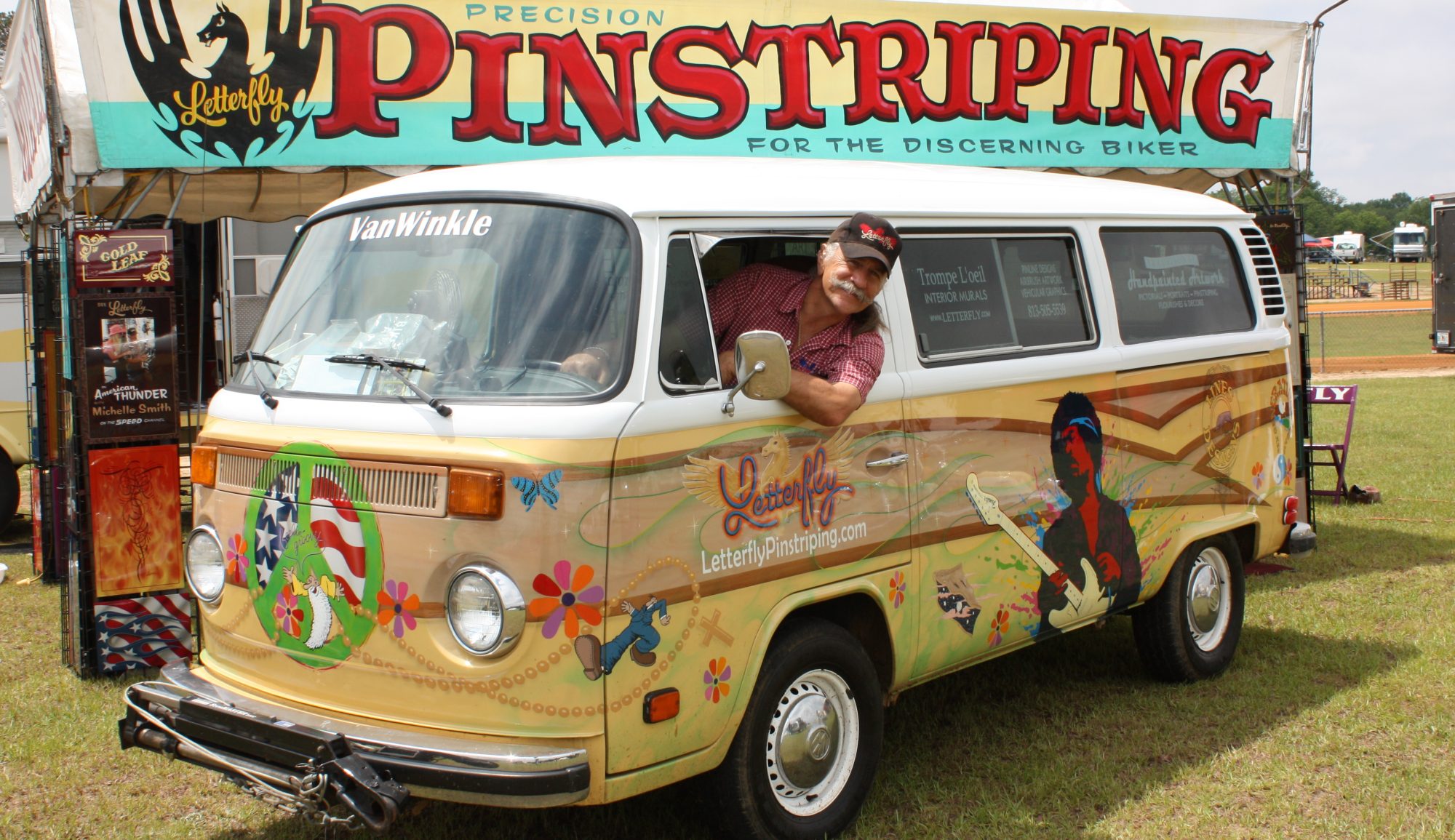
It was early one morning at the polo grounds that I came up with my new moniker. True, “Krazee Davee” was emblazoned across both sides of the bus, but during my travels, I had met several other crazy Dave’s. This prompted an awareness for the need of a new brush name. I had been born with a name that nobody could remember, spell or pronounce.  Frustration with the difficulties of my real name in school made the creation of something simple with animation a priority. A dividend would be a hidden meaning.

Out of the blue, one uneventful morning, came the inspiration; “Letterfly!” I immediately liked it. The hidden meaning would imply not only proficiency with lettering but also hint at ready to go and imitate the slang Let ‘ER fly used by the horsemen. My new name was everything my German name was not. It was easy to say, remember and spell.

I began to think of images to use with my new name for a logo. I recalled my childhood hobby of insect collecting with butterfly raising.  My first artistic attempt incorporated butterfly wings flanking a woman’s body with an artist hidden in the design. He was at work painting away. These early attempts with the butterfly never really worked, so I kept searching for the right image.

My stay at the polo grounds was certainly interesting and productive but beyond the box seating and the scoreboard there was very little sign work to do. One of the horsemen told me to go north to the West Palm Trotting Center. This was the wintertime headquarters for horses and horsemen of a different genre. They could surely use my skills on their variety of equipment.

The drive to this new destination through the concentrated suburbs was brief. Luxury and opulence was in evidence the whole way. The trotting center was an even more sophisticated horse facility with neat rows of barns, spaciousness and several large oval tracks where the daily training took place. Young horses were started here to prepare them for a career pulling a bike or two-wheel cart at any number of trotting tracks across the country and Canada. Other horses were recuperating and undergoing therapy so at some point their career could resume.

The bikes were painted with stable colors, the color scheme that was on all their equipment even the driver’s silk uniform. The nicer bikes had pinstripes that ran along the length of the shafts and the occasional track mishap or close call would scuff a little of this paint off. This is where Letterfly the sign painting guy fit right in. Not only would I letter the stable name on their tack trunks, truck doors and director’s chairs, but I could repair the damaged paintwork on these bikes.

Back at Hayes, I had fashioned a fold up drawing table that neatly tucked away in the bus. Now at the trotting center with plenty of lettering to do, I set up shop under an overhanging roof of one of the stable barns. The bus was parked under the comfort of a shady tree nearby, and in the midst of the ongoing pace of daily activity, Superdog and Letterfly thrived.

At night all was quiet. With no lights on any of the barns the only illumination came from the billions of stars that commanded the skies. The darkness provided a comfortable place to contemplate the vastness of God’s splendor, dream up creative solutions for the steady stream of artistic requests that came each day and unwind with Superdog, prior to bedtime.

It was on one such peaceful and quiet night that an exciting occurrence took place. I heard the thundering of horse’s hooves dominate the darkness. My heart quickened, my first thought was to get out of the way but in the darkness, I was unable to see where the loose horse was. So how could a collision be avoided?

Evidently a young horse with a daily regimen that made him strong, fast and restless had managed to get out of his stall. Now he enjoyed freedom and expressed his joy the best way a horse knew how and that was to RUN! “To fly without wings” best describes what this majestic beast is made for.

While I sat in the darkness not knowing where the wild horse was going to go next, I was inspired. I realized how appropriate honoring the horse was to me. I knew to redesign the logo for my new name Letterfly.

Horses are a big part of my life. The image of a horse would best exemplify all that, as an artist, I stand for. Including this image validated my love for the horse and when I added wings to support the fly. My design began to work.

Several versions later I had what I wanted. The new image successfully communicated the scope of my interests, suggested proficiency and was a concept of what I stood for. Also implied was that my service provides propulsion for my clients to rocket forward. This is how Pegasus was adopted and remains the icon that best describes Letterfly the artist/horseman/entertainer.

My time at the trotting center remained productive through the winter months until finally, the time came to return to the circus winter quarters and begin my role as decorator of the fleet. I bid farewell to my many horsy friends and headed north.
Circus Winter Quarters

While driving south through Georgia, I noticed palm trees dotting the landscape as we neared the sunshine state. The terrain had a unique look. In spite of the frequency of rain, the green of the foliage had a faded look the result of relentless sunshine. The highway billboards became frequent. Ads attempted to lure the viewer with promises of mermaids, sunshiny beaches and water wonderlands along with sophisticated destinations for golf, amusements and sunbathing. My favorite billboard ads were for the Coppertone products. A reclining bikini clad beauty provided the focal point and was very effective at capturing attention and prompting my imagination.

My destination was Deland to respond to the request to decorate the entire fleet of the Clyde Beatty-Cole Brothers Circus while they were in winter quarters. I studied a map and found a route that went through a great forest. Florida wilderness is unlike other places. A unique charm exists as palmetto thickets in the midst of tall pine and oak trees thrive to provide a home for wildlife. Graceful birds and fleet footed lizards in abundance gave animation to the serene tropical forest.

As the trip progressed, directional arrows for the fleet started to appear on the posts of the roadside signs. I then realized my destination would be very easy to find. I would simply follow the arrows.

As I neared Deland, the arrows led me to an interesting show business mecca. Outside of town, near the railroad station were the old fairgrounds that now served as the winter quarters for the three circuses owned and operated by the Acme Circus Corporation.

Arriving at this location brought my experience with this show full circle.  The annual visit of the Clyde Beatty Cole Bros. Circus during my childhood was like a holiday/festival/adventure all rolled into one. As I neared this special place, I spied the tall chain link fence that surrounded the place. I went through the gates in front. Palm trees lined the roads inside. Bright yet well-worn circus trucks were parked haphazardly, as if abandoned in a hurry. Only a few people stirred, and none were in any special hurry.

Superdog was anxious to get outside. The sight of the fleet meant he was at home. His life on a show was the only life he knew. As we rounded the driveway and maneuvered towards the travel trailer parking area, he became noticeably animated. Barely coming to a stop, the moment I opened the door, a white fluffy blur shot over my lap and went out the door.

His self-appointed job was to check out each new neighborhood.  If you could take the course he took on these jaunts and straighten it out, the length would easily reach from here to the moon. Superdog had wisdom learned from being on many different shows for every year of his life. Now he carefully assessed the layout of this place, frequently looking back for me while determining his options. This dog was the perfect match for someone with an appetite for adventure.

Superdog was the only pup in his litter not currently in a dog act. All of his sisters earned their living sitting on pedestals and jumping through hoops. And his sister Fluffy even jumped off the high ladder into the arms of her trainer. Superdog was born to blaze a trail, seek distant horizons and make friends all along the way. His smiling face caused most people to melt. Many times, as I searched, wondering where he was, I would find him smiling in the midst of a group of girls petting and adoring him.

I would exclaim “there you are,” but inside I was secretly saying, “I’m proud of you.”

Here in the circus winter quarters he was in his element. He checked out the row of travel trailers ignoring the harmless yapping dogs. He appealed to the animal lovers that attracted him. Relentlessly he inspected this new home and disappeared around the corner of a barn on his quest to become familiar with every aspect of his new surroundings.

This was a mysterious place that the circus-loving public didn’t see. Gone were the musicians, performers, the sparkling costumes and the hoopla. No flags were waving or lights flashing. Other than the exotic smells of the animals, nothing was much out of the ordinary here.

I found my friend Billy Griffin, who had his travel trailer parked in one section of the vast compound. After checking in with him, I set out on foot to explore the grounds. Billy was a retired clown who now sold tickets in the office. He had a perpetual seven-ounce bottle of Coca Cola in his hand and had been around the circus since he was old enough to join as a teen. We met on the Fisher Bros. circus just a few years prior.

Large silver barns stood empty except for the piles of seat boards that appeared hastily unloaded from the nearby trailers. Now they accumulated the inevitable layer of dust, illuminated by long narrow bands of sunlight coming from overhead. Bundles of canvas were piled atop the stacks as if the elevation would offer some protection. A group of red trailers wait outside, each with its specialized task aboard yet dormant for a time. The splash of color emblazoned on the sides of each one in this setting seemed to stir little excitement.

The lions and tigers are gone, away at a compound in another county but the elephants were here evidenced by the activity going on in a large area at the very back. What was once the fairgrounds grandstand is now a stair stepped roofed barn that housed the pachyderms, all chained in a row. The picket line was not unlike when on the road, except here the chains are secured in the concrete of the floor. This is the only place where a full crew remained. The task of feeding, exercising and picking up after the bulls took place year-round and the nearby steaming mountain of manure was testimony to the magnitude of by-product these animals produce.

With throngs of people absent from this collection of brightly painted apparatus, a different kind of energy dominated the scene. I entered the main barn where a lone workman stood at his bench in the dim light of a solitary bulb. A jig had been made on the workbench to receive three grandstand chairs at a time. This facilitated the ongoing, much-needed repair of hundreds of seats during the winter months. Chairs stacked high dwarfed him as, one-at-a-time, he replaced damaged and worn chair legs, seat boards, and in some cases discarded the trusty folding flat, wooden seat that had easily seen enough loading and unloading for one lifetime. Three of these chairs were attached together with a strap of flat steel top and bottom. All this activity requiring drilling and bolting in addition to simple wood crafting. This lone workman had a pace that would, like the tortoise, get him to the finish line by the time the circus opened in the spring.

Among the plethora of interesting items stored in that vast hall was a Cinderella float. A pumpkin shaped carriage that had obviously occupied this corner for a long time judging by the thick coat of dust that all but obliterated the faded orange paint. Occasionally a scruffy workman, one of many society outcasts, filed into this great barn filled with interesting artifacts to urinate in the corner.

The big top pole trailer with the all-important center poles, quarter poles, side poles and a spare bale-ring occupied the center of this barn. Sacks of rigging and bundles of canvas were aloft in an area designated as a safe from critters and moisture, the two deadly enemies of canvas during storage.

A forgotten trapeze hung from high in the rafters; a silent testimony to one genre of this entertainment’s many art forms. Ticket boxes and trunks of all sorts were stacked nearby. The worn concrete floor had large areas of dried paint with footprints that lead away, evidence of an industry that had taken place long ago in this now fallow environment.

As I emerged through a doorway on the other side, the relentless sunshine bombarded the willing palm trees that separated us from the quaint brick railroad station. As I turned to make my way towards a large grassy field, my route caught up to Superdog. As he zigzagged a path ahead, he looked up to acknowledge me. With a slight hop in his step, he continued to blaze ahead.

As I crossed the field, I recalled that this as where they put the big top up in the spring. My mind began to wander. I pondered generations of circus history that had taken place on these grounds. I perused the preparations that took place decades ago, prior to the time I saw the show as a child and paused to appreciate the multitude of tasks that all blended into the finished product to provide pleasure and entertainment to throngs of people. As I stood alone filled with the wonder of it all, the sun warmed my face. The love of my furry companion warmed my heart. There is no activity taking place here today. It will be a couple of months before these semi-trailers began the annual process of receiving a fresh coat of red paint to get ready for the new season when my services as a sign painter were needed.

Uh Oh

Beaming with pride, my attention was soon distracted. I noticed a strange clicking noise coming from the engine in the rear. A glance at the dash was all it took. The oil light was on, so I immediately steered the bus to the side of the road and shut her down. An inspection of the underneath and the rear of the bus looked grim. Oil was all over the back dripping from the engine. My heart sank. Superdog would have to wait in the bus while I hitchhiked for help.

Standing on the side of the road, I studied the view of the grassy fields to the left and right as I waited for the next car to go past. Long amber shafts of grass with full seed heads waved rhythmically in a breeze as large olive and black grasshoppers flew lazy arcs overhead. Tired fences offered shelter to infant trees safe from the routine of mowing along the road and during the harvest of the hay. Clumps of mature sumac, maple and oak took a stand along these boundaries initiating a windbreak and providing shade.

Not much for standing still, my walk took me farther and farther from the disabled bus. A driver, seeing the curious vehicle on the side of the road and the tall longhaired guy continuing on foot figured it out immediately. He slowed down and offered me a ride. Pikeville was only a few miles ahead and yes, he knew of a garage he could take me to.

Soon I faced a shallow, faded white block building with the usual array of rusted car parts and shiny grease stains on the worn driveway. I made my way inside the dimly lit garage and followed paths between piles of worn tires and stacks of oily motor parts and found the woolliest man I have ever seen. He was bent over a car fender concentrating on the cold gray mass of metal under the hood. I began to speak.

As I explained my quandary, he began to smile, lighting up the place. He thought as he wiped his hands on a maroon rag. He then gestured for me to follow him out back. There, he told an enthusiastic youngster immersed in a repair job behind the building about our quest and that we would be back soon. We walked toward a rusty stout truck that, although it started right up, the sound was evidence that the mechanical components were in dire need of attention. Unspeaking, he seemed confident that the truck would make it, so after climbing in, I settled into the most comfortable part of the torn foam seat and held on.

With the help of a tow strap and with me at the wheel soon the decorated bus was rolling down the highway again. Knowing the value of having the vehicle sign work on display, I opted for parking the bus in the front of the garage next to the road. There I could stretch an electric cord and have relative comfort while I arranged for and then waited to get the mechanical work done.

My sign work became a sensation for the youngster working out back. He became interested in, not only my plight, but also my vocation. In contrast, my wooly savior seemed satisfied that his job was done. He didn’t seem to be able to communicate information about the services offered that I would have found helpful. As the result, a solution to my dilemma was not forthcoming.

Sign Man

I set out on foot to find some work. The Auto Parts store wanted their name lettered in an arc across the face of their block building over the front door. While doing this job, I found and used a long piece of quarter-round trim to assist laying out the large arc. When the project was almost complete, two curious sign painters stopped by and asked me how I laid it out.

I also found some glass doors that wanted some business names lettered on them and some trucks to letter. The local fire department/rescue squad became a friendly haven and an excellent place to network with people in this community. I became friends with an ambulance driver and during our chats, I found the same kind of genuine fellowship I enjoyed with my friend Hayes back in Michigan.

Although in just a few days, I had become a productive part of this community, my wooly host wasn’t making any progress on my broken engine.

One night after work, I was invited to go with him and his assistant. It was an evening of drinking and driving the old rusty truck. We went up and down the windy mountain roads that began at the edges of the flat plain and the activity seemed innocent enough. The good old boys were out for a joy ride. That is until the driver made a decision to do something heinous.

In the darkness, on a section of mountain road with a flat area between the curves was a large dumpster. He negotiated the truck in behind the large steel object and gunned the motor. With a loud scream the truck lurched forward and the steel box began to skid away from its resting-place. As I watched this activity in horror, my host purged a cynical laugh and we drove away leaving that large ominous object directly in the path of anyone attempting to use the highway. Although this deviation from the innocent joy ride created concern deep inside me, I was unable to voice my fear.  What was I to do? Stranded without hope of escape, it didn’t seem appropriate for me to squeal. I began to fear the homicidal tendencies of my host.

My close friend at the Rescue Squad noticed that nothing was going on with my dead motor. He took it upon himself to retrieve my engine, take it to the rescue squad garage and tear it apart. With his help, we discovered the problem; a valve had dropped and broke a piston. He then found the needed parts and reassembled the motor. Grateful for the camaraderie and prosperous with sign work, now my mechanical needs were being met. I was once again mobile. With a few more sign projects to complete and the show date of the circus in Knoxville now well past, there was no need to hurry out of town.

One morning, I was alarmed to see the ambulance that my friend drove, hooked onto the back of a large wrecker. The front of this rescue vehicle was smashed flat. I found my friend inside the fire department with his head bandaged up and his arm in a sling. He then told me the story.

On a late-night emergency run with an injured patient on board, at a high rate of speed they ran right into something they couldn’t see. The object they hit was somehow sitting right in the middle of the road. I immediately had a flood of emotion grip the inside of the back of my throat rendering me unable to talk.

I was appalled, yet I didn’t know what to do. Should I tattle on the woolly one and risk the vengeance he is capable of? How can I be a friend to this man that is now hurt who took an interest in me when I was down. I was in a terrible quandary.

Like so many times when threatened with the cruel nature of the world, I did not know what to do. I stuffed this down along with the unanswered relational conflicts of childhood, siblings, girlfriends, family and home. This debacle went deep inside to a secret forgotten place and hopefully the episode would stay there forever. 

An inner tension existed and I found myself reluctant as I interacted with my injured rescue squad friend. With the last few sign painting projects complete and motor integrity restored, soon I motored away from this place and toward another adventure.

A few weeks lapsed. I looked at the beautifully lettered sign for the circus. They would be long gone by now, headed for California.  Sadly, there was no hope of ever delivering that beautiful sign to them. I still have it.

Life deals circumstances that often have no reasonable explanations. There are questions about events that nothing can be done to improve. Such was the emotional quandary that accompanied me as Superdog and I motored away from Pikeville and headed south. The engine was back to its optimal self and the routine of travel resumed, albeit with a different direction due to the extended stay in Pikeville. Plus, it was getting cold outside. I made haste and motored across the peach state.

Circus Vargas

       During the wonderful drive climbing the mountainous regions of east central Tennessee, I found many scenic overlooks. These afforded a place to pause, enjoy the vibrant autumn colors and reflect. I also noticed along the way, cardboard arrows to guide the path of a fleet of show trucks. I took a detour to follow the arrows to wherever they led. At the end of my effort, I found a grand tented circus such as I had never seen before.

Circus Vargas was from California and the grassy showgrounds was adjacent to a shopping plaza. The colorful fleet and the flags flying in the breeze atop the large canvas big top was an impressive sight to behold. I didn’t know any of the performers or workers on this show but it didn’t take long to make some contacts.

Circus 24

Thanks to my VW bus being decorated with sign work of all sorts and my habit of parking in a location with maximum visibility, the circus management soon noticed and responded by commissioning a sign. The project would take a few days to complete. I had to find a board and begin with several coats of paint. When the board was dry and ready, I began to letter the copy. The show would be in a different town by the time the sign was complete so I was given a route card. I would deliver the sign in Knoxville where they would play and give two shows the following week.

I found a board at a local lumberyard and had it cut to the proper size. I sanded the edges and began the process of painting front and back with several coats of white enamel to insure a long life. The colors selected for the copy were blue and red and when the board was dry, I was ready to lay out the letters.

A lettering man starts to draw the entire layout with a Stabilo or water-soluble crayon. Having carefully-formed guides for the letters helps prior to the tricky technique of using the brush loaded with paint to depict each letter.

Having an intimate knowledge of letterform is a big part of what it takes to be a lettering artist. Each character is individual and has unique features that must remain intact in order for each character to be recognized. Time-honored rules provide the foundation for re-creating these old lettering styles. Beyond a respect for what remains constant, the variety of possibilities for letterforms is endless.

I became fascinated with this art form partly because it is so vast. That and constant demand for lettering skills exist virtually everywhere.

Creating these forms with enamel paint and a special lettering brush is tricky. First, the paint must be thinned to the proper consistency, with the outside temperature and humidity playing a factor, to achieve proper viscosity. Then, loading the brush with paint requires a special technique. First, the brush is dipped to the hilt to get paint around every hair and after the excess is wiped off on the inside rim of the can, the brush must be palleted, or wiped back and forth on a flat surface to insure even distribution of paint. With the brush fully charged the lettering can begin. It is best not to wait too long because the paint in the brush is liquid and gravity is constantly playing a role. If you wait without doing anything, you run the risk of getting a big drip of paint on your shoe.

Circus 30

Once the brush touches the surface, the same rule applies. The motion of moving the brush across the surface unloads the paint in the area where contact is made using a gradual twist of the brush while lifting away from the surface, allowing one corner to make a sharp point. Round shapes are facilitated by dragging the loaded brush in an arc. Care must be taken not to double-stroke these areas with two layers of paint because the buildup can sag later when the next half dozen letters are complete.

Another discipline that made me efficient as a lettering man was to stop looking at what I had accomplished while I painted and only look where I was going. Adopting this technique increased efficiency and promoted faith in what was going on. Trust the process.  Sure, I could glance at what was complete to make sure it was acceptable but my attention must remain focused on where I was going at all times.

Once all the red letters were intact, the time arrived to add some interest to the sign. A shadow is an effect that adds impact. Each letter appears to be an inch thick, standing off the surface. This is accomplished by visualizing where a shadow would fall. I would visualize a light source as coming from above right that would cast a shadow on the area below and left of each letter. By using the brush again to create these shapes I added interest to the sign.

The finishing touch is the border. I secured a pinline wheel device for such a purpose and was pleased with consistent results every time I used it.  Once everything on the sign was completely dry, I wiped off the stray crayon lines and had it ready for delivery. Although completely satisfied with the results, I was also aware that my accumulating additional knowledge of letterform would be beneficial.

Circus 14 2

Soon the beautiful sign was lying on my bunk in the back of the bus. With Superdog smiling in the passenger seat, we headed south through a great valley in the middle of the state of Tennessee. The project was complete in plenty of time to rendezvous with Circus Vargas in Knoxville. All went well on this perfect, sunny day and I was filled with the joy of accomplishment. A comfortable breeze competed with the view of fertile pastureland that stretched out to the foothills of the mountains beyond. Ram Jam played an up-beat rock and roll tune on the eight-track player as Superdog and I motored toward the next town and the circus. I was smug as the accomplishment was sure to impress my customers on the circus and hopefully lead to more work.

The Adventure of a Lifetime

       Watching the trees turn color, starting from northern Michigan and traveling across to the central Midwest and on to the southern states in my VW bus during 1977 was perhaps one of the most outstanding events of my lifetime. The magical bus was the perfect conveyance to enjoy the early morning magic while finding another little town, and to peruse the sights around the countryside. I had begun the first autumn viewing and sign painting expedition of my life that wonderful year.

My intention was to start in the Upper Peninsula of Michigan and head south through Indiana, Kentucky and Tennessee, as the color gradually shifted, with the eventual destination being Florida for the winter. The first jump of my journey after closing with the carnival in Allegan was straight north through the middle of the state. Although the color was about seventy percent in Jackson County, as I headed north the intensity of color became complete. The vibrant yellow and orange scenery whetted an appetite for more. The little bus meandered through quaint villages, stunning farm country, beautiful water and boating destinations that one by one were investigated my Superdog and decorated by Krazee Davee.       

I had fallen in love with this state over the last few years while performing in most of the towns across its length and breadth on a tented circus doing one-day stands, doing two shows a day. After high school, I had joined the circus as a drummer in the band and began to live a lifestyle full of adventure. The microbus helped me trace some of the route the show had taken and allowed me to stop in to see a couple of the girls I had met.        

Tourist destinations were all closed down by this time, yet apples and pumpkins were available all along the way. The hint of winter rode the breeze and an ominous overcast sky caused me to select a change in plans. I headed south before I arrived at the Mackinaw Bridge. I am continually amazed at how a hundred miles can influence comfort.      

With cold weather looming, heading south became priority. Crossing the state line placed us back in the gorgeous autumn weather. As I headed south through Indiana on the interstate, I reached a point where the van started to run rough and soon thereafter, just refused to go any further. I had to hike to the next exit and get friendly with the mechanic that drove the wrecker parked at the gas station.      

The first order of business once the van had been pulled to this establishment was to pinstripe and letter the mechanics toolbox as he investigated the mechanical issue. Scottsville, Indiana was the name of the community. I must admit, some of the most memorable times with my beloved bus were when she broke down. Call it divinity, serendipity or whatever you will, but the timing for being here couldn’t have been more perfect. It was almost Thanksgiving and while the VW was waiting for the parts needed, I walked into town to find some work. Literally every store I went to was ready to have Christmas decorations painted on the picture windows and glass doors thanks to the service having been provided for years by the local sign painter, who incidentally, had died the day before I broke down.      

This coup allowed me to rapidly establish rapport with all the members of the business community. Not only did I paint Christmas wreaths, Santa’s, Nativities and holiday messages of all sorts for the next few weeks, but the contacts also led me to dude up hot rods, create extensive pen and ink artwork for a nautical themed menu at a local restaurant and fine sign-work for a jewelry store.        

Because of the void being left behind with the passing of the local sign painter, I could have easily assumed his role in this town and moved right in. But a longing in my heart was to take me away from this place that could have become my home, but not before a few false starts.       

On one occasion, finally complete with the last project, I was ready to head down the highway. An enthusiastic youngster headed me off before I got to the entrance ramp of the interstate. After begging me to paint one more painting, I then returned to his dad’s auto lot to paint a small mural on the glove compartment door in his sports car. I must admit this community had a lot to love.      

My life would have fared quite different if I had stayed in that town, but the lure of the highway kept calling. Soon, I was driving along with the festive colors of autumn flanking both sides of the highway. I was headed into Kentucky.            

I decided that the autumn colors would be especially pleasant in a college town so Bowling Green became my next destination. At the edge of a nearby town on the way, I stopped at a corner gas station. While looking at the Hot Rod magazines in the rack inside, I met a young fellow. The elaborate paintwork on the bus piqued his curiosity. He had a 40’s car he was making into a hot rod and wanted a mystical scene painted on the large trunk lid. I followed him to his family’s large sawmill and saw the dark blue vehicle in one of the buildings. On the car, I visualized a rugged mountain scene with a castle atop in the midst of subtle clouds and a large moon. The foreground would have a winding road that led to the ominous dwelling.      

During the project, I was made part of the family. Meals took place in their large home in town, in an equally large kitchen. I sat at the biggest dining table I had ever seen and enjoyed the family style of passing large serving bowls heaped with southern vittles. Collard greens, fried okra, lima beans, cornbread, fried chicken and mashed potatoes with white gravy were among my favorites. In addition to my hosts siblings and parents, his grandparents sat at this large table for each meal.       

I painted the castle a small size, leaving plenty of room for the rest of the vista on the car trunk lid. I wanted the architectural features of the structure to be accurate upon close inspection. Intricate details for this airbrushed castle were created with the help of cutting friskets or stencils. I carefully cut out interesting shapes from index cards and sprayed color through them. The tedious process produced stunning results that my customer, now my friend, found very pleasing. Finally, complete, I took the memories of this job, being part of his family and the Polaroid photo of this latest masterpiece and bid adieu and headed south into Tennessee.

The County Fair


       By august, the time for the Jackson County Fair had arrived. During a rare day off on the Fisher Bros Circus a few years ago I recalled a trip with Hayes to meet his friend Jim Elliott who was setting up his ride. He was now the manager of W G Wade Shows. I figured this would be another place to thrive. With my last twenty dollars, I bought a gallon of paint thinner, a case of beer and had enough left to pay my admission into the fairgrounds. I was then out of money. This situation became do or die.

       Once on the fairgrounds, I put a sign under my arm that said “Signs, all kinds” and started walking. I walked around the midway until a showman named Eddie saw me. He hired me to letter “3 plays quarter” on his two Digger games 46 times. While I worked, word got around that I was here.

       Next, I met Tim. He had a request to paint something very special. Tim had a stunning clown design and wanted a design embellished with scrollwork and his initials. In order to paint this on either end of his Skee-Ball alley trailer, I had to begin after closing at night and paint throughout the night. The alley was open for business all day. The next morning, my efforts were on display as the showmen awakened. Tim Bors was pleased and would become a steady customer and one of my favorite carnival showmen of all time.

       An older man named Peg had a limp and owned a peanut company. He guided me over to where a cute girl was working in one of his lemonade stands. As he encouraged rapport between us, he mentioned that she would really enjoy having her name lettered on the entry door of the trailer. I was happy to oblige as I basked in the glow of her smile. The finished product promoted a sense of pride and even more of her grateful smile. When the project was done, I couldn’t find Peg anywhere to get paid for that name. I never saw him again.

       Additional requests for sign work assumed flood status. Soon I was as busy as ever. Although falling for the slick manipulative ploy by Peg, I did go on to become the sign painter for his son and his adopted grandson who still tour with their premier concession operation.

       Jack & Sid had the popcorn concession on the show. They had two brand new cotton candy booths. They wanted me to paint fancy Victorian scrollwork around the tops of these booths to imitate what was popular on the circus. They also wanted portraits of clowns holding a cotton candy painted around the base. I referred to an image of friend Bernie Kallman, a clown on the CBCB circus and created his likeness for them. They became not only good customers but great friends. From that humble start, I went on to meet more showmen who provided interesting artistic challenges.

       Soon, as the sign painter at the county fair, I drove my little bus among the components of the midway in the morning, parked alongside my next project, behind rides and between concession trailers. All I needed was a little niche near my project. Then as the throngs of fair goers arrived to mill about, I became lost in the project at hand. I had found that perfect place to fit in.

       I was encouraged to follow them to the State Fair, where I continued to be as busy as ever. Making money, producing a variety of decorative projects and eating the fun foods that this industry is famous for became my modus operandum. As I became immersed in this society, I also began to notice activities unique to this industry going on in the background – both during the fair and especially during tear down and set up.

       I have always been fascinated with how the circus was able to accomplish moving all the components of a giant tented city every day. Here on the carnival, the equipment was much more sophisticated and engineered to perform amazing things. The engineering that went into, not only the ability to carry passengers on a variety of undulating circular ride paths, but the portability that allowed these steel masterpieces to fold up into a manageable size was amazing. During tear down, I was often studying how the crew worked together as the load was transferred from spindle to carrying rack.

       These observations opened up a whole new world. I never saw this entertainment environment as the naive patron did. At first, I sought a huge canvas waiting to be enhanced with decorative paint. The I became savvy to why these components work. I studied the mechanics, the science of marketing, the seduction using music, art and lights. I also recognized the psychology of influencing behavior and developed my art form to create desire and appeal. In an effort to better serve this industry, I began to study and become fascinated with other forms of art. I studied comic books, magazine ad illustration, letter forms and color theory.

       These showmen competed for attention. Each one seemed to be obsessed with “look at me,” and for good reason. The more effective their advertising, the more they sold. As they sought to out-do each other, requests for finer and more intentional work became an uncanny payoff that benefited us all. Split color roman letters with triple outlines and a double-shadow would tie me up for days, denying a competitor access to the sign man. As they competed, I thrived.

       I learned quite a bit about effective visual marketing and how artwork adds to the entertaining environment of the fairgrounds that summer. After the last fair of the season, I received a request from the manager of the show, Jim Elliott. The final project would be on his living quarters/house car.

       “I want elephants painted there,” he commanded while pointing at the side, adding, “and I want the paint real thick.”

       His green semi soon received elephant heads surrounded by orange circus scrollwork. While I worked on this final project the crew parked the ride equipment in the barns at the fairgrounds for the winter. With the season over I returned to Clarklake.

       Hayes reveled at the stories of my adventures and the photos of sign work when I returned to his home. I was motivated to continue with my career as a sign painter. I had an idea for a drawing table to use wherever I went.  In an effort to be helpful, he gave me some nice cherry wood slats that I fashioned into folding supports for a portable drawing table that would pack away in the bus. That project was complete when the jacks were varnished and the slats pinstriped.

       As the trees began to turn orange in the fall, I took my cue to start my next adventure. I planned to drive first to northern Michigan and then head south to enjoy the fall foliage change across Indiana, Kentucky and Tennessee. I would find sign painting opportunities all along the way.  

The First VW

   My love affair with the Volkswagen bus began on a sunny afternoon, as I sat in the passenger seat of a pickup truck. I was waiting for my friend to return from the Veterinarian’s office where he had taken his little dog for shots. I hitchhiked earlier that year to visit Billy Griffin in Florida to secure a job on the Clyde Beatty Cole Bros Circus. I found out the rigors of my role as the 24-hour man would not completely satisfy my relentless inner creative urge.

       I discovered the merits of the winter in Florida. Sunshine and palm trees coincide with practical weather and enabled life and work to take place outdoors. As I sat in the truck, through the side window I saw a magical vehicle pull in and park next to me. The microbus was dark green and rigged for camping with jalousie windows on each side and a bicycle rack on the front. A flowery couple enjoying themselves ambled out of it and went into one of the stores.

       As I studied this unique vehicle, I was sold. I realized this small practical vehicle could provide housing in addition to transportation. This would allow travel and adventure and be the perfect conveyance for a guy with a dog pursuing a trade. That brief introduction to Volkswagen piqued my interest for a compact, unique and loveable mode of transportation.

       Three months later, my handling the logistic and advance duties for the largest big top circus on earth was over. I decided the time was ripe to launch my career as a sign painter. 

       My companion Superdog and I hitchhiked from the Adirondacks, over the mountains of Pennsylvania and across Ohio to land in Michigan where I shared tales of my adventures with friend Hayes.

       In a moment of epiphany, as we sat together in his living room, I announced something pivotal.

       “Hayes,” a new thought had entered my mind, “I’ve decided that I ought to become a sign painter.”

       Inwardly, he chuckled, having known the perfection and perhaps inevitability of this career direction.

       “That sounds like a great idea,” beamed his response.

        In anticipation of my visit, Hayes had fashioned some decorative shaped boards in his wood shop, routed ornamental edges on them and varnished them to an admirable shine. While I enjoyed respite from the road, Hayes asked me to paint images of his prized birds: a Komourner Tumbler, pigeon and a bantam on the plaques. One board had such a shape that the likeness of the standing Komourner left a blank place in one corner. No problem. I painted a likeness of a blue ribbon and lettered “Champion” on it. Like déjà vu, the next spring at a competition, that bird got a blue ribbon.

       Hayes also liked the idea of pinstripes to decorate the slats on the utility trailer he pulled behind his car. Although my first attempts qualified as crude, his enthusiasm for my effort was genuine. I was also getting geared up to serve my customer in Clarklake, Tom Collins, who wanted more signs for the Beach Bar.

       One day Hayes spotted a VW bus with a “for sale” sign in the front window along Highway 231 and suggested that we go look at it. The next thing I knew, I was the owner of a 1964 bus with jalousie windows and a pop-top roof, all set up to camp out in. The interior had cabinets and a bunk. Once the bus was mine, I designated an area for my painting gear, personal effects and comfortability for my dog.

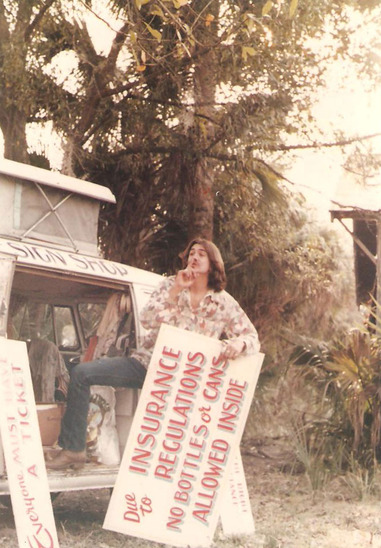
       The first order of business was to decorate this bus. A perfect panel existed next to the jalousie windows to letter the word signs. I was also experimenting with a device called an airbrush. After securing a CO2 bottle for propellant, I emblazoned my moniker “Krazee Davee” across the entire side in an effective way. A bright orange splat became a comical decorative element above and around the driver’s window to suggest that I had been pelted with something orange. To add to the humor, upon this funny shape I lettered, “I got it!” Then the adventure of a lifetime began.

krazee

       I started that summer enjoying the barefoot, casual experience of lettering signs at the Beach Bar, with regular intervals of simply walking across the street and immersing myself in the refreshing water of Clark Lake. Becks was on tap and I made friends with several of the waitresses, one of whom became instrumental with my future.

       Over the years I made additional signs, logos, gilded window treatments, murals and T-shirt designs for the Beach Bar. What became the focal point in the dining room, was the fancy plate-glass piece with glue-chipped fern shapes in the glass with gold leaf designs to showcase an old-time photo of his dad with his dog. The inscription read ‘Best Friends Meet at the Beach Bar.’ My development over the years from an enthusiastic beginner into an accomplished professional coincided with the Beach Bar morphing from a drink shots and get crazy joint into a respectable place to bring the whole family for dinner.   

       Being on display while I worked became an effective way to find the next customer. When the annual summertime festival on Clark Lake occurred, my bus was parked in the middle and I lettered signs while I met the people who lived in the area.

       The magical microbus transported Superdog and myself to many places. Whenever I needed work, I found the downtown drug store where merchants gathered for a cup of coffee at ten o’clock each morning. I became an attraction when I parked the decorated bus outside and began to paint on it. Lettering ‘Mobile Sign Shop’ across the roof of the bus was one such undertaking. This manner for meeting clients was effective.

       Adding to the existing sign work on my vehicle always lead to a job or two from the local merchants. While I painted away on the exterior, someone would ask me to come with them and look at their storefront. Then, I would have a store window, an office door, truck or a van to work on with never a lack of ideas for designs.

       Early in my relationship with the VW, a slight inconvenience occurred. The beloved bus refused to start. After some frustration, I became elated to find out that if I planned ahead and parked on a hill, the situation was easy to live with. When the time came to go, I rolled down the hill and popped the clutch while in gear and this vehicle started right up. Even on a flat area, the small size of the vehicle made it easy to get rolling; I pushed it myself and then jumped into the driver’s seat to repeat the above-mentioned procedure. Soon we roared on our way.

       I saved my money for a new starter. Little did I know that this situation also provided an opening to influence more than just mechanical integrity.

       Hayes suggested I go downtown to Fletcher’s Garage in Jackson to get the starter. I arrived in front of the two-story brick storefront with service bays and out of habit, scanned the available parking spaces for one with a suitable incline to facilitate starting. I then went inside and spoke to the new owner of the business. Kelly Osborne was my age.

       “I would like to buy a starter from you, but I don’t have enough money to hire you to install it,” I began, “Can I buy the part from you and install it myself in your driveway?”

       Evidently this odd request coming from a good-natured individual created a good impression, because his response was to be helpful. When the bus was in front of his bay doors I went underneath to dismount the starter. This was when I discovered I did not have the proper tools to get the job done. Soon I was back inside.

       “May I borrow a socket to remove the rear bolt?”

       My good-natured host provided me with the tool I needed.

       Over the years Kelly not only became a good friend, but his place of business, renamed ‘Kelly Imports,’ soon sported sign work by Krazee Davee.

       During several points in my career, his garage housed a variety of my painted projects. He allowed me to decorate business vehicles there along with making 4×8 wooden signs. I even decorated a complete set of rounding boards for a carousel there one winter. Those were the days of sharing an amber beverage on a tailgate after work with an occasional smoldering herbal accompaniment.

       As the years brought maturity to the fellows at Kelly Imports, in addition to keeping an endless succession of VW buses running for me, they became mentors of clean-living and fine examples of living successful lives.

The Great Chalkmarksman

   The large tented circus of yesteryear making one-day-stands required finely tuned choreography for all its components. I admired the Clyde-Beatty Cole Bros. Circus since I was a kid. The wreck of the truck used to haul my liberty act ponies and my performing horse shelved my ability to perform with any circus.

       I had to assume a job that didn’t require having my own vehicle. The Clyde-Beatty Cole Bros. Circus needed an advance man and the position came with a panel truck in which to work out of. When I arrived at the winter quarters near Deland, I found out more about this job.

       My responsibilities were to remain 24 hours ahead of the show. I would put up the arrows for the fleet to follow, lay-out the lot and make all the last-minute preparations. I would also arrange for fuel, hay and other provisions to be delivered to the showgrounds. The most important of these duties was to lay out the lot or designate the positions of the tents and trucks to optimize the circus configuration in the local setting. Another big part of the job was to rail the road, the term left over from the horse and wagon days when, in advance of the circus, rails from local fences were laid across the roads at an intersection to guide the teams pulling the heavy baggage wagons.

       The modern truck circus used cardboard arrows taped to sign posts and chalk indications on bridge abutments to give drivers directions to the next lot. This influenced the name I gave myself. Childlike artistic urges found expression as I quickly fashioned directional arrows that resembled stylized circus tents with flags flying and elephants with trunks that pointed the way. Images of clowns, girls and horses were all created spontaneously using large pieces of marking chalk. These diversions made the lonely job ahead of the show interesting and became a source of amusement for the show folks too. 

       While driving the panel truck towards the next town, I became quite good at finding a place to jump the curb for a place to park. From this location I walked back to a sign post to tape up an arrow or walk to a bridge post and draw a chalk image.

       One day while immersed in these duties in Maryland a surprise awaited me. I returned to my truck, prepared to leave and looked in the mirror to see a barefoot girl running up from behind me frantically waving.

       “Hey mister” she yelled “can I have a ride?”

        I invited her inside. There must have been something comfortable and curious about the white Chevy panel truck with the three speed on the column. My white Spitz Superdog shifted from the shotgun seat to the middle to make room and the barefoot girl settled in. She was tall with long brown hair. She held her head a little forward and looked down as she reeled from what was going on internally. Sad heavy eyes had a demeanor that seemed to look inward, yet were somewhat playful. She was mildly curious about what I was up to but was clearly wrapped up in a world that I knew nothing about. 

       When she noticed I was looking, her expression perked up and she would quickly smile. Then in an effort to be sociable, she asked an innocent question about the dog, what I was doing, or where we were going. I found out her name was Mary. Our conversation began this way. She was running away and didn’t mind the refuge or the beer. As my tasks along the way continued, my passenger became involved. It ended up that she had no immediate plans so I had a companion for a few days. It was actually fun having someone along while I laid-out the lot and pursued my other duties.

       A journey of a hundred miles took all day. I stopped every couple of miles to put up another directional arrow. Each upcoming turn was indicated with a series of three arrow sets. A system of arrow configurations signaled slow down and turn ahead. A mile before a turn the arrangement began with two down arrows on top with one right (or left) turn arrow. The next set had one down and two turn arrows to say slow down, turn ahead, final warning. At the turn all three arrows pointed the direction the fleet was to go. A mile in the right direction a straight up arrow validated everything was right for the driver.

       By the time all my arrows were in place for the fleet to find the shopping mall parking lot.  Mary was excited about the circus and eager to help. As I stepped off the lot to see how I could get the show to fit, she patiently waited and enjoyed watching Superdog who, filled with zeal, explored the new location.

       The big top was laid out using metal rods driven into the asphalt (or grass) to indicate the location of each center pole. From those locations a light chain was used to form the radius of the round ends of the tent. The spacing between the stakes at the perimeter was accurately determined with the use of an extra length of chain dragged along as an “El” behind the spoke of the chain from the center. Thusly the 150×300 canvas behemoth had a place to go and every stake along the perimeter was designated. To anchor the ridge of the tent between the four center poles, semis were parked in a straight line with the length of the top so aerial rigging inside had secure anchor points.

       The midway, backyard or performers area, various animal departments, cookhouse and various maintenance departments were all arranged around the central big top. Once the lot was laid out and ready to receive the fleet, we could relax and wait. During this time, we enjoyed a cool amber beverage and reflected on the wonders around us in this new location. The first trucks would roll in, depending on the length of the jump, by midnight or so and at that time I would spot them.

       The steady pounding of the stake driver on steel stakes was our alarm clock. The next morning the once vacant lot began transformation into a tented city. With a minimum of sleep, workers began to get the massive tent into the air. The first dramatic feature was the fifty-five-foot aluminum center poles that soon commanded the area that, the evening before was my exclusive territory.  Like the proverbial beehive, many activities were accomplished simultaneously and all was intact and ready for a show by noon, in plenty of time for the 2 O’clock matinee.

       My companion was content while she observed this plethora of activity while I attended to my sideline business that provided me with extra income: my newspaper route. I arranged for feed, hay and fuel to be delivered to the lot along with the inevitable incidental emergency tasks that occurred with an operation of this size. Mary was imprinted that day with my love for the circus.  

       When the band started playing for the big show, Mary saw how the physical elements and preparation activity combined to promise an entertaining show for the throngs of people that now filled the seats.

       A shrill whistle blast came from a dapper Count Nicolas. He was dressed as a traditional ringmaster in black boots, white riding pants, red claw-hammer tails and top hat. My new friend sat up straight in her seat as if not to miss a thing. This was pure circus all the way.

       Lions and tigers went through their paces as well as aerialists, clowns, horses, dogs, jugglers and the large group of elephants that filled three rings with their unique presence. The show culminated with a couple who rode a motorcycle up a cable that went the length of the tent. All of the noise, hoopla, thrills and showmanship climaxed with their final feat of daring.          

       The circus moved to a new location in the DC area every couple of days. In the midst of helping me prepare the way for this large circus, Mary told me about her family and asked for a ride home to get some shoes. During one of the jumps to lay out the next lot, we drove to her house.  After the panel truck crept into a plush suburban neighborhood and I waited, she entered a nice home. She soon returned with a minimum of supplies and was eager to resume her adventure. This glimpse perhaps cemented our connection. I discovered that we had much in common with our backgrounds. We both have an older brother and a younger sister, great parents and came from lovely homes. Yet we searched for something else. We then headed out to be ahead of the show.

       With the help of my new friend, the arrows went up, chalk artwork was created on bridge abutments and lots were laid out. Once again, the fleet was efficiently guided to other locations in Maryland. My route card had the list of the next few weeks of towns we were to play. The show was headed through New Jersey and beyond the city to Long Island. With this information looming, my friend reluctantly sought a ride home.

       Putting the magical sawdust world behind us, the panel truck penetrated the suburbs. Once we arrived at her home, parting became sad. We exchanged tears and hugs and vowed to stay in touch. Then I went on my way. I may never know the full imprint she received those few days at the circus. But in the following years as her correspondent and friend I was happy to observe she had accumulated a love for both the circus and adventure.

       Through the great sprawling city that began in New Jersey and continued with a labyrinth of highways and cloverleaves, my role ahead of the fleet was tested. Putting up the arrows through New York City was only possible at night when traffic was light. Without a shoulder to pull off onto, the panel truck sat in the slow lane unattended while I affixed arrows to the poles.

       Long Island was beautiful. New England quaint, yet the same restlessness that originally brought me to this place would take me away. As the solitary routine wove its way through New England, my skills as a creative artist were established amongst the showmen and I began to desire a different, more stimulating situation. My relentless zeal to create could never be completely satisfied with this routine no matter how many bridge abutments existed.

       The circus management being aware of my artistic gifts begged me to illustrate a book for future twenty-four-hour men. John Pugh commissioned the artwork best created by a 24-hour man with a working knowledge. The artwork for my ‘Lot Layout Planbook’ was completed in pen and ink in a motel in upper New York state.

       I trained a replacement to do my job and became ready to hitchhike to Michigan to launch my career as an artist/sign painter. Before leaving John Pugh requested me to return during the winter to paint the lettering and décor on the entire fleet.

       My plan was for Superdog and I to hitchhike to Michigan and launch my career as an artist. I shipped my stuff to Michigan.  My horse waited there also. The time spent ahead of the circus had been lucrative. This fallow time gave me ample opportunity to create, live and laugh. My chance meeting allowed my love for the circus to be passed on to another. There could not have been a better place for the beginnings of my visual communication attempts and entertaining artwork. During this time providing guidance for the fleet, I received direction for my career. I often wonder how my friend from long ago is doing as I savor those memories of adventure with the circus as the Great Chalkmarksman

       It was during those months ahead of the show that my thought processes combined to point the same direction. When I arrived back in Michigan to share my tales of adventure with Hayes, he was already anticipating what he had predicted as inevitable. He was delighted to hear among the friendly exchange my impromptu announcement.

       “Hayes,” I began in all earnestness, “I’ve made a decision.”

Seeing the World

     During the season of 1976, I began to have additional opportunities to study my surroundings. Unscheduled retreats to peruse picturesque places occurred while I waited for tire repairs. And later, when the structural features of my trailer began to break, welding repairs. The year unfolded to become a series of leap-frogs from show towns to repair places, and then back to the show. As the result, I am not of the contention that the best way to see the world is while traveling on a circus.

        It is true that the entire troupe of a big top circus doing one-day stands is involved with canvassing a large area but while doing so, they remain involved in accomplishing repetitive tasks that often require being surrounded by the same environment each day. Sort of like the potato peeling navy man sailing the seven seas.

       One jump across the vast grain belt area of Saskatchewan, I had a concern about my fuel and thought perhaps I could make it to the next community with a fuel stop. Wrong. As I coasted to a stop alongside the long straight road that sliced through vast grain fields that stretched toward both horizons, I had an opportunity to truly study this broad country.

       Once the noise of the engine stopped, I was immersed in silence. The first thing I noticed as I scanned my situation was the feel of the gentle breeze massaging the pale jade young crop in the field. As I walked around the rig, I saw wild flowers hugging the only surface not commanded by farmer or highway.

       The sky was large and had a mauve tone close to the horizon even though the sun was well up. Off in the distance I saw a miniscule motion that piqued my interest. As my attention zeroed in on this activity, I saw a large tractor pulling an even larger device designed to cultivate a huge swath as it passed over a section of land. While watching, I saw it go a tremendous distance and made a U-turn to travel parallel to the area just covered. I was then able to predict where the giant device would be going next.

       I watched his long slow dance across the field and reviewed my options. I was inspired. I started a long walk, stepping over the rows of young plants and headed for the middle of the field where I predicted the farmer would pass. As the place where our paths would cross loomed closer, the driver saw me and when convenient for him, stopped that massive machine.

       Double sets of high ridged tires stood higher than me. The driver had to exit the glassed-in cab and descend the steps that hung between the tires to get to where he could greet me. I told him about my predicament that seemed almost self-explanatory anyway and he laughed. He pointed towards the far end of the field where his pickup was parked. He would retrieve the gas can inside and fetch it to me on the return pass.

       Standing in the field, I watched as the massive machine resumed its task of pulling an enormous device over, but not harming any plants, and considered my rig now off in the distance. A beautiful rig that now seemed tiny, dependent on my consistent maintenance. Yes, this was the way to see Canada.

       On the return pass, my friendly host brought me a gas can with fuel inside that soon rocked my engine back to life. I drove forward to the lane where his farm truck waited and placed the can in the back. I was then able to continue my trip. From that intimate peek at this facet of a wonderful land, I resumed the juggernaut of activity that yielded entertainment for the people my rescuer probably knew.   

Smokey Jones

       When I was a child, my mother took us to see the circus. This was an amazing experience and I was sold on the spot. Under the giant canvas big top, numerous things took place simultaneously.  Among the many displays were three rings filled with elephants. These groups of giant mammals would move, pose, stand and salute. The prop men who rolled the tubs in and out of the ring had to be fast to stay out of the way of these fast moving behemoths. At the conclusion of the three ring display, all twenty-two elephants were lead out onto the track that surrounded the rings and encouraged to run. With the herd running at breakneck speed, the ground shook and our adrenaline spiked. The speed and thundering mass of the herd created its own cyclonic vortex that sucked empty popcorn boxes behind them in their wake. In front of the grandstand the elephant boss would stop the first bull in his tracks. Then, like dominos except going backwards, the successive elephants would stop, rise and place their front feet on the back of the bull in front of him, and in only a few moments, the entire column of twenty two pachyderms dwarfed the audience that now looked straight up to see the giants posed in what is called the long mount. This is one of the most significant thrills I remember as a child and the picture remains vivid in my mind.    

SMOKEY 5

During the Voorheis Bros Circus tour in the fall of 1974, I became friends with the famed elephant trainer, Smokey Jones who took me under his wing. During our tour of one day stands performing in high school gymnasiums, I learned many things. The specific manner he taught for popping a whip utilized a technique of swinging my arm in front of my face that seemed to be counter intuitive but, as Smokey pointed out, would result in the return action of the lash – after the crack – going away from my face, hitting the ground and rolling away from my pants leg. He explained that the sound is made when the speed of the end of the lash actually breaks the sound barrier. In addition to learning how to properly pop a whip, I also learned how to twist a popper and weave a four strand plait.

Smokey Jones was a perfectionist. Every little detail was carefully attended to. Instead of a mere bucket to water his elephant from, Smokey had a spotless, stainless steel diary bucket. When the leg chain was removed, instead of the customary mainstream procedure of dropping it to the ground in a heap, to be untangled when next needed, Smokey carefully unhooked the fastener and laid the chain out straight, so that when he returned, the motion required to reattach would be minimal. As I noticed these and other peculiar behaviors, I also realized and appreciated this nuance of efficiency. An opportunity was here to learn a wealth of, not only information, but an uncanny personal philosophy that would influence in a positive way. As Smokey pored forth his personal recipe for success, I came to know and appreciate the attention to detail and attendance to exact procedure he was obsessed with. Smokey introduced me to the concepts of integrity, perfection and preparedness invaluable to animal trainers and caretakers.

Smokey gave me a twisted willow whip handle which is an interesting device. A piece of wood is actually quartered most of the length and each section is rounded to resemble strands. Then, after being soaked to promote pliability, the strands are twisted into a rope-like configuration and lashed at the end with a loop of leather to receive the lash. After acquainting me with this hefty device, he proceeded to demonstrate how a lash is fashioned out of sewing machine belting, a long, round piece of leather used for pulley belts. After securing one end, he made a gentle taper using a sharp knife, a steady hand and a keen eye. Into the end of this ideally shaped leather lash, an eye was punched to receive the popper of which I was next shown how to make. Using nylon kite string, multiple strands were doubled over; an eye was tied into the end and held fast on a nail. Then the twisting and turning that made the many strands begin to resemble rope began with an occasional half hitch of just a few threads to bind it together. Then the twisting and turning resumed adding length to the popper. Occasionally a few threads were severed to allow a taper to occur and after these processes were repeated multiple times, a handsome popper about nine inches long was completed with the tying off of the stray ends with several half hitches and the excess was left hanging out, to become the working end that takes the beating.

In response to his generosity, I not only told him about recently exploring the winter quarters of the Lewis Bros Circus in Jackson and disclosing my finds, but I presented him with the antique elephant bracelet, a wide leather band with three buckles, covered with brass spots as one of a set of decorative pieces for the elephant to wear during the show that I had found. He also gave me a handsome lash with a latigo Turks head that connected the loop to a tapered four strand plait body that went into a single length of strap onto which another of his famous poppers was attached. He explained that this lash was somewhat clumsy and did not work due to being out of balance, so I could only use it as an example of the craft. I still have this lash in my collection.

The idle times together were quite enlightening. Not only was I being introduced to specialty skills but as I imitated the procedures he demonstrated and taught, the stories of circus life in the old days kept me at the edge of my seat the whole time.    

When the two shows were over each evening, the children from the audience were often enthusiastic about the ponies and were often available to recruit to help carry out the pieces of Celetex flooring. When I had these little helpers, after the show, I could stay at the truck to receive and load the pieces as they were carried out. Once the last piece was loaded, I could close the doors on the truck, load the ramp and drive away.  No one was allowed to remain on the school grounds overnight, so once again all the show folks were on their own. Smokey and I had similar needs. We would often find a place to park together somewhere along the way to the next town.

Smokey was full of stories, especially anecdotes about his days with the big herds. At one time he was the boss of the Ringling Bros Barnum & Bailey herd of 38 animals. Elephants are ideally suited for a variety of roles and a big reason that the circus was able to accomplish so much in a day. Elephants could do more than just pull as the baggage horses did. They could also lift, push and grab. In addition to the performance roles where large groups of pachyderms would dance, pose, form pyramids, stand and salute in the show, the elephants would also augment the teamster’s efforts and even perform specialty tasks. They would push heavy wagons, pull stakes, hoist rigging and provide a valuable service to the immense aggregation of muscle that moved the giant tented city each day.SMOKEY 6 2       He told another story about when he was young and just learning to be an elephant handler around the Daily Bros Railroad Circus. One of the many duties of a work elephant around a show with wagons was to prepare them before the end of the day prior to when a team hooked on to take it to the train. Pushing the wagon pole of a heavily loaded wagon off center, toward the outside of the lot, would not only facilitate the teamster hooking up his team, but ease the initial pull by this team. Instead of a dead pull straight forward, the torque needed was fractioned somewhat to move the wagon sideways at first, gathering momentum out of that spot, then straightening out while underway. Moving a wagon pole was effortless for an elephant. She simply leaned against it with her trunk.          
SMOKEY 4B 2       If a heavy wagon had a team hooked up that needed help getting momentum started, the handler would have the elephant place her head against the rear of the wagon and push. Once after spec, while the elephant was still wearing her fancy leather headpiece with ornamental brass spots all over, and Smokey was still in wardrobe he saw such a wagon in distress. He simply went over and had his elephant give the wagon a push with her head. When he got back to the picket line and the boss saw that all the brass spots on the headpiece had been flattened, Smokey got an earful.

During his youth around the “corporation” shows that wintered in Peru, Indiana, named because several circuses operated under one umbrella, tremendous time was spent caretaking the abundance of animals on the three shows. Those were the days when the circus made a spectacular impression on audiences all over the country by providing an abundance of wild animals in a variety of massive displays. Exotic cats, lions, tigers, bears, camels, seals, horses, and others, ad infinitum made up these big acts.

These herds, teams, groups, collections, gangs, gaggles and flocks all required an immense amount of hay, feed, fruit, vegetables, meat and other forms of sustenance. That was the main reason the winter quarters were situated in the middle of farm country. They were close to the grain, hay fields, farms and stockyards. Plus the immense amount of by-products had to be handled and disposed of requiring crews of men with specific and often multiple roles to fill.

He beamed a sinister smile as he recalled the story about when he was cutting up meat for the cats and how a little renegade ankle-biter dog, that was the pet of one of the office ladies, was drawn to the temptation of fresh animal meat and entered his proximity. Smokey took some disgusting part of the carcass innards and tied it around the neck of the little dog and shooed it away, so that when it returned to the circus office, the dog owner would get disgusted.

As he shared these stories about the good old days and the rigors of the railroad circus, I was in awe of what he got to witness during his lifetime. The recollections shared made this history that took place before I was even born, come to life once again.

 The style of daily routine on the school house circus, in contrast to the intense routine and highly social lifestyle on the tented circus made for a lonely on the road experience. I was glad to have a friend like Smokey on this tour. During the afternoons of tending to our chores, I was imprinted positively as the result of the observation, tutelage and encouragement received from this man. His influence echoes today as I go through the routine of up, down and over the road, making sure all preparations possible prior to showtime have been completed. He stressed “be ready” as the mentality to maintain throughout the day when searching for the next right thing to do.  I have found many positive experiences and influential personalities along this road called life so far, and Smokey gifted me with his big hearted positive influences, yet my heart longed for more.