During the season of 1976, I began to have additional opportunities to study my surroundings. Unscheduled retreats to peruse picturesque places occurred while I waited for tire repairs. And later, when the structural features of my trailer began to break, welding repairs. The year unfolded to become a series of leap-frogs from show towns to repair places, and then back to the show. As the result, I am not of the contention that the best way to see the world is while traveling on a circus.
It is true that the entire troupe of a big top circus doing one-day stands is involved with canvassing a large area but while doing so, they remain involved in accomplishing repetitive tasks that often require being surrounded by the same environment each day. Sort of like the potato peeling navy man sailing the seven seas.
One jump across the vast grain belt area of Saskatchewan, I had a concern about my fuel and thought perhaps I could make it to the next community with a fuel stop. Wrong. As I coasted to a stop alongside the long straight road that sliced through vast grain fields that stretched toward both horizons, I had an opportunity to truly study this broad country.
Once the noise of the engine stopped, I was immersed in silence. The first thing I noticed as I scanned my situation was the feel of the gentle breeze massaging the pale jade young crop in the field. As I walked around the rig, I saw wild flowers hugging the only surface not commanded by farmer or highway.
The sky was large and had a mauve tone close to the horizon even though the sun was well up. Off in the distance I saw a miniscule motion that piqued my interest. As my attention zeroed in on this activity, I saw a large tractor pulling an even larger device designed to cultivate a huge swath as it passed over a section of land. While watching, I saw it go a tremendous distance and made a U-turn to travel parallel to the area just covered. I was then able to predict where the giant device would be going next.
I watched his long slow dance across the field and reviewed my options. I was inspired. I started a long walk, stepping over the rows of young plants and headed for the middle of the field where I predicted the farmer would pass. As the place where our paths would cross loomed closer, the driver saw me and when convenient for him, stopped that massive machine.
Double sets of high ridged tires stood higher than me. The driver had to exit the glassed-in cab and descend the steps that hung between the tires to get to where he could greet me. I told him about my predicament that seemed almost self-explanatory anyway and he laughed. He pointed towards the far end of the field where his pickup was parked. He would retrieve the gas can inside and fetch it to me on the return pass.
Standing in the field, I watched as the massive machine resumed its task of pulling an enormous device over, but not harming any plants, and considered my rig now off in the distance. A beautiful rig that now seemed tiny, dependent on my consistent maintenance. Yes, this was the way to see Canada.
On the return pass, my friendly host brought me a gas can with fuel inside that soon rocked my engine back to life. I drove forward to the lane where his farm truck waited and placed the can in the back. I was then able to continue my trip. From that intimate peek at this facet of a wonderful land, I resumed the juggernaut of activity that yielded entertainment for the people my rescuer probably knew.
Returning to the fairgrounds in Hugo, Oklahoma with a herd that now included three seasoned, crowd broke ponies, the time arrived to finish my aspiration for a liberty act with eight matched palominos. During the winter of 1974-75, I resumed assisting Bob Grubb with the training of the rest of my Liberty Act, of which, from the batch of eleven ponies to pick from, six ended up matching nicely. The training procedure and method was the same as the previous winter. Bob and I entered into the regular rhythm of our familiar routine.
The original three ponies were now coming three, the right age to geld, or remove their ability to reproduce. This would eliminate their increasing tendency to bite, be aggressive and kick at each other, a common studly behavior.
One afternoon, the veterinarian came out to perform this procedure. As they readied themselves for this familiar (to them) procedure, I was recruited to sit on the neck once the pony had received a shot of something that would make him collapse. Bob had a rope tied to each hind foot and the rope went underneath and around the pony’s neck. As the pony laid on his side, Bob held these ropes fast, so that Doc could perform his procedure without getting kicked. First the loose ball sac skin was pulled out and cut away revealing the nuts inside. In order for the geld procedure to be ideal, the balls plus some cord that lead to a little button all had to be removed. If the little button was to remain, the animal would retain some studly characteristics and be referred to as “proud cut.”
Superdog was there to eagerly observe, and the vet threw him the nuts which he eagerly gobbled up. After the procedure, the pony was allowed to get back up. One at a time we turned each of them loose in a paddock to heal. Throughout the day, we encouraged them to move around so they wouldn’t stiffen up.
Over the long run, this procedure proved to have a great settling effect but with the addition of the younger males, some studly activity would plague the initial season for the six.
The seasoned three veteran ponies provided a solid foundation for the introduction of the new yearlings. Of the new animals, three had the color and size to fit nicely with the others. “Jumper” was placed in the lineup at position number three. He had earned his name early on as we observed his style of getting out of the stock trailer. Tex was the seasoned cut-back pony, so he went to position four.
“Julie” was the filly thrown in during the second purchase. She was named after Hayes daughter. Although our ambition was an act with all males, since she had the prettiest color and the right size, she was selected from all the rest to fill position five.
“Finley” was slightly shorter than the rest, perfectly suited to assume the role of clown renegade that Bob had in mind for the tail pony. Impressed with a school teacher I met during the previous season named Diane, I used her last name as his moniker.
The remaining colts were traded and sold to both circus and cowboy contacts Bob had in the area. This group of six became our sole focus.
Once established, the sequence for these animals never changed. They were tied in the barn next to each other in the same order they appeared in the ring. This way they became accustomed to always being in the right sequence. The same arrangement existed when they were out on the picket line or loaded in the truck.
Bob started the new individuals, one at a time, like before, getting them used to being handled and responding to his cues in the circus ring. In just a few weeks he had the new guys in the ring with the three veterans. Doubling the size of the group increased the opportunity for mistake making exponentially. Our daily training routine now required immense diligence and being functionally proactive.
After the morning training sessions, my afternoons were dedicated to building the many features for the pony truck visualized in my mind. In nearby Paris, Texas I found a 24-foot truck box to replace the 18-foot box. This size would provide more room inside but the chassis would have to be modified. The truck went to a machine shop to get the frame stretched. This is a procedure where the frame is cut and a new section of frame rail and a drive shaft is added, then the longer box is attached. Once intact, a truck body modification place added two side entry doors. One would receive my new improved ramp system and the other, a set of steps to access what would become my living quarters. With these modifications complete, the rig was again parked at the fairgrounds and my work on the interior began. The experience on the tent show, and later on the school house show made me aware of challenges in these differing situations and various features to include on this truck. I had many ideas for these improvements.
Outfitting the larger box to comfortably house the ponies utilized the earlier design expanded for six. The walls were insulated and lined with plywood. Slide open windows were added for ventilation. A sizeable overhead loft for hay was created in the area over their heads. Many efficient features were designed and built to best accommodate these ponies including water storage and an improved ramp system hinged inside the side door for loading. The living quarters created in the front featured a shower with hot and cold running water, a first for me. The following summer I would find and install a ceiling made of salvaged decorative, sculpted tin panels found at a building being torn down. My bunk was high across the front, over wardrobe storage space and I even had a desk. At the entrance to my living quarters was a mini foyer with a tool, gadget and work center with a hand cranked bench grinder, among the many tools and fastening devices stored in this handy place.
Each evening after my morning training session with Bob and the afternoon of building inside the new rig, I walked a mile downtown to Vet’s Café for dinner. Arriving to greet the staff near the end of their day, I would usually request that they use me to finish off any of the specials of the day items that remained.
“Just use me to scrape out a pot” I’d say.
The ladies took a liking to me and made sure I had a generous meal each night. Often times I would find hidden in the basket of rolls, a few pieces of chicken wrapped in foil to put in my pocket for later. Once I quizzed the black cook about this gesture. She explained that her daughter was off at college and she hoped that someone else was watching out for her.
The long walk back to the rig in the waning light became a time to de-brief, plan for the new day and pause, as I had become accustomed to, to find something to be grateful for in the midst of all this industry and for the many positive influences that were shaping my life.
With all the preparations made, and the ponies working as well as to be expected at the barn, the time had come to head out. Although I still had dreams for additional features for this truck that included possum bellies and a decorative red stripe around the outside. The time had come at the same time as my usual indicator – my boots being completely worn out – to hit the road. As these preparations were finalized and the pony act was rehearsing better and better, I found out about a tour with what was left of the Fisher Bros Circus through Louisiana in the early spring. As before, the daily rehearsal of the pony act could only go so far. The time had come to work the act in front of an audience.
After that short tour, I could lay over at a winter quarters in Missouri prior to the trip to Canada. Many of the personnel on the show also had the main goal of another tour of Canada for the summer. Before leaving Hugo, Bob encouraged me with the idea of having a Manage Horse that did many tricks as a second act. When I returned the following winter, his colt “Bingo” would be another year older and a prime candidate. We made another deal. Bob would begin his training that summer while I saved my money. Then it was time to hit the road.
The first season of the 1971 Fisher Bros Circus was a huge success. Mel and BK even took off mid-summer for a few days and returned with a new Suburban truck and a Holiday Rambler trailer. The old Chevy panel truck that had been used to pull their travel trailer was replaced with this fancy Suburban and the panel truck began to pull the generator trailer.
During the tour, the raggedy old big top was replaced with a new large tent. Same with the side show. The 20×30 tent was replaced with a 30×50 tent that allowed for other additions. Inside the bigger tent I had room for the elephant to be on display. This provided a boost in attendance and an opportunity to sell peanuts. Other attractions were steadily added during our lucrative season in Michigan.
We acquired some caged monkeys. Among them was a green, dog-faced baboon who we named “King Kong.” King Kong helped with the opening procedure of the side show.
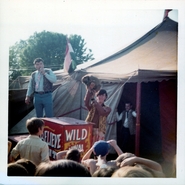
Before the big show, Melvin would stand on the platform in front of the side show tent and announce, “Ladies and Gentlemen, you are going to want to bring the children up close to see this very special attraction… right here, right now that is absolutely free!”
Boisterous best describes the fourth of the Silverlake children. With a passion for old westerns, Melvin dressed the part. Perpetual boots and a cowboy hat were augmented at showtime with a gun belt, string tie, bandana and an exotic fur vest.
He could recite classic lines from film stars of the genre he loved and often did when he entertained. With the help of a sixteen-millimeter film projector, he loved showing us western movies up against the side of the ticket trailer during the occasional Sunday evening after a matinee only.
Melvin took a wide stance that included his face flanked by dark shiny hair that imitated Elvis and infectious enthusiasm. This demeanor was perfect in his role as host of the circus. His interactions with crew and staff resulted in enthusiasm that permeated throughout. At show time on the side show platform this exuberance served well as the audience got caught up and responded to his calculated charm.
“Since there is still plenty of time before the doors open for the big show,” he continued, “And in an effort to bring a little entertainment out here for you, while you are waiting, we are going to bring King Kong right out here for everyone to see.”
I waited inside the tent at his cage for the right moment in Melvin’s presentation, I snapped a leash to his collar and led him out at just the right moment. Kong jumped on the ticket box responding to the facial expressions of the crowd with some expressive behavior of his own. Kong jumped up and down and showed them his teeth. King Kong proved to be a real crowd pleaser and effective to drive patrons inside to see the attractions.
The result of receiving a percentage of the side show revenue was an incentive for me. I fashioned flags to dress up the front and lettered Believe It or Not on an old bally cloth.
After that summer in Michigan, we headed south. An interesting cross section of the circus industry had come and gone. Performers, friends and fans had visited and wished us well. The sister show – Clark & Walters – closed early. They returned the equipment to Indiana and some of the personnel showed up on Fisher Bros including Ralph the mechanic. The show meandered south and west before returning to Medora. When the season ended in the fall, we contributed ideas and plans for improvements.
Once back at winter quarters in Medora, Indiana, the combined equipment for both circuses packed that hilly place and a brief reunion of personnel began to swap stories of the season’s highlights before leaving for the winter.
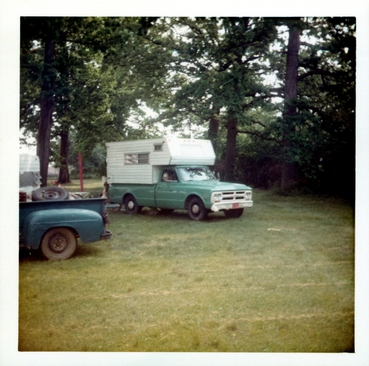
At the seasons end, with my portion of the proceeds from the side show, I purchased a GMC pickup from Ralph the mechanic, made plans to travel to Elkhart, Indiana to see how RVs were made and buy supplies needed to build my own camper. Then I returned to my parent’s home to begin building my special camper that would open up into a bandstand for my drums.
I also set out to learn another skill that would make me a more valuable showman. Torchy, a retired aerialist asked me what it was that I was going to add to my repertoire that winter.
Out of the blue I blurted, “I’m going to become a bagpipe player.”
She knew a couple in the Chicago suburbs of Wheaton that used to troupe and now had a music store. She made a phone call. Yes, they could get me a set of bagpipes. With Torchies help I began to plan my attraction for the side show.
During a phone call to my parents to announce that I would be coming home for the winter, I asked my mother to find me a bagpipe teacher. That winter, among my many projects, I met Scotty regularly over the next two months. Scotty taught me how to play Gaelic melodies on the Chanter. I learned special fingering techniques and how to blow and squeeze the air bag with my arm to maintain constant pressure. He also instructed me in how the reeds in each pipe were tuned and maintained. Scotty also suggested a great way to build a storage box to protect my pipes.
I still remember his last comment; “Ya got de guts kit, larnin’ de pipin’ for da bally hooin’.”
At my parent’s house out in the garage, I set up my workspace. I cut two by twos to length and created a series of interlocking notches and glued and screwed the entire skeleton together for my bandstand/camper. The finished skeleton was then lined with paneling, insulated and covered with corrugated aluminum. Windows, a propane system and a bunk over the cab was installed. The entire back of the camper was designed to lift open to create a large area for my drums. This was to ensure that I would be out of the weather and have greater visibility while playing during the show.
By February, I had completed my camper/bandstand and drove over to Michigan to visit Bev. I met her the previous summer and stayed in contact. I showed her family what I had accomplished. While enjoying snowmobiling and holding tightly to my girl, I saw huge snowflakes drift down to transform this beautiful country I knew from warmer days.
After our togetherness, I drove to visit friend Hayes in Clarklake, and then on to Medora.
Winter quarters consisted of a block building dug into the side of a hill with a large area inside for the two elephants named Norma Jean and Dixie who were in the back. These two stood for long hours chained in the barn. In order to cope, they developed an animated swinging behavior using their entire bodies, swaying side to side. Trigger, the five-footed horse, was also tied next to them. He developed the same habit of swinging in order to avoid getting bumped. The front half of the barn housed bundles of canvas from both shows, piled high along one side, and there was a central work area for construction projects.
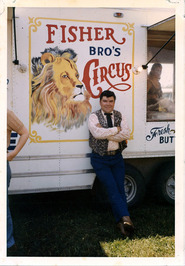
This is where I began painting signs, banners, and ticket boxes during the cold weather. On warmer days I worked outside on the new popcorn trailer and then lettered all the doors of the trucks. The second season of the Fisher Bros Circus appeared in sharp contrast to the ragged upstart of just a year ago. As the opening date loomed closer, the new canvas, seats and improved trucks promised to produce a better all-around show.



 Letterfly Writes