Sir Bingo


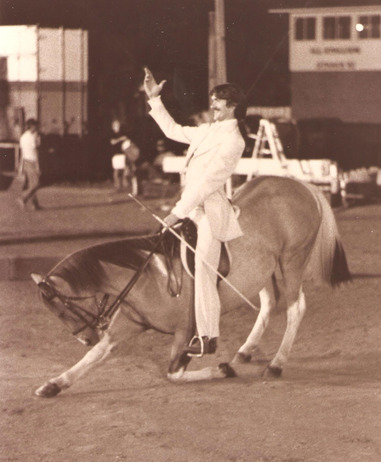
       The auction barn in the middle of the fairgrounds in Hugo, Oklahoma during the off- season of 1975-76 had become a familiar place. Now during my third winter, energy was invested as I learned to work the horse that Bob Grubb had not only trained to perform a circus act but had raised from a baby. Now as a five-year-old, “Bingo” could march, bow, side step, lay down, sit up, rear, volte, and do the camel stretch. Each rigorous session with this horse concluded when Bob saw an improvement in how we were getting along and instructed me to “walk him cool.”

       Part of what I enjoyed with this horse was to just get away and go for a ride. The streets of Hugo were used to seeing unusual sights around town because of the circus people who lived here. Occasional mornings we deviated from the rigors of practice and Bingo and I went sightseeing. This was a reward for doing well.

       His father was buckskin with a black mane and tail and his mother was a white and sorrel paint horse. The combination they conceived was a white and buckskin paint body with white legs and a black mane. Spectacular was his tail; white with a black tip.

Bingo Bow

       My time in the saddle became a time to think through the many other tasks that were waiting and to organize a plan for accomplishing them in the afternoon. This equine enterprise came with additional fascinating elements. Julie, one of the ponies, was pregnant. With Bob’s encouragement, we situated a foaling stall for her in the barn.

       One rainy morning we discovered a wet baby in the stall. As we watched, the little wonder struggled at first to find a way up to her feet. After a few wobbly attempts, she finally stood. Seeing this wonder cemented awe. This addition to the group, as the season progressed, would prove as yet another target for my affection and an ongoing source of fun.

       I had a challenge not predicted. The truck allowed great comfort for just the pony act. In order to haul the horse in the truck, I had to rearrange the floor plan. Instead of ample room for just them with the manger alongside an entire side, the interior of the truck received changes. Part of the manger was removed; the ponies were squeezed tight to the front and a standing stall was built along the outside wall for “Bingo.” The remaining area in the other corner was reserved for Julie and the baby. A small wall prevented Bingo’s front feet from stepping on anyone in front of him. I had to cross-tie his head up high to keep him from biting Finley, who now stood underneath and in front of him.

       Adding the horse pushed the limit of this truck over the top. As the winter practice session came to its conclusion, the time arrived to go. I headed toward another brief tour, this time across Louisiana. I would perform the horse act for the first time. Then my plan was for another tour of Canada. Starting in Louisiana in the spring with what was left of the old Fisher Bros Circus, I worked my new act in front of sparse crowds.

       The season of 1976 began with tire trouble. The pony truck was now overloaded. The leaf springs seemed to be getting tired.  To prevent the tires from rubbing the underside of the truck box, I placed blocks of wood as spacers between the overloaded leaf springs. At one time I thought the best way to see the country would be on a traveling circus. That is just not true. The best way to see the details that abound and get to know the locals in this country is to be broke down between towns on a circus. I would see plenty this season.

       At one location in Louisiana it was impossible to continue my trip without replacing tires. I was in picturesque bayou country. Spanish moss hung from Grandfather Oak trees. My rig stopped along a quiet road. I had room to unload.  The ponies were out on the picket line, with the baby and Bingo nearby. I awaited assistance from a tire service truck. While there I studied the details of the weathered surroundings bleached by the relentless sun.

       A long, low wooden building with large porch had no exterior indications to hint at what was inside aside from the neon beer signs in the windows. Completely open sided most of the year, a corrugated metal roof provided shade. Old wooden chairs invited comfort on the creaky wooden floor. A spring-loaded screen door with a porcelain “Tetley Tea” push bar across the middle would slam after each customer pried it open and went in or out.

       This was not a highly traveled road. My compromised parking site on the side of the road was not a big concern for the slow-moving people in this sparsely populated and pleasant area. When the tire truck arrived my ability to roll down the highway was restored. I returned to the pace of two shows a day for the remaining weeks of the short season.

        An oasis occurred when that short tour was over partway to the opening town. Those of us heading to Canada stopped at a family farm in Missouri to lay over for a few days. At that place I had an opportunity to paint the red stripe around the truck box. I also saw the remains of the hippopotamus semi that I took care of a few years prior. Ava had died. It was rusting, unused in the woods. We left in plenty of time to make the long trip to Alberta for the opening of season 1976 with Royal Bros Circus.

       Prior to Memorial Day, the long jump to western Canada was complete and we were ready to open early summer. In addition to the six-pony liberty act and my new horse act, I played the pre-show calliope concert on the midway and became “David McDavid” the bagpipe player in the side show. I also worked the magic act as taught to me by Dennis Michael where I had the bird whistle pitch.

       The baby pony, only months old, had begun to prefer hanging around Bingo, who was loose while other ponies were secure on the picket line. With increasing bravado, the baby’s territory increased. The baby began to follow us while I rode Bingo. The performance each day started with Spec, the parade of all the performers around the three rings in the big top. While I rode my horse, the little baby trotted along behind to the amusement of everybody.

BINGO Liberty Ponies

       The Royal Bros Circus opened the 1976 season in southern Alberta. The route took us up into the foot hills of the Rockies to several spectacular resort towns. In the midst of this rugged splendor, a flat place large enough to put up a circus was rare but, there we were. The raggedy old big top with our curious collection of rolling stock was pitched between the imposing mountains that dwarfed us and our specific intention. One day was especially memorable.

       One sunshiny day prior to the matinee with the mountains looming all around us, I remember standing on the bally platform with the others during the side show opening. A sudden gust of wind blew way up in the mountains. A few moments later we were lightly dusted with the snow dislodged from the high altitudes. A chill of delight passed through the crowd accompanied this surprise. In a few moments the sun warmed us back up.           We were immersed in some of the most picturesque country I had ever seen accumulating vivid memories.

One magical, dark morning, I drove into the tempering horizon with the foothills at my back. The roadbed leveled onto a long flat stretch. Ahead I saw a layer of fog that looked like a lakebed settled on the lower altitude. As the jump continued, I descended into this foggy area and became immersed in dense, misty surroundings. Visual access to the surrounding terrain disappeared. This was the fog of the cliché about your hand in front of your face.

       Mile after mile I drove with utmost caution. Unknown to me, the sun began to rise. Accumulating light slowly illuminated the surface of this layer of fog, just above me. A visual sensation began and became a magical dance of light. An ocular rhythm occurred due to moving forward underneath the surface of this sea of fog. The light interacted with the irregular surface of the cloud and combined with a slow turbulence as it responded to the warming rays of sunshine. The visual experience that morning was not unlike the mystique of the Aurora Borealis.

       On the other side of that long low stretch, an incline allowed me to emerge from the fog, where I witnessed the most splendiferous sunrise I have ever seen, in a sky so huge it must obviously have some of Montana’s mixed in with it.

       This spectacular wonder was just one of the many visual sensations that mixed with the joy of being a performing horseman, creative in many ways that also served to validate the original decision to join the circus. To this day I remain on the lookout to continue seeing new wonders in this world that God has created. This life I have been gifted with continues to fill me with awe and zeal for each and every new day.

Circus Horses

    On the big spectacular three ring circus of yesteryear, horses commanded the performance tober.  The lavish warm-up display prior to the presentation of the elite dancing horse act, was a massive pageant of Manege horses filling all the rings and the hippodrome track in front of the audience. Among the circus equestrian performing arts, the Manege horse is an entry-level performing animal that the novice rider soon fulfills. Famous for the lay-down, sit up, bow, march and camel stretch, these poses are manageable by most riders, thus the name.

Camel stretch old time circus

       Dozens of horses were choreographed to perform these movements in time with the music prior to the introduction of the true star of the show, the Haute E’cole or High School or horse schooled to the highest level.

       With that spectacle over, all eyes were directed to the highest-ranking equestrian performer of all. Classic horsemanship movements, the result of years of training and rehearsal, were then demonstrated to the audience. Passage, piaffe; high trot, march, canter changes, even the backwards canter with one elevated foreleg.             These remarkable movements qualify as poetic and gymnastic and share the echelon populated by opera, ballet, orchestra and Shakespeare virtuosos. I had recently witnessed this rich tradition at Chuck Grant’s farm and my creative mind began to dream bigger dreams.

       I had been saving my money during season 1975 to buy Bob Grubb’s horse “Bingo,” a Buckskin Tobiano Paint Horse with spectacular markings. Standing at 15.2 hands, his stocky quarter horse frame would provide me with a handsome steed. When the season was over, the riding lessons with Clarence gave me a foundation for beginning. Now back at the fairgrounds in Hugo, the time came for the purchase and to begin to learn how to work my new horse. I started learning another circus act.

       With my six-pony liberty act, I had created a wonderful career with a promising future. Once the startup hurdle was over, the animals became seasoned performers. This package was perfect in many ways. The magnitude of work to get to this place had been rewarding and the experience would help me in ways I would realize later. Now the business of having this pony act settled into finding opportunities to perform on a regular basis and the ongoing maintenance on the road.

       Another aspect that made this small business perfect was that I had options other animal handlers did not have. For extended periods I could place them on pasture during the off season, freeing me to pursue other opportunities. I actually credit these ponies with making me a better sign painter. No matter what, they kept right on eating. That motivated me ongoingly to find and secure sign work.

       Now I was adding a Manege horse to the lineup. I still had plenty to learn about this genre of horsemanship. The success of this enterprise required developing relationships with others. Networking within the circus industry is how one kept an act booked. Established circus families had strong connections that resulted from many generations of activity. The upper echelon of circus performers was a close-knit family that trusted only time-honored generational links to the industry. I was the new guy and because of my childhood I was reluctant.

IMG_4553 (1)

       During the five years I provided the palomino liberty act to big top circuses, the most I ever worked in one season was twenty-seven weeks. Compared to the lucrative experiences enjoyed at the beginning of my career, the pay I received for this attractive collection of performing ponies did not match the investment.

       I had been lucky right out of high school with Mel Silverlake, who wanted my creative skills. I had been in the right place at the right time, landing a lucrative role with his show. I had not learned several valuable social lessons in this industry. My mind was always on, but I was lost in the creative realm of visualizing more of what I wanted. I hadn’t developed an interest in others. Booking employment for horse acts and negotiating pay required skills and knowledge I did not possess. I was taken advantage of by shrewd producers and selfish circus owners. I was an outsider, not coming from a circus family. This promoted a skepticism and an aloofness that I didn’t understand or know how to break through. But it didn’t seem to stop me. I added a horse to my line up.

       Perhaps the writing was on the wall in regard to horses in the circus of the future. Regardless, I continued with my plans to become bigger and better than ever. I had found another way to thrive. I was fortunate that when the ponies were loose on pasture I could chase and secure sign painting to do.

       As Bob showed me how to make my new horse bow, stretch, kneel and march. I utilized the riding skills that Clarence had taught me. I began to speak the language to my horse that came through my seat, hands and attitude from the saddle.

       Bob continued to teach me how to get this new horse through the paces each morning. Each morning our routine was to practice with supervision, covering all the movements. Then rehearsing a possible routine, striving to maintain the proper posture and attitude the whole time.

       While learning the lay-down starting with a kneel, from where the horse would roll down onto his side, I had to make sure to keep my leg away from his side as he laid over, or else I would become pinned to the ground with a half-ton laying on my leg. I was taught to hold my left leg out when the barrel of the horse became steeply inclined, and this became instinctive.

Bingo Bow

        After an intense session Bob would encourage me to go on a leisurely ride around town and along the country roads to get familiar with my horse and to give him a quiet reward. I had grandiose ambitions and while immersed in this learning curve, I would also find out there was a lot to love with having a horse. A horse is a magnificent and wiling animal and the reason that mankind has been able to accomplish so much throughout history. Once the horse understands what is being asked, he is willing to comply. He develops a work ethic that is directly related to the consistency of the rider or trainer, forcing an honesty to the surface. Results don’t lie.

Clarence Hastings

       At one time, a fighting warrior mounted on a horse wielding a sharp saber had the most advantageous place on the battlefield. Automatic weapons changed all that.            Overnight, the cavalryman became the prime target for the machine gun. Realizing this shift in advantage promoted phasing out of these centuries old tradition of discipline, pride and honor on horseback.

       Clarence told me a story from his younger days, during his early career when he was with the cavalry. He was an officer and riding instructor up until the time the cavalry was abolished. The story he told was about that historic moment, on a sunny, postcard perfect afternoon in the midst of acres and acres of horses and mounted men, assembled for the last official order of the US Cavalry. Thousands of men were on horses, the groups delineating precise shapes across the rolling landscape in Virginia. Also significant was that this was the only time the entire force had ever been assembled in one location.

Once these thousands of horses and men were assembled all around him and the ranks became quiet with only flags flapping in the breeze, horses snorting and stomping, sword sheaths clinking and leather creaking can get, he heard the order given from the general in chief over the loudspeaker.

       “Prepare to dismount,” echoed several times.

       The order filtered down through the ranks, repeated by the subsequent ranking officers until the order was finally repeated to those in the outlying areas of that great assembly a full twenty minutes later. Then, after an appropriate moment had passed by, the final official order of the United States Cavalry was issued.

 “Dismount,” echoed out over this massive collection of men and equine.

        With that seemingly insignificant order, the historic tradition of fighting men on horses as part of military strategy in the United States came to a close.

       By autumn 1975, my six-pony liberty act was working well, having completed the recent summer tour of Canada on the Royal Bros Circus. The next logical step to augment my ambition as a performer was to have a dancing horse. The Ganiard home in Michigan offered respite between tours and Hayes enjoyed hearing my strategy. Frequenting Clarklake had become a regular pattern of my behavior.

       Earlier that year, the topic of having a performing horse occurred in conversation. My idea was met with encouragement and a surprise resources with which to start. I learned Hayes had a friend who was a riding instructor who lived nearby. For my lessons I was welcome to ride the family horse Coco, a black mare that had helped dozens of 4-H kids learn how to ride. Hayes equipped me with the bridle and saddle I needed, and soon thereafter, my riding instructor showed up to get me started.

       Clarence Hastings had a snippety proper air about him. He had a curious upward hook on the edges of his smile, and a radiance that beamed from the sculpted features of his face. He had a specific way of standing in repose with one arm behind his back, palm out, holding the other arm at the elbow. This is the way I remember seeing him stand at the edge of our riding area, as he gave me instructions to follow. Clarence drove out frequently to give me these riding lessons in the fall of that year.

       During the visits before and after these lessons I got to know more about this special man. His career began, first in the cavalry and then as a huntsman in charge of stables for the affluent. Like Hayes, he had a love for anything circus and had even dabbled in the theater.

        Between riding sessions, I tended to the ponies, worked on sign work for the Beach Bar, and built improvements for my rig.

        As the years went by, Michigan remained a regular stop to share tales of circus adventures with, not only Hayes, but now especially Clarence, as my circle of friends with positive influence on my life expanded. During these visits I became especially close to Clarence and listened to many stories of when he was in charge of hunt stables for the affluent. He had a big job. As the master huntsman he was in charge of the staff who provided care for the stable full of horses, the maintenance of the surrounding property and the care of saddles and tack. He also purchased hay, feed, blankets, special accouterments and everything else that went into the reason all of this existed: the hunt.

       The master of the hunt rode first in the group of mounted owners, guests and support persons, following the pack of dogs on the trail of a fox. Tradition dictated hierarchy amongst the participants in the pursuit. The guest of honor rode up front. This person also received the cherished prize when the hunt was over – a forefoot cut off the dead fox. This was presented in a ceremonious way by the master of the hunt. Specific anecdotes from numerous hunts provided fodder for our evenings full of reminiscing. These fascinating stories from a privileged echelon of society revealed another dimension of my friend and added to the richness of what I admired.

        In addition to the lessons, Clarence was able to give me a peek into the world he was introducing me to. During a special excursion Clarence took me to nearby Brighton, where he served as the director of a group of horsemen aspiring to give an exhibition performance. I rode along with my new friend to witness the rehearsal of “Horse Capades” at the farm of Chuck Grant, a garish horseman who also had a background with the cavalry.           Later in Chuck’s career while running a fine riding stable in Chicago, he met and worked with the Konyot family of circus fame during their winter layoffs. Arthur taught him the finer aspects of classic horsemanship. He took what he learned to become the Grandfather of Dressage in America, and an esteemed instructor of riding and the trainer of upper level dressage horses. The best way to describe Chuck Grant is brassy. He was always first to call your attention to that which was good, especially if it was some aspect of himself. “You gotta toot your own horn, or else someone is going to use it as a spittoon”

       As I watched from the seats at one end of the arena, the group of eight riders and horses began to rehearse their precision drill that showcased classic horsemanship. The group first began to parade around the indoor arena in single file following their leader. One by one, they imitated the example Chuck provided, assuming a similar posture going around the outside and then through the diagonal path across the arena, where two-tracks or side-stepping was demonstrated.

       The rehearsal also included canter departs and changes, reversing direction by riding half a loop and walking the center line with alternating horses bent in either direction all staying on the same path. After this precision riding, more fun took place. One by one, each rider and horse found a place side by side across the center of the arena to stop. Then, all together, they asked their horses to tuck up one fore leg, lean back and put one knee on the ground for the bow.

       Later, more amazing things happened with this group. I saw all the horses march, lay down, sit up, and after getting back up on all fours, do the camel stretch. As I watched in amazement from the plank I sat on at one end of the arena, Clarence was helpful with explaining what was going on. This glimpse at classic horsemanship gave me a new direction for the focus of my attention. The accumulation of knowledge and this new discipline would become both a passion and an obsession.

       One winter, I made a road trip with Clarence to a circus fans home where a pre-shrine circus party was going on. Here I saw him in his element amongst an advantaged portion of society. His magnetism was apparent as the ladies gravitated around him to bask in his mystique. Active and entertaining, the conga line benefited from his zeal. He never married but did confide to me that one widow of a wealthy family wanted to cement their union and that perhaps he regretted not actually doing that. I suppose that his being a bachelor was established. His example revealed a hint at the flamboyance and the regard he had for others that radiated from his rich personality. We had many a get-togethers over the years and shared many facts about ourselves. I came to know and love this horsemanship icon from a unique industry and savor to this day, the influence he had on my life.

       Autumn gradually turned colder. Our regular riding lessons became a situation where I was riding in deep snow and Clarence was sitting nearby in the comfort of his car. The miles I practiced sitting in the saddle properly, posting to the trot, guiding my horse through corners and making transitions – from walk to trot, trot to canter, canter to trot, trot to walk and walk to halt and stand – were all preparing me for the next logical step in my career. But the time had come to head south.

Escape from the snow took me on a track towards Hugo, Oklahoma. Bob Grubb had “Bingo” the horse waiting for me. He had raised and trained this colt to perform a circus routine. I immediately began to practice the exercises introduced to me by Clarence on this new horse, and learn all the motions that would result in his circus repertoire with the supervision of Bob Grubb.                 

Soon I was rehearsing in the practice ring in the barn the routine I would present on the circus that included march, lay down, sit up, camel stretch and rear.

I opened on a little touring circus in Louisiana in the spring. Bingo had become attached to the string of ponies. I could simply turn him loose while the ponies were on the picket line and he would remain close by. Julie had a foal in the spring, who was loose all the time, nursing on her mother. She learned to hang around the horse because he was more interesting than staying with mom who was tied up all the time. Soon the baby was following the horse into the big top for spec, the beginning of the show parade around the interior of the big top. Many people marveled at the sight of this little baby following that big horse.   By Memorial Day I was headed northwest to open in Alberta, Canada with the Royal Bros Circus for the summer.

The Liberty Act

  Normally, with a six-pony liberty act on a circus, handling getting in and out of the tent with its many backyard obstacles is facilitated with two assistants.  Usually, two people leading two ponies each, help the trainer with his two, and safely handle this task. True to my self-sufficient nature, I figured out how to never need any assistance from anyone helping handle my pony act.  I utilized the system of “come alongs” learned from Bob, which linked each pony to the preceding one. Using calm repetition, they learned to stay in a single file line and get through the many obstacles as I oversaw their effort.  During the introductory announcement by Corky the ringmaster of Royal Bros Circus, we made our way inside the big top, and then into the ring. I would then have them stand at the back of the ring, unhook the “come alongs,” and start the act with all of them truly “at liberty.” Our act began at once.Ponny Act 3 2     
 Gesturing “Lead off,” they would start to run around the ring. After several revolutions, the time came for a change of course or a complete reverse of direction for this single file line of yellow ponies within the ring. This involves my signal and a quick change of position in the ring, that blocked forward movement and encouraged them to come toward and then away from me. As the group threads their way around me, they run in this new direction for a while. After a few laps, I would have them reverse again and encourage them into being six abreast, or what is called the spoke of a wheel.  This involves the lead pony at the outside perimeter cantering very fast and the tail pony near the center, next to me, walking very slowly. After the six abreast, it was time to single them out once again, and at the back of the ring, bring them to a halt.       
Consistent behavior is what they understand best.  The structural language of gesture, maintaining a calm emotional condition and consistent body language is key to maintaining healthy communication with a horse.  With the repetition of two shows a day, they became comfortable responding correctly to my cues as I guided them. Among what I oversaw to insure harmony were influences of individual speed; slow one down or catch another one up. By far the most important movement to maintain is to have the ability for them to stop at the back of the ring and face me. All these responses are reinforced with consistent body language.       
I had been reading some new age main stream spiritual literature by Carlos Castaneda and as the result was inspired to utilize positive mental imagery to influence the outcome of each performance with the ponies. Each day while standing in the backyard waiting for my time to go in, I would close my eyes and visualize the entire routine occurring flawlessly in my mind.       
The first season touring with six ponies was not without challenges. Among the distractions around the Royal Bros Circus in Canada was when the sidewall was hoisted up on a hot day and the view of the spacious outdoors proved tempting to the filly, who became noted for jumping out of the ring. Since he had been trained to follow her, little Finley often joined her as she ran around the interior of the tent while the show as going on.  My being a perfectionist with esteem issues, taking the behavior of a pony personally – as evidence of failure – wanting to provide only a flawless performance, had set me up for an endless source of frustration.     
 When a pony made a mistake, due to the dynamic of behavior, typically the same mistake would occur at the same place in the routine the next time the act was on. Rehearsing between shows was only partly good. The stock soon became wise to the fact that without an audience, they would have to comply or do an extended rehearsal. They became what is known as “crowd wise,” that meant I had to become an effective trainer during our act in front of the audience. As a hot headed teenager with an inferiority complex, I took any aspect of what the ponies did personally. Fortunately, as the season progressed, so did the ponies.Ponny Act 2                 
The original three ponies, with a season under their girth, were a steadfast influence to the three green ponies. Jumper was a new pony third in line. Due to the unwavering nature of the two in front of him, he became steadfast and consistent. Tex was the cut back pony moved from position three in the line up to number four. Tex was ideal in this role. The cut back is where the last three ponies reverse direction while the first three maintain their counterclockwise momentum. His long back, stout physique and somewhat simple mind had learned concisely what he was to do when asked that also coalesced into a do or die attitude. Whenever I asked for the cut back he was quick to comply. Once he had the concept he was unstoppable. After the cut back I would single them out once again. After another revolution, at the back of the ring, I would bring them to a halt.       
While styling for applause in front of my standing group, the prop man would set the hurdle at the front of the ring.  I had fashioned this hurdle using two pair of hames. Hames are a two-piece structure used with pulling harness that goes over each side of the horse collar that has the trace straps attached. I had found two fancy metal pairs with brass knobs on the top. They were welded crisscrossed for the hurdle jacks, with an opening on the ends for a 2X4 suspended between, that provided the bar for them to jump. When the hurdle was in the ring I would tell the standing ponies to “lead off” and as before in single file, they would all begin to run around the ring and go up to the hurdle and jump over, all except the tail pony. Finley appeared to be mischievously avoiding the hurdle although he had been trained that way.  Another round and all the ponies would jump again… all except Finley, who by this time had captured the attention of the audience. My exaggerated gestures and feigned frustration at his defiance got a laugh.  Finally, the third time around, I am shaking my finger at him and he finally makes the jump and gets a big hand.  The fourth and final time the whole group goes over the hurdle and he gets away with avoiding it one last time to get a laugh. I line up and halt the group at the back of the ring, and then style, and take a bow.Ponny Liberty Act 2      
Next, one by one, I ask them to begin to walk and turn away from me and go toward the ring curb. One at a time they mount the curb with their front feet. By carefully placing one foot over the other, they proceed to travel the entire perimeter walking around the entire ring, two fore feet on the curb, both back feet on the ground.  Once they have traversed the entire circumference of the ring and are all poised at the back, still mounted on the curb, I take a style and get a big hand.
        I next gesture for them to come off the curb and they single out at a brisk pace in contrast to the recently completed slow portion of the routine. Once again they are running around the ring.  When conditions are right, I gesture for them to waltz, which is to turn 360° within their own length.  Each pony has a different vantage point to observe my cue from.  The lead pony is off my port side, the tail pony my starboard side and the rest are at various points in-between.  As I gesture, which is a step forward and backward with a sweeping signal of the whips, each pony has a different reference angle to observe this body language that means something to him. Simultaneously they all do a turn in their own length. After several successful waltzes, I allow the first five to continue circling around the ring as I call the tail pony, Finley to join me in the center of the ring.  He comes to me, and once at my side, I ask him to lay down, sit up and after the get up, ask him to bow.  Once these specialties of his are complete, he resumes his position at the end of the rest, still running around the ring.
       The conclusion of the act takes place as I halt the group at the back of the ring. Once they are all facing me, I ask for the rear.  This cue has me first, making sure that I have their attention, and then sharply moving toward them with the command “hup.” Simultaneously they stood up, straight as a candle, and then came back down to the ground.  I then turned toward the audience and ran to the front of the ring. The ponies were following right behind me, encouraged by a helper behind them. I leapt over the ring curb directly in front of the patrons in the front row and as I did, the ponies mounted the ring curb with their front feet.  This was the final salute, an opportunity for the final bow in the midst of thunderous applause. I took my bow. Then the time came for me to re-attach my “come alongs” between each of them. Once intact, I would hold the lead pony, encourage the rest to back off of the curb, and the lead them single file through the center of the ring towards the exit of the tent.
       A liberty act takes a couple of seasons of repetition before they work consistently. The summer of 1975 in Canada on the circus was the perfect place for this exposure and training to prepare me for my ambition of bigger and better circus opportunities in the future. That is, if nothing went wrong.

All Six

Returning to the fairgrounds in Hugo, Oklahoma with a herd that now included three seasoned, crowd broke ponies, the time arrived to finish my aspiration for a liberty act with eight matched palominos. During the winter of 1974-75, I resumed assisting Bob Grubb with the training of the rest of my Liberty Act, of which, from the batch of eleven ponies to pick from, six ended up matching nicely.  The training procedure and method was the same as the previous winter. Bob and I entered into the regular rhythm of our familiar routine.

all six 1

The original three ponies were now coming three, the right age to geld, or remove their ability to reproduce. This would eliminate their increasing tendency to bite, be aggressive and kick at each other, a common studly behavior.

One afternoon, the veterinarian came out to perform this procedure. As they readied themselves for this familiar (to them) procedure, I was recruited to sit on the neck once the pony had received a shot of something that would make him collapse. Bob had a rope tied to each hind foot and the rope went underneath and around the pony’s neck. As the pony laid on his side, Bob held these ropes fast, so that Doc could perform his procedure without getting kicked. First the loose ball sac skin was pulled out and cut away revealing the nuts inside. In order for the geld procedure to be ideal, the balls plus some cord that lead to a little button all had to be removed. If the little button was to remain, the animal would retain some studly characteristics and be referred to as “proud cut.”

Superdog was there to eagerly observe, and the vet threw him the nuts which he eagerly gobbled up. After the procedure, the pony was allowed to get back up. One at a time we turned each of them loose in a paddock to heal. Throughout the day, we encouraged them to move around so they wouldn’t stiffen up.

Over the long run, this procedure proved to have a great settling effect but with the addition of the younger males, some studly activity would plague the initial season for the six.

The seasoned three veteran ponies provided a solid foundation for the introduction of the new yearlings. Of the new animals, three had the color and size to fit nicely with the others. “Jumper” was placed in the lineup at position number three. He had earned his name early on as we observed his style of getting out of the stock trailer. Tex was the seasoned cut-back pony, so he went to position four.

“Julie” was the filly thrown in during the second purchase. She was named after Hayes daughter. Although our ambition was an act with all males, since she had the prettiest color and the right size, she was selected from all the rest to fill position five.

“Finley” was slightly shorter than the rest, perfectly suited to assume the role of clown renegade that Bob had in mind for the tail pony. Impressed with a school teacher I met during the previous season named Diane, I used her last name as his moniker.  

The remaining colts were traded and sold to both circus and cowboy contacts Bob had in the area. This group of six became our sole focus.

 Once established, the sequence for these animals never changed. They were tied in the barn next to each other in the same order they appeared in the ring. This way they became accustomed to always being in the right sequence. The same arrangement existed when they were out on the picket line or loaded in the truck.

Bob started the new individuals, one at a time, like before, getting them used to being handled and responding to his cues in the circus ring. In just a few weeks he had the new guys in the ring with the three veterans. Doubling the size of the group increased the opportunity for mistake making exponentially.  Our daily training routine now required immense diligence and being functionally proactive.

After the morning training sessions, my afternoons were dedicated to building the many features for the pony truck visualized in my mind.  In nearby Paris, Texas I found a 24-foot truck box to replace the 18-foot box.  This size would provide more room inside but the chassis would have to be modified.  The truck went to a machine shop to get the frame stretched. This is a procedure where the frame is cut and a new section of frame rail and a drive shaft is added, then the longer box is attached. Once intact, a truck body modification place added two side entry doors. One would receive my new improved ramp system and the other, a set of steps to access what would become my living quarters. With these modifications complete, the rig was again parked at the fairgrounds and my work on the interior began. The experience on the tent show, and later on the school house show made me aware of challenges in these differing situations and various features to include on this truck. I had many ideas for these improvements.

all six 2

Outfitting the larger box to comfortably house the ponies utilized the earlier design expanded for six. The walls were insulated and lined with plywood. Slide open windows were added for ventilation. A sizeable overhead loft for hay was created in the area over their heads. Many efficient features were designed and built to best accommodate these ponies including water storage and an improved ramp system hinged inside the side door for loading. The living quarters created in the front featured a shower with hot and cold running water, a first for me. The following summer I would find and install a ceiling made of salvaged decorative, sculpted tin panels found at a building being torn down. My bunk was high across the front, over wardrobe storage space and I even had a desk. At the entrance to my living quarters was a mini foyer with a tool, gadget and work center with a hand cranked bench grinder, among the many tools and fastening devices stored in this handy place.

Each evening after my morning training session with Bob and the afternoon of building inside the new rig, I walked a mile downtown to Vet’s Café for dinner. Arriving to greet the staff near the end of their day, I would usually request that they use me to finish off any of the specials of the day items that remained.

“Just use me to scrape out a pot” I’d say.

 The ladies took a liking to me and made sure I had a generous meal each night. Often times I would find hidden in the basket of rolls, a few pieces of chicken wrapped in foil to put in my pocket for later. Once I quizzed the black cook about this gesture. She explained that her daughter was off at college and she hoped that someone else was watching out for her.

The long walk back to the rig in the waning light became a time to de-brief, plan for the new day and pause, as I had become accustomed to, to find something to be grateful for in the midst of all this industry and for the many positive influences that were shaping my life. 

With all the preparations made, and the ponies working as well as to be expected at the barn, the time had come to head out. Although I still had dreams for additional features for this truck that included possum bellies and a decorative red stripe around the outside. The time had come at the same time as my usual indicator – my boots being completely worn out – to hit the road. As these preparations were finalized and the pony act was rehearsing better and better, I found out about a tour with what was left of the Fisher Bros Circus through Louisiana in the early spring. As before, the daily rehearsal of the pony act could only go so far. The time had come to work the act in front of an audience.

After that short tour, I could lay over at a winter quarters in Missouri prior to the trip to Canada.  Many of the personnel on the show also had the main goal of another tour of Canada for the summer. Before leaving Hugo, Bob encouraged me with the idea of having a Manage Horse that did many tricks as a second act. When I returned the following winter, his colt “Bingo” would be another year older and a prime candidate. We made another deal. Bob would begin his training that summer while I saved my money. Then it was time to hit the road.

Hugo, Oklahoma

 The winter of 1973/74 found me in Hugo, Oklahoma as the understudy of Bob Grubb, who had a background of performing with circus liberty horses for many years. Now he was going to begin with my ambition of a liberty act of my own. Out of the original ponies purchased the year before, four matched up nicely. Once introduced to this group, Bob began to observe the minute distinctions that existed between them and comment about what he saw. He began to name them, handle them to find out about their temperament, and begin to visualize a logical sequence for them to assume.

bob grubb

      He named “Buster” first, who had the most handsome conformation and attitude of the whole group. I named “Buttons,” who had the color of a new penny, after a favorite first grade teacher. “Tex” had a long back and Bob had a concern about his being juggy, whatever that meant. “Teddy” was a willing animal but seemed frail compared to the others.        

Tie stalls were rigged for the comfort of the ponies in the ring barn at the fairgrounds, and my camper and trailer were parked nearby. Anticipating this project, Bob had his ring curb already installed in the central area of the barn and was eager to begin the training process. We quickly adopted a regular routine. After chores and breakfast every morning, training took place.        

The result of Bob’s teachings and the universal attitude among the community of animal trainers around the circus is that the animals always come first. As I woke each morning, the first thing I did was go into the barn, grab a foot tub, fill it with water and offer each pony a drink. When they had their fill, it was time to feed. Nose bags received a scoop of feed each, a blend of oats and sweet feed. The ponies anxiously nickered and cavorted in anticipation, as I slipped the strap of each nose bag over their ears. The animated scene transformed as each pony became content to chew the sustenance that now hung conveniently under their lips.      

 Now I could retreat and fix myself something to eat. In the interest of efficiency, I developed a way to fix a Hearty Breakfast and only have to wash four items when complete. First, I would boil a potato in the coffeepot. When cooked, I would mash it in a frying pan and move it out to the edges. In the middle I put a few strips of bacon. A pot of coffee would then get prepared in the coffeepot and I would break two eggs on top of the mess in the frying pan. When the food was ready I would eat it right out of the pan. After my meal I only had to wash the coffeepot, one coffee cup, a fork and the frying pan. Then it was time to get the chores done before Bob arrived to begin training.      

Bob arrived each morning with an agenda that was clear to him. As I watched, one at a time, Bob would gently coax each young pony into a sequence of actions at the end of a tether rope or lunge line. The pony was first encouraged to walk around the ring, out against the curb. Bob was constantly talking to them with a gentle demeanor that proved to be very effective. “Walk,” “git up,” “there now,” “whoa,” “come in line,” “good boy,” were all soon part of each ponies understanding and my verbal repertoire. 

Stevens52BobGrubbTrickHorse1

       The whip was used to communicate with each animal as an extension of his arm and was only used gently as an aide to help push or suppress forward motion when needed. Introducing each animal to the whip involved letting them get acquainted by seeing, sniffing and getting touched all over with it. A variety of specific body gestures like pseudo semaphore signals accented with these extensions became a big part of communicating and asking for a variety of responses from each pony. Bob was careful to not scare the animal needlessly and was quick with a verbal reward or a lump of sugar when the youngster responded willingly to his cue. As the days went by, each pony began to grasp what Bob was teaching and the lunge line was discarded. Soon, two ponies were working together in the ring. Only three weeks into the process, the whole group of four was in the ring.      

 Repetition teaches. The sessions were at the same time each day, every day of the week except Sunday. The result of this consistency was a tremendous amount of progress in a short time. Also fortified with another form of reward was when they provided the correct response, we would often simply end the session. The behavior and understanding each equine accumulated soon proved his technique as being very effective. Those hours of observing the tedious training process were to prove valuable when it became my turn to do the training.

        The most important concept for any liberty horse to grasp is something that is not seen when the audience watches them perform, and that is to stay in the ring. This is taught by; never allowing them to have the experience of being outside of the ring or, when they do jump over the curb and go out of the ring, make sure they have a negative experience while on the outside to cause them to desperately want to get back into the ring. Bob had a rope barrier elevated around the outside of the curb, at shoulder level to a pony, for them to run into if they did jump out of the ring. My job was to be the bad guy. During one point in the training, one of the ponies got the notion planted in his head that he was going to go somewhere else and would jump out over the ring curb at the same place in the routine every time we rehearsed. I was on the outside of the ring and with a whip in my hand. I would yell, chase and swish the whip in an effort to strike terror into the heart of this cute but misbehaving equine. The moment the pony jumped back in the ring, I stopped with the terrible animation and Bob was quick with an assuring word. He appreciated the fact that I was there and he didn’t have to be the bad guy. I was learning how these little guys would become predictable and how important it was to interrupt negative behavior before it became established.

      Another important response to have firmly established with each animal is to halt whenever asked. This is especially important if the horse should become rattled, because from a halt, the trainer has a chance to personally connect, calm down and reassure the horse. I couldn’t believe it; here I was, in a dusty ring barn with aspirations of glamour and excitement, taking “Functional Relations 101” from an old cowboy, learning functional strategies that would prove to be helpful in many arenas later in life.

        The circus ring is a special, highly regarded, almost holy place. In my role as drummer for the circus, I served in a capacity that complimented the other performer’s efforts. Now, as I assisted the training of my ponies from outside of the ring, I looked forward to the time that a rite of passage of sorts would occur placing me in the limelight for the first time. Not only would the duties as the trainer of the ponies be passed to me but also the transition of contributing to the show from the bandstand to graduating as a performer and working in this revered circus ring. I still recall the moment when the time came for Bob to have me join him in the center of the ring. At first I stayed behind him, as he demonstrated how to encourage them through their paces, allowing the ponies to get used to me. Then the time came for me to hold the whips while Bob instructed me, first from standing behind me in the center of the ring, and soon thereafter, from outside the ring. This was the beginning of a long, rigorous and rewarding experience.

        As I look back, I realize the ponies were God sent, and an opportunity for this teenager to become functionally relational in the midst of being intensely emotional, perfectionistic and self-sufficient. Ponies don’t understand anger and erratic behavior. Very little representational communication means anything to them. Progress was only made with kindness. The ponies forced me to become functional, aware and consistent with my behavior. This must be the source of the term “having horse sense.” The animals learn through intentional repetition and functional consistency. For the sake of becoming a good horseman, I became proficient with my behavior around them, even though relationally with people, I still remained reluctant, isolated and often frustrated and angry. Over time, this role as a pony trainer became a segue that facilitated my connectedness to others.

Bigger Better Brighter

The first season of the 1971 Fisher Bros Circus was a huge success. Mel and BK even took off mid-summer for a few days and returned with a new Suburban truck and a Holiday Rambler trailer. The old Chevy panel truck that had been used to pull their travel trailer was replaced with this fancy Suburban and the panel truck began to pull the generator trailer. 

51 FBC1 2

During the tour, the raggedy old big top was replaced with a new large tent. Same with the side show. The 20×30 tent was replaced with a 30×50 tent that allowed for other additions. Inside the bigger tent I had room for the elephant to be on display. This provided a boost in attendance and an opportunity to sell peanuts. Other attractions were steadily added during our lucrative season in Michigan. 

We acquired some caged monkeys. Among them was a green, dog-faced baboon who we named “King Kong.” King Kong helped with the opening procedure of the side show.  

Before the big show, Melvin would stand on the platform in front of the side show tent and announce, “Ladies and Gentlemen, you are going to want to bring the children up close to see this very special attraction… right here, right now that is absolutely free!” 

Boisterous best describes the fourth of the Silverlake children. With a passion for old westerns, Melvin dressed the part. Perpetual boots and a cowboy hat were augmented at showtime with a gun belt, string tie, bandana and an exotic fur vest. 

He could recite classic lines from film stars of the genre he loved and often did when he entertained. With the help of a sixteen-millimeter film projector, he loved showing us western movies up against the side of the ticket trailer during the occasional Sunday evening after a matinee only.     

Melvin took a wide stance that included his face flanked by dark shiny hair that imitated Elvis and infectious enthusiasm. This demeanor was perfect in his role as host of the circus. His interactions with crew and staff resulted in enthusiasm that permeated throughout. At show time on the side show platform this exuberance served well as the audience got caught up and responded to his calculated charm. 

“Since there is still plenty of time before the doors open for the big show,” he continued, “And in an effort to bring a little entertainment out here for you, while you are waiting, we are going to bring King Kong right out here for everyone to see.”

54 King Kong 1971

I waited inside the tent at his cage for the right moment in Melvin’s presentation, I snapped a leash to his collar and led him out at just the right moment. Kong jumped on the ticket box responding to the facial expressions of the crowd with some expressive behavior of his own. Kong jumped up and down and showed them his teeth. King Kong proved to be a real crowd pleaser and effective to drive patrons inside to see the attractions. 

The result of receiving a percentage of the side show revenue was an incentive for me. I fashioned flags to dress up the front and lettered Believe It or Not on an old bally cloth.

After that summer in Michigan, we headed south. An interesting cross section of the circus industry had come and gone. Performers, friends and fans had visited and wished us well.  The sister show – Clark & Walters – closed early. They returned the equipment to Indiana and some of the personnel showed up on Fisher Bros including Ralph the mechanic. The show meandered south and west before returning to Medora. When the season ended in the fall, we contributed ideas and plans for improvements.  

Once back at winter quarters in Medora, Indiana, the combined equipment for both circuses packed that hilly place and a brief reunion of personnel began to swap stories of the season’s highlights before leaving for the winter. 

At the seasons end, with my portion of the proceeds from the side show, I purchased a GMC pickup from Ralph the mechanic, made plans to travel to Elkhart, Indiana to see how RVs were made and buy supplies needed to build my own camper. Then I returned to my parent’s home to begin building my special camper that would open up into a bandstand for my drums.

I also set out to learn another skill that would make me a more valuable showman. Torchy, a retired aerialist asked me what it was that I was going to add to my repertoire that winter.  

Out of the blue I blurted, “I’m going to become a bagpipe player.” 

She knew a couple in the Chicago suburbs of Wheaton that used to troupe and now had a music store. She made a phone call. Yes, they could get me a set of bagpipes. With Torchies help I began to plan my attraction for the side show. 

During a phone call to my parents to announce that I would be coming home for the winter, I asked my mother to find me a bagpipe teacher. That winter, among my many projects, I met Scotty regularly over the next two months. Scotty taught me how to play Gaelic melodies on the Chanter. I learned special fingering techniques and how to blow and squeeze the air bag with my arm to maintain constant pressure. He also instructed me in how the reeds in each pipe were tuned and maintained. Scotty also suggested a great way to build a storage box to protect my pipes.  

I still remember his last comment; “Ya got de guts kit, larnin’ de pipin’ for da bally hooin’.” 

At my parent’s house out in the garage, I set up my workspace. I cut two by twos to length and created a series of interlocking notches and glued and screwed the entire skeleton together for my bandstand/camper. The finished skeleton was then lined with paneling, insulated and covered with corrugated aluminum. Windows, a propane system and a bunk over the cab was installed. The entire back of the camper was designed to lift open to create a large area for my drums. This was to ensure that I would be out of the weather and have greater visibility while playing during the show. 

67 First Camper

By February, I had completed my camper/bandstand and drove over to Michigan to visit Bev. I met her the previous summer and stayed in contact. I showed her family what I had accomplished. While enjoying snowmobiling and holding tightly to my girl, I saw huge snowflakes drift down to transform this beautiful country I knew from warmer days.   

After our togetherness, I drove to visit friend Hayes in Clarklake, and then on to Medora. 

Winter quarters consisted of a block building dug into the side of a hill with a large area inside for the two elephants named Norma Jean and Dixie who were in the back. These two stood for long hours chained in the barn. In order to cope, they developed an animated swinging behavior using their entire bodies, swaying side to side. Trigger, the five-footed horse, was also tied next to them. He developed the same habit of swinging in order to avoid getting bumped. The front half of the barn housed bundles of canvas from both shows, piled high along one side, and there was a central work area for construction projects. 

This is where I began painting signs, banners, and ticket boxes during the cold weather. On warmer days I worked outside on the new popcorn trailer and then lettered all the doors of the trucks. The second season of the Fisher Bros Circus appeared in sharp contrast to the ragged upstart of just a year ago. As the opening date loomed closer, the new canvas, seats and improved trucks promised to produce a better all-around show.

Corn Country Show Biz


The Circus Hall of Fame was situated on the one-time home of several touring railroad circuses.  Many artifacts remain from the historic winter quarters of this large circus conglomeration that resided here a hundred years ago. A circus fan aspired to make this a tourist attraction. He wanted live circus attractions among the old wagons and artifacts. A big top was erected next to the last of the remaining barns that at one time housed the animals. Another barn housed wagons, costumes, and had a sail loft where canvas production used to take place. 

Now, a handful of performers were employed each summer to provide two shows a day. The single location for the summer meant a vacation from the travel regimen I was used to. I liked the idea of having a stationary place to work my performing animals but from the get-go, I discovered that the momentum and function of this place was fractured and would probably remain so through to the end. 

By this time my animals had solid routines. I had appropriate costumes, clever choreography, patter and pratfalls. The mule act developed into a fun act that required the participation of the announcer as a straight man to support the comedy with the lines that I had written.  

With rehearsal appropriate, John Fugate, the ringmaster, deflected my request by declaring, “We are all professionals here. We don’t need to rehearse.”  

We entered into our performing regimen of two shows a day with John fuddling his lines as he read off index cards in front of the audience. The plethora of mistakes he produced proved frustrating to me as he missed crucial parts of the comedy. Fortunately, the high school horse act did not require his participation.  

With the use of a live organist, I developed an interesting interlude for the middle of the horse act. After the first two segments of the routine and after the bow, I assumed a striking pose in the middle of the ring to acknowledge the audience. The announcer then invited everyone to participate. 

“Please join Souveran the horse as he high-steps to the music,” John bellowed, “clap along as he dances for you.” 

As the musical strains of the Mexican Hat Dance began, I had Sir walk sideways a few steps and at the right moment in the song, had him do a double leg extension coordinated to the music which prompted the audience to clap two times. Then, as the music resumed, we walked sideways the other direction and did it again. This was repeated four times to complete the stanza that resulted in a logical conclusion and good reception.  

The conclusion of the act was next. By this time in his career a few elevated strides of the high trot occurred, followed by our now consistent canter work. After his halt at the front of the ring we bowed.  

With the concluding announcement complete, we backed through the center of the ring. In front of the curtain at the back of the ring, we took another bow prior to our exit. In spite of the constant bumbling of the ringmaster, the grassy venue, permanent stables and luxury of two shows a day all summer, I had a wonderful opportunity to perform and enjoy my animals. 

Some of the personnel at this place, starting with the director, were hopeless. They were retired fans who wore clown faces and had no clue about this culture. In spite of their pathetic contribution they still wanted to be treated like stars. The elephant guy seemed to resent being here. He had inherited an elephant from his father along with a couple of camels. In contrast to the exact efforts of most animal caretakers, his work ethic was sloppy. The elephant got loose one night and walked over to the water faucet and turned it on. In the morning the entire floor of the barn including my horse and mule stalls was flooded. I didn’t do anything wrong but I had to shovel out the mess his elephant created. He never did apologize or offer to provide replacement shavings. He just moped. He didn’t like anything about taking care of animals.  

Late that summer his wife and daughter joined him. Little Dallas fell in love with my horse. She hung around and offered to help me groom him. I’d lift her up onto his back so she could brush his mane.  

Often times after my act she waited by the back door. She knew after I dismounted, she could sit on him and get a ride while I lead him back to the barn. 

Not everyone at the Circus Hall of Fame was dysfunctional. Circus animal training greats Vince and Pom Pom were here with their collection of tigers. The steady pace of loving animal care provided the heartbeat in the backyard. We were all used to the hectic pace of travel and one day stands. With ample time here for the summer, we all found extra activities to keep ourselves busy. Michelangelo Nock was here and his enthusiasm was infectious. Having grown up in this business, he displayed a flexibility and a regard for others that helped ease any tension that occurred.   

I had spare time each evening and sought to develop new skills.  I hired a tutor to teach me computer skills. I went into town to make friends. I went to AA meetings. My life had changed as the result and I now had nine years sober.  

  One Sunday morning I met a great guy at the Presbyterian Church and began to attend the weekly Lions Club meetings with him. Tom was amazed that I performed with my dancing horse and comedy mule act at the Circus Hall of Fame for the summer.   

The Lions Club of Peru, Indiana met in the banquet room at a local restaurant every Thursday. During those meetings they searched for ways to benefit the community. I attended as a guest of my new friend Tom.  

Among the activities at the meeting were sending encouraging notes in greeting cards for people we didn’t even know. Each member received three cards and three envelopes. A notebook with names and addresses of unfortunates were passed around for us to copy from. There were also announcements about others in unfortunate circumstances who would benefit from our encouragement.  

During those weekly meetings the Lions considered new ideas to benefit others. When an assisted living home for those suffering from terminal medical conditions came up, they discussed possibilities. I had an idea. I volunteered to bring Betty the mule and perform for them. The plan was to work my comedy mule act for the assembled patients outside on the lawn and then take the mule inside and visit patients who couldn’t leave their rooms.  

The Lions Club members welcomed this idea. This created a stir with most of the club except one, a curmudgeon who seemed grumpy about everything. Harold scowled at the idea. 

The rest of the group asked about doing this little show and made a list of what was needed. Soon volunteers came up with a P.A. system, wooden stakes and ribbon to cordon off a ring area. They made plans to coordinate this event with the personnel at the facility and one member acquired a stock trailer to move Betty. This activity fit into my schedule after the matinee on an upcoming Sunday.     

The entire club rallied to make this work. On show day several men arrived early to stake off a circular area for the ring and stretched boundary ribbon around the circle. They acquired chairs for the patients who could walk. My friend Tom became the announcer. He learned the lines of the straight man to support the comedy. On show day he became acquainted with the P.A. system while I showed Betty the venue.  

Other club members went inside the facility to get our audience. They pushed patients in wheelchairs outside and onto the grass to completely surround the ring. When our audience was intact, we began our show.  

Tom the ringmaster began with his introduction, “Ladies and gentlemen, we welcome you here today to our little show.” 

“Introducing at this time,” Tom bellowed, “direct from California gold mining country, here to launch their career in show business, please welcome Gold Dust and the Old Cuss.”  

I led Betty into the makeshift ring and waved at all the patients. Our routine began with liberty work. I had Betty trot around the ring, reverse direction, trot the new course a few rounds and then reverse again to a stop. Since there was no ring curb, we didn’t do the ring curb walk. Tom set the hurdle in the ring. I gave Betty the cue to lead off and she resumed running around the ring.  

With the hurdle in the ring the desired response was obvious but she was trained to do otherwise. As Betty neared the hurdle she veered off and avoided the jump. I acted as if in disbelief. I feigned frustration. I gave her the benefit of the doubt. As she rounded the ring and came up to the hurdle the second time she veered away again. I acted miffed and took the whips in both hands. I bent them as if in frustration. As she neared the hurdle for the third time, I shook my finger at her and she jumped the hurdle to the delight of all in attendance. Tom was really having fun. Then just for good measure Betty rounded the ring one more time. As she neared the hurdle the fourth time, she veered around it again as if being mischievous. After I stopped her at the back of the ring, we took a bow.  

Next Betty came to the center of the ring. While she stood next to me, I gestured to the audience as if I was going to have her do another trick. While I looked away from what she was doing, Betty kneeled and then laid down.   While I made gestures to the audience, Tom called out to me. 

“Hey Cuss,” he stated, “it looks like you may have a problem.” 

I looked around and acted surprised to see the mule lying flat on the ground.  

“I think she fainted,” Tom surmised. 

“You are going to have to get her up,” he suggested. 

I stepped away, scratched my head and acted as if thinking about what to do next.  

Tom spoke up, “What are you going to do to get her out?” 

I perked up as if a thought had occurred. I stepped over her, reached down and grasped one front leg and the ring on the bit in her mouth. I pulled gently. I inverted her onto her back. She soon had four legs sticking up. I straddled her while she was upside down to steady her. I took her front feet in my two hands.  

“How are you going to get her out like that?” Tom asked. 

“I’m going to peddle her out,” I responded and gyrated her front feet in twin circular paths as if they were bicycle pedals.  

This generated a laugh especially from Tom who enjoyed every minute. I then laid her back down onto her side. I had to wait until he calmed down enough to remember his next lines. 

“You’re still going to have to do something,” he blurted between laughs. 

This was when I went into position next to her between her outstretched legs. I faked losing my balance, waved my arms and fell backwards over her and did a backwards somersault. This was her cue to go into the sit up position.   

I got up and dusted myself off. Tom continued with the patter. 

“Hey she’s sitting up,” Tom reported, “she’s sitting up.”  

“Hey Cuss, she’s sitting up!” He was excited. 

I scanned the situation and blurted out, “Oh no she’s not!”   

“Well if she’s not sitting up, then what is she doing?” 

“She’s sitting down.” 

That prompted a groan from Tom and the audience. 

“Cuss,” he continued, “you are going to have to do something to get her up.”  

I stood at the front of the ring and scratched my head as if in thought.  

“Hey Cuss, why don’t you just pull her up?” Tom wondered, “just give her a jerk.” 

   I went in front of her, lifted the reins up over her head and stretched them out in front of her in preparation for my next move. Two of the Lion’s club members had noisemakers and waited until my next move to add sound effects to the fun. I firmly planted my feet.   Being careful to not hurt her in anyway, I exaggerated a gesture with my entire body that looked like I had given her a tremendous yank. The attempt did not produce any result. 

“Give her another jerk,” Tom commanded. 

I repeated my wild antic to no avail. 

“And another jerk.” 

I did it again. 

“Another,” Tom repeated. 

Nothing. 

“Well Cuss, it looks like you’re the jerk.” 

Tom paused for effect while he thought of another idea. 

“Hey Cuss,” he continued, “why don’t you try to lift the back end up and get it even with the front?” 

I resigned to this idea and shrugged my shoulders. I pondered his suggestion and moved into position behind Betty. I did a quick muscle-man pose to flex my muscles. Then I leaned over and placed my hands beneath her rump. I strained and made another gesture that coincided with the funny noise makers and a loud grunt. 

“Try it again,” Tom said. 

I grunted along with the funny sounds again. 

“One more time”  

Groan. 

I limped away, stooped over, like I may have over-exerted myself. I walked clutching my back as if it were hurt. 

“I guess that is not going to work,” Tom observed before he reminded me, “you are going to have to do something!” 

He repeated, “you are going to have to do something to get her out of here.”. 

At this time, I walked over in front of her. As if under pressure with frustrated anger, a thought came to mind. I began swinging my clenched fist in a big circle as if to hit her. 

“NO! Cuss!” Tom intervened, “not that.” 

I relaxed and stepped away.  

“Hey Cuss,” Tom continued, “why don’t you think of something nice to say?”  

  I acted quizzical, as if I didn’t know what he talked about. 

“You know,” he continued, “something nice. Like the magic word.”  

I still acted miffed. 

“You don’t know what the magic word is?” Tom spewed forth, “I bet the boys and girls know what the magic word is.”  

He scanned the audience and shouted, “Don’t you?” 

They responded as well as they could. 

“Well what is it?” He yelled. 

The crowd responded “please!” 

I acted enlightened.  

I moved from the position maintained throughout this portion of the act in the quadrant of her starboard side. My position in the ring was the cue for her to remain sitting. When I moved around behind her, I came into an area where she saw me with her other eye – the get-up eye. She knew to get up next but not until I gave her the cue to do so.  

“On three everybody,” Tom shouted, “let’s say the magic word.” 

“One.” 

“Two.” 

“Three.” 

I placed my hands together as if to pray and bent my knees in an ask gesture as everyone shouted, “Please!” 

Betty got up. 

I stepped in front of her as if to take all the credit as the audience applauded. My posterior in front of her was the cue to give me a nudge with her nose.   

I exaggerated being nudged out of the way and then spun around to acknowledge her being there.  

“Now that you have said please,” Tom continued, “why don’t you say thank you?” 

I pulled out the carrot that was in my back pocket the whole time and showed it to the audience. Then I gave it to Betty. That got a big hand.  When the applause subsided, Tom turned to the audience with his question. 

“Have you ever seen a dancing mule?” 

I picked up the whips that had laid near the back all this time and got ready to lead-off again.  

“Maestro please,” Tom gestured to the man with the music machine.   

The music began. I used a wonderful orchestra piece for this part of the act that started with a little dainty sequence that implied a ballerina routine.  

As Betty rounded the ring, at the right place I gave her the cue to waltz. The waltz was where she turned 360 degrees in her tracks. Betty loved to waltz. We repeated the waltz movement several times until the music led up to the beginning of the crescendo portion of the orchestra movement.  

I stopped her at the back of the ring and gave her the command for the hind leg walk.   She stood up as straight as a candle and took careful steps that resulted in her walking from the back of the ring all the way to the front.  

The music culminated in a grand conclusion as we neared the front of the ring. I let her come back down and gave her the cue to bow. With her taking a bow, I styled to the audience for applause. When I gave her the cue to come up from the bow, I stepped in front of her. That was her cue to bite the rag attached to the back of my break-away pants. As she bit that rag, I pulled the buckle that released the securing Velcro closure. I stepped forward as the pants released making it appear that she had pulled them off.  

The backside of my inner costume was made to look like long underwear with the flap on the back. The flap had the words the end stitched onto them. I became frantic as if embarrassed. I moved to the center of the ring and took a wide stance with my legs apart and my backside to the audience.     

I whistled. That was Betty’s cue to come running. She came right at me and put her head down and ran between my legs. She scooped me up onto her back as she went. From that position – I sat on her back and waved – we rode out of the ring.  

Tom gave our concluding announcement, “ladies and gentlemen there you have it.” 

“The talented and entertaining personalities brought to you direct from the California gold mines,” he bellowed, “let’s send them off with a great big round of applause.” 

There was no reason to be in hurry when the act was over. Afterwards Betty and I browsed and said hello to many of the patients in wheel chairs. One lady spoke up to me. 

“I’d love to pet your mule but I have M.S. and can’t move my arms.” 

I guided Betty close to her and placed her head on this woman’s shoulder. Betty seemed to understand and carefully laid her head against her. The lady wept with joy. The local newspaper cameraman captured this moment in a photo that showed up in the paper.  

When the act was over, our plan was to take the mule into the care facility to personally visit the patients who couldn’t come outside to see the show.       

By this time the Lions had dismantled the ribbon ring and put away the sound system. The army of caretakers pushed wheelchairs back into the facility. Those able to walk went back inside after they stopped to see the mule.  

The Lions club members took bags of carrots into the facility and went into each room. They gave each patient a carrot for Betty. Betty would go from room to room and get a snack at each stop. This created excitement in the place. The Lions seemed to be just as excited.  

When I led Betty in through the foyer to begin going from room to room, I was stopped by a woman who wanted to chat. As I stood and answered her questions, one Lions Club member saw this friendly rapport was holding up the works. Wouldn’t you know it. It was grumpy old Harold. 

“Gimme that mule,” he demanded. 

I watched as Harold gently led the mule down the hallway to get started. Sure enough, they disappeared into the first room. After a few moments Betty emerged with her new friend and went into the next room.  

The afternoon went well. Betty enjoyed the tour of the place and all the carrots. This became a bonding experience for all of us, especially Harold.  

I received the report at the next Lions Club meeting that the patients were still talking about the day that the little mule came, did all the circus tricks for them and even visited them in their rooms.   

Overall, the summer tending my stock, performing twice a day, joining the community and making progress with other areas of my life qualified as a delightful experience. Right on schedule too. The largest RV dealership in the country had made it attractive for me to be their resident artist. This opportunity was priority. The severe incompetence of the Circus Hall of Fame provided a reality check; it got the desire to perform with the circus out of my system. 

A Fascinating Woman

Dorita’s farm became an oasis spring and fall for several years as the increase in mural work among the RVers provided me with abundance. The idea of developing entertaining acts with my horse and mule remained a constant dream.  I valued the opportunity to work with her. I also connected with the AA community in Sarasota and began to attend services at the Unity Church.

During the day, while at her home in Sarasota, I busied myself with rehearsals and lessons to become a better horseman. In the evening, Dorita and I would share strong coffee and talk about many aspects of classic horsemanship. These discussions rocketed my understanding and appreciation of this fascinating art form. While becoming her friend, I also found out many interesting things about her personally.

Dorita Konyot was a small woman. She was physically fit her entire life with long beautiful dark hair that was unusual for a person her age. Horn-rimmed glasses accentuated the high cheeks on her almond shaped head and a large elderly nose suggested, along with her accent, European origins. While we visited with each other, she typically sat across from the table. Cigarette smoke rose lazily into loops and shapes that eventually coalesced into the haze that stained the interior of her home.

Among the stories shared were anecdotes about her friend the author of the Black Stallion. Several eight by ten photographs of her friend Walter Farley astride a silver dapple Andalusian hung on the wall over the coach. While I listened intently, I found out more about this fascinating woman.

Dorita was born on a traveling circus caravan May 18, 1922 in Talouse, France, into a family of renowned equestrians. Her Scandinavian and Hungarian lineage blended with the flavors of all the countries that made up her playground as a child.  Her father was a stern and capable trainer of horses and an outstanding rider of the highest level. 

At a young age, riding instruction began with the ever-watchful eye of her mother, Manya and her father Arthur, trainers and presenters of High School horses and other kinds of horse acts. 

She and her brother along with mom and dad soon made the foursome astride handsome Lusitano dancing horses that entertained European audiences from the bullrings in Portugal to the major permanent and traveling circuses across Europe.  Related to a larger family with connections in all aspects of show business, her relatives had even built a large successful show before the Great War (WWI) occurred and all the equipment was confiscated for the sake of the war effort.

Her story was interrupted by the sharp bark of her canine companion. Raven, a sleek and

tiny miniature pinscher wanted attention too. His animated loops around the room and back to her side provided comic relief while we sipped our strong coffee. With Raven back in her lap, she continued her story.

                Talent scouts found the Konyot family shortly before WWII and her family quartet with the command of centuries old Haute E’cole horsemanship skills came to America. In 1941, they began performing for Ringling Bros Barnum & Bailey Circus. Those audiences had occasion to witness the finest dancing horses in the world. 

Incidentally, Dorita as a teenager was photographed on a rearing horse and that picture found its way into the book I found at the library when I was a kid in school, just developing my fascination with the circus.  The picture showed a brilliant smile at ease under a large Cossack hat astride a large horse that stood up as straight as a candlestick on its rear legs.

The family also toured with Orrin Davenports Shrine Circus and the Clyde Beatty Circus among other shows. Years later a special moment occurred when Dorita received a standing ovation at Madison Square Garden for her performance with Bouncing Bomba her American Saddlebred High School horse.

One winter in Chicago at an exclusive riding stable, the Konyots stabled their horses during the winter break. A horseman with a background in the cavalry and a reputation for brassy showmanship befriended and became a student of the Konyots.  Chuck Grant took the principles of classic horsemanship learned from them to add to his repertoire. He went on to become, as he coined himself, the grandfather of American dressage.

A school teacher who had never sat on a horse was in attendance at a circus performance in Detroit. So, moved was she by the equine choreography presented by the Konyots, that she selected to make a major career change.  Vi Hopkins not only began to learn classic horsemanship and pursue a lengthy career as a riding instructor but went on to begin the unification of dressage instruction in this country when she initiated the USDF Instructors Clinic at her farm in Michigan.

Dorita’s emerging talent clearly was with the training of horses and horse people. When the Disney movie The Miracle of the White Stallions brought public awareness of Austrian Lipizzan horses to the forefront, Dorita trained a group of riders to present the Quadrille, or precision routine involving eight horses and eight riders for a traveling show that took advantage of the existing frenzy. Many of these riders went on to become stars in tier own right.

Gaylord Maynard performed the hilarious routine that her father used across Europe with his almost human equine partner Chief Bearpaw.  Although the comedy routine contrasts with everything classic about this equine art form, Gaylord was another testimony of the influence and talent that Dorita brought to this country.

                Literally all of my riding instructors and horse trainers had been influenced by this talented family. The Konyots are credited for bringing to America the equine art form known as Dressage. Virtually everyone associated with performing horses in this country today has been influenced by Dorita and her family. Her niece is a regular contender on the US Dressage Olympic team. In my quest to become a classic performing horseman I had been on a trail that led to Dorita.

She spent the final years of her life-giving lessons in the dressage community in addition to helping circus performers who strive to improve their horsemanship skills.

The Awards Ceremony

The indoor coliseum at the fairgrounds had been converted into a banquet facility to host hundreds of circus personalities who participated in or attended the event.

Prior to the event, many couples and groups dressed to the t’s in gowns and tuxedos. When the doors opened, they made their way inside and found a place to sit at the many round tables with formal place settings. Once everyone was seated, the wait-staff served dinner.

Imitating the many famous televised awards ceremonies, this one was no different. Once the ceremony portion of this event began, legions of speakers and attractive personalities made their way up to the podium to share anecdotes about circus history and to announce the winners of each category, followed by those performers who added their rhetoric between spurts of applause.

I was seated with Tino Wallenda and his family. I had mentally prepared a brief statement for when my time came at the microphone. The owner of the Clyde Beatty Cole Bros Circus, John Pugh, who I had worked for two decades ago, was part of the duo that arrived on stage to announce the winner of the category Domestic Animal Acts.

John was short. He had to stretch to speak into the microphone. When he announced my name as the winner of the category, I rose from my seat with the Wallendas and made my way up to the stage.

As I climbed the stairs, John tried to be funny and suggest that I stop before I got to the top where I would dwarf him. His lovely assistant placed my award – a handsome medal on a neck ribbon like Olympic winners get – over my bowed head. John gave me a handshake. Then I made it up to the top of the platform. I had a brief statement prepared in my head.

“I want to thank my heavenly Father,” I began, “who made all this possible.”

“And for this wonderful horse that I have been blessed with.” 

             I let that sink in for a moment and then added, “and John Herriott for all his encouragement and the patient help given me.”

While I made my way back to my table, I received congratulatory gestures from many people who applauded as I went past.

             My heart acknowledged a tremendous truth as I savored all that happened to get me to this place. Although life contains tragic challenges, when I move into harmony with an unseen influence and allow that power to work in my life, amazing things happen.