Circus Vargas

       During the wonderful drive climbing the mountainous regions of east central Tennessee, I found many scenic overlooks. These afforded a place to pause, enjoy the vibrant autumn colors and reflect. I also noticed along the way, cardboard arrows to guide the path of a fleet of show trucks. I took a detour to follow the arrows to wherever they led. At the end of my effort, I found a grand tented circus such as I had never seen before.

Circus Vargas was from California and the grassy showgrounds was adjacent to a shopping plaza. The colorful fleet and the flags flying in the breeze atop the large canvas big top was an impressive sight to behold. I didn’t know any of the performers or workers on this show but it didn’t take long to make some contacts.

Circus 24

Thanks to my VW bus being decorated with sign work of all sorts and my habit of parking in a location with maximum visibility, the circus management soon noticed and responded by commissioning a sign. The project would take a few days to complete. I had to find a board and begin with several coats of paint. When the board was dry and ready, I began to letter the copy. The show would be in a different town by the time the sign was complete so I was given a route card. I would deliver the sign in Knoxville where they would play and give two shows the following week.

I found a board at a local lumberyard and had it cut to the proper size. I sanded the edges and began the process of painting front and back with several coats of white enamel to insure a long life. The colors selected for the copy were blue and red and when the board was dry, I was ready to lay out the letters.

A lettering man starts to draw the entire layout with a Stabilo or water-soluble crayon. Having carefully-formed guides for the letters helps prior to the tricky technique of using the brush loaded with paint to depict each letter.

Having an intimate knowledge of letterform is a big part of what it takes to be a lettering artist. Each character is individual and has unique features that must remain intact in order for each character to be recognized. Time-honored rules provide the foundation for re-creating these old lettering styles. Beyond a respect for what remains constant, the variety of possibilities for letterforms is endless.

I became fascinated with this art form partly because it is so vast. That and constant demand for lettering skills exist virtually everywhere.

Creating these forms with enamel paint and a special lettering brush is tricky. First, the paint must be thinned to the proper consistency, with the outside temperature and humidity playing a factor, to achieve proper viscosity. Then, loading the brush with paint requires a special technique. First, the brush is dipped to the hilt to get paint around every hair and after the excess is wiped off on the inside rim of the can, the brush must be palleted, or wiped back and forth on a flat surface to insure even distribution of paint. With the brush fully charged the lettering can begin. It is best not to wait too long because the paint in the brush is liquid and gravity is constantly playing a role. If you wait without doing anything, you run the risk of getting a big drip of paint on your shoe.

Circus 30

Once the brush touches the surface, the same rule applies. The motion of moving the brush across the surface unloads the paint in the area where contact is made using a gradual twist of the brush while lifting away from the surface, allowing one corner to make a sharp point. Round shapes are facilitated by dragging the loaded brush in an arc. Care must be taken not to double-stroke these areas with two layers of paint because the buildup can sag later when the next half dozen letters are complete.

Another discipline that made me efficient as a lettering man was to stop looking at what I had accomplished while I painted and only look where I was going. Adopting this technique increased efficiency and promoted faith in what was going on. Trust the process.  Sure, I could glance at what was complete to make sure it was acceptable but my attention must remain focused on where I was going at all times.

Once all the red letters were intact, the time arrived to add some interest to the sign. A shadow is an effect that adds impact. Each letter appears to be an inch thick, standing off the surface. This is accomplished by visualizing where a shadow would fall. I would visualize a light source as coming from above right that would cast a shadow on the area below and left of each letter. By using the brush again to create these shapes I added interest to the sign.

The finishing touch is the border. I secured a pinline wheel device for such a purpose and was pleased with consistent results every time I used it.  Once everything on the sign was completely dry, I wiped off the stray crayon lines and had it ready for delivery. Although completely satisfied with the results, I was also aware that my accumulating additional knowledge of letterform would be beneficial.

Circus 14 2

Soon the beautiful sign was lying on my bunk in the back of the bus. With Superdog smiling in the passenger seat, we headed south through a great valley in the middle of the state of Tennessee. The project was complete in plenty of time to rendezvous with Circus Vargas in Knoxville. All went well on this perfect, sunny day and I was filled with the joy of accomplishment. A comfortable breeze competed with the view of fertile pastureland that stretched out to the foothills of the mountains beyond. Ram Jam played an up-beat rock and roll tune on the eight-track player as Superdog and I motored toward the next town and the circus. I was smug as the accomplishment was sure to impress my customers on the circus and hopefully lead to more work.

The Adventure of a Lifetime

       Watching the trees turn color, starting from northern Michigan and traveling across to the central Midwest and on to the southern states in my VW bus during 1977 was perhaps one of the most outstanding events of my lifetime. The magical bus was the perfect conveyance to enjoy the early morning magic while finding another little town, and to peruse the sights around the countryside. I had begun the first autumn viewing and sign painting expedition of my life that wonderful year.

My intention was to start in the Upper Peninsula of Michigan and head south through Indiana, Kentucky and Tennessee, as the color gradually shifted, with the eventual destination being Florida for the winter. The first jump of my journey after closing with the carnival in Allegan was straight north through the middle of the state. Although the color was about seventy percent in Jackson County, as I headed north the intensity of color became complete. The vibrant yellow and orange scenery whetted an appetite for more. The little bus meandered through quaint villages, stunning farm country, beautiful water and boating destinations that one by one were investigated my Superdog and decorated by Krazee Davee.       

I had fallen in love with this state over the last few years while performing in most of the towns across its length and breadth on a tented circus doing one-day stands, doing two shows a day. After high school, I had joined the circus as a drummer in the band and began to live a lifestyle full of adventure. The microbus helped me trace some of the route the show had taken and allowed me to stop in to see a couple of the girls I had met.        

Tourist destinations were all closed down by this time, yet apples and pumpkins were available all along the way. The hint of winter rode the breeze and an ominous overcast sky caused me to select a change in plans. I headed south before I arrived at the Mackinaw Bridge. I am continually amazed at how a hundred miles can influence comfort.      

With cold weather looming, heading south became priority. Crossing the state line placed us back in the gorgeous autumn weather. As I headed south through Indiana on the interstate, I reached a point where the van started to run rough and soon thereafter, just refused to go any further. I had to hike to the next exit and get friendly with the mechanic that drove the wrecker parked at the gas station.      

The first order of business once the van had been pulled to this establishment was to pinstripe and letter the mechanics toolbox as he investigated the mechanical issue. Scottsville, Indiana was the name of the community. I must admit, some of the most memorable times with my beloved bus were when she broke down. Call it divinity, serendipity or whatever you will, but the timing for being here couldn’t have been more perfect. It was almost Thanksgiving and while the VW was waiting for the parts needed, I walked into town to find some work. Literally every store I went to was ready to have Christmas decorations painted on the picture windows and glass doors thanks to the service having been provided for years by the local sign painter, who incidentally, had died the day before I broke down.      

This coup allowed me to rapidly establish rapport with all the members of the business community. Not only did I paint Christmas wreaths, Santa’s, Nativities and holiday messages of all sorts for the next few weeks, but the contacts also led me to dude up hot rods, create extensive pen and ink artwork for a nautical themed menu at a local restaurant and fine sign-work for a jewelry store.        

Because of the void being left behind with the passing of the local sign painter, I could have easily assumed his role in this town and moved right in. But a longing in my heart was to take me away from this place that could have become my home, but not before a few false starts.       

On one occasion, finally complete with the last project, I was ready to head down the highway. An enthusiastic youngster headed me off before I got to the entrance ramp of the interstate. After begging me to paint one more painting, I then returned to his dad’s auto lot to paint a small mural on the glove compartment door in his sports car. I must admit this community had a lot to love.      

My life would have fared quite different if I had stayed in that town, but the lure of the highway kept calling. Soon, I was driving along with the festive colors of autumn flanking both sides of the highway. I was headed into Kentucky.            

I decided that the autumn colors would be especially pleasant in a college town so Bowling Green became my next destination. At the edge of a nearby town on the way, I stopped at a corner gas station. While looking at the Hot Rod magazines in the rack inside, I met a young fellow. The elaborate paintwork on the bus piqued his curiosity. He had a 40’s car he was making into a hot rod and wanted a mystical scene painted on the large trunk lid. I followed him to his family’s large sawmill and saw the dark blue vehicle in one of the buildings. On the car, I visualized a rugged mountain scene with a castle atop in the midst of subtle clouds and a large moon. The foreground would have a winding road that led to the ominous dwelling.      

During the project, I was made part of the family. Meals took place in their large home in town, in an equally large kitchen. I sat at the biggest dining table I had ever seen and enjoyed the family style of passing large serving bowls heaped with southern vittles. Collard greens, fried okra, lima beans, cornbread, fried chicken and mashed potatoes with white gravy were among my favorites. In addition to my hosts siblings and parents, his grandparents sat at this large table for each meal.       

I painted the castle a small size, leaving plenty of room for the rest of the vista on the car trunk lid. I wanted the architectural features of the structure to be accurate upon close inspection. Intricate details for this airbrushed castle were created with the help of cutting friskets or stencils. I carefully cut out interesting shapes from index cards and sprayed color through them. The tedious process produced stunning results that my customer, now my friend, found very pleasing. Finally, complete, I took the memories of this job, being part of his family and the Polaroid photo of this latest masterpiece and bid adieu and headed south into Tennessee.

The County Fair


       By august, the time for the Jackson County Fair had arrived. During a rare day off on the Fisher Bros Circus a few years ago I recalled a trip with Hayes to meet his friend Jim Elliott who was setting up his ride. He was now the manager of W G Wade Shows. I figured this would be another place to thrive. With my last twenty dollars, I bought a gallon of paint thinner, a case of beer and had enough left to pay my admission into the fairgrounds. I was then out of money. This situation became do or die.

       Once on the fairgrounds, I put a sign under my arm that said “Signs, all kinds” and started walking. I walked around the midway until a showman named Eddie saw me. He hired me to letter “3 plays quarter” on his two Digger games 46 times. While I worked, word got around that I was here.

       Next, I met Tim. He had a request to paint something very special. Tim had a stunning clown design and wanted a design embellished with scrollwork and his initials. In order to paint this on either end of his Skee-Ball alley trailer, I had to begin after closing at night and paint throughout the night. The alley was open for business all day. The next morning, my efforts were on display as the showmen awakened. Tim Bors was pleased and would become a steady customer and one of my favorite carnival showmen of all time.

       An older man named Peg had a limp and owned a peanut company. He guided me over to where a cute girl was working in one of his lemonade stands. As he encouraged rapport between us, he mentioned that she would really enjoy having her name lettered on the entry door of the trailer. I was happy to oblige as I basked in the glow of her smile. The finished product promoted a sense of pride and even more of her grateful smile. When the project was done, I couldn’t find Peg anywhere to get paid for that name. I never saw him again.

       Additional requests for sign work assumed flood status. Soon I was as busy as ever. Although falling for the slick manipulative ploy by Peg, I did go on to become the sign painter for his son and his adopted grandson who still tour with their premier concession operation.

       Jack & Sid had the popcorn concession on the show. They had two brand new cotton candy booths. They wanted me to paint fancy Victorian scrollwork around the tops of these booths to imitate what was popular on the circus. They also wanted portraits of clowns holding a cotton candy painted around the base. I referred to an image of friend Bernie Kallman, a clown on the CBCB circus and created his likeness for them. They became not only good customers but great friends. From that humble start, I went on to meet more showmen who provided interesting artistic challenges.

       Soon, as the sign painter at the county fair, I drove my little bus among the components of the midway in the morning, parked alongside my next project, behind rides and between concession trailers. All I needed was a little niche near my project. Then as the throngs of fair goers arrived to mill about, I became lost in the project at hand. I had found that perfect place to fit in.

       I was encouraged to follow them to the State Fair, where I continued to be as busy as ever. Making money, producing a variety of decorative projects and eating the fun foods that this industry is famous for became my modus operandum. As I became immersed in this society, I also began to notice activities unique to this industry going on in the background – both during the fair and especially during tear down and set up.

       I have always been fascinated with how the circus was able to accomplish moving all the components of a giant tented city every day. Here on the carnival, the equipment was much more sophisticated and engineered to perform amazing things. The engineering that went into, not only the ability to carry passengers on a variety of undulating circular ride paths, but the portability that allowed these steel masterpieces to fold up into a manageable size was amazing. During tear down, I was often studying how the crew worked together as the load was transferred from spindle to carrying rack.

       These observations opened up a whole new world. I never saw this entertainment environment as the naive patron did. At first, I sought a huge canvas waiting to be enhanced with decorative paint. The I became savvy to why these components work. I studied the mechanics, the science of marketing, the seduction using music, art and lights. I also recognized the psychology of influencing behavior and developed my art form to create desire and appeal. In an effort to better serve this industry, I began to study and become fascinated with other forms of art. I studied comic books, magazine ad illustration, letter forms and color theory.

       These showmen competed for attention. Each one seemed to be obsessed with “look at me,” and for good reason. The more effective their advertising, the more they sold. As they sought to out-do each other, requests for finer and more intentional work became an uncanny payoff that benefited us all. Split color roman letters with triple outlines and a double-shadow would tie me up for days, denying a competitor access to the sign man. As they competed, I thrived.

       I learned quite a bit about effective visual marketing and how artwork adds to the entertaining environment of the fairgrounds that summer. After the last fair of the season, I received a request from the manager of the show, Jim Elliott. The final project would be on his living quarters/house car.

       “I want elephants painted there,” he commanded while pointing at the side, adding, “and I want the paint real thick.”

       His green semi soon received elephant heads surrounded by orange circus scrollwork. While I worked on this final project the crew parked the ride equipment in the barns at the fairgrounds for the winter. With the season over I returned to Clarklake.

       Hayes reveled at the stories of my adventures and the photos of sign work when I returned to his home. I was motivated to continue with my career as a sign painter. I had an idea for a drawing table to use wherever I went.  In an effort to be helpful, he gave me some nice cherry wood slats that I fashioned into folding supports for a portable drawing table that would pack away in the bus. That project was complete when the jacks were varnished and the slats pinstriped.

       As the trees began to turn orange in the fall, I took my cue to start my next adventure. I planned to drive first to northern Michigan and then head south to enjoy the fall foliage change across Indiana, Kentucky and Tennessee. I would find sign painting opportunities all along the way.  

The First VW

   My love affair with the Volkswagen bus began on a sunny afternoon, as I sat in the passenger seat of a pickup truck. I was waiting for my friend to return from the Veterinarian’s office where he had taken his little dog for shots. I hitchhiked earlier that year to visit Billy Griffin in Florida to secure a job on the Clyde Beatty Cole Bros Circus. I found out the rigors of my role as the 24-hour man would not completely satisfy my relentless inner creative urge.

       I discovered the merits of the winter in Florida. Sunshine and palm trees coincide with practical weather and enabled life and work to take place outdoors. As I sat in the truck, through the side window I saw a magical vehicle pull in and park next to me. The microbus was dark green and rigged for camping with jalousie windows on each side and a bicycle rack on the front. A flowery couple enjoying themselves ambled out of it and went into one of the stores.

       As I studied this unique vehicle, I was sold. I realized this small practical vehicle could provide housing in addition to transportation. This would allow travel and adventure and be the perfect conveyance for a guy with a dog pursuing a trade. That brief introduction to Volkswagen piqued my interest for a compact, unique and loveable mode of transportation.

       Three months later, my handling the logistic and advance duties for the largest big top circus on earth was over. I decided the time was ripe to launch my career as a sign painter. 

       My companion Superdog and I hitchhiked from the Adirondacks, over the mountains of Pennsylvania and across Ohio to land in Michigan where I shared tales of my adventures with friend Hayes.

       In a moment of epiphany, as we sat together in his living room, I announced something pivotal.

       “Hayes,” a new thought had entered my mind, “I’ve decided that I ought to become a sign painter.”

       Inwardly, he chuckled, having known the perfection and perhaps inevitability of this career direction.

       “That sounds like a great idea,” beamed his response.

        In anticipation of my visit, Hayes had fashioned some decorative shaped boards in his wood shop, routed ornamental edges on them and varnished them to an admirable shine. While I enjoyed respite from the road, Hayes asked me to paint images of his prized birds: a Komourner Tumbler, pigeon and a bantam on the plaques. One board had such a shape that the likeness of the standing Komourner left a blank place in one corner. No problem. I painted a likeness of a blue ribbon and lettered “Champion” on it. Like déjà vu, the next spring at a competition, that bird got a blue ribbon.

       Hayes also liked the idea of pinstripes to decorate the slats on the utility trailer he pulled behind his car. Although my first attempts qualified as crude, his enthusiasm for my effort was genuine. I was also getting geared up to serve my customer in Clarklake, Tom Collins, who wanted more signs for the Beach Bar.

       One day Hayes spotted a VW bus with a “for sale” sign in the front window along Highway 231 and suggested that we go look at it. The next thing I knew, I was the owner of a 1964 bus with jalousie windows and a pop-top roof, all set up to camp out in. The interior had cabinets and a bunk. Once the bus was mine, I designated an area for my painting gear, personal effects and comfortability for my dog.

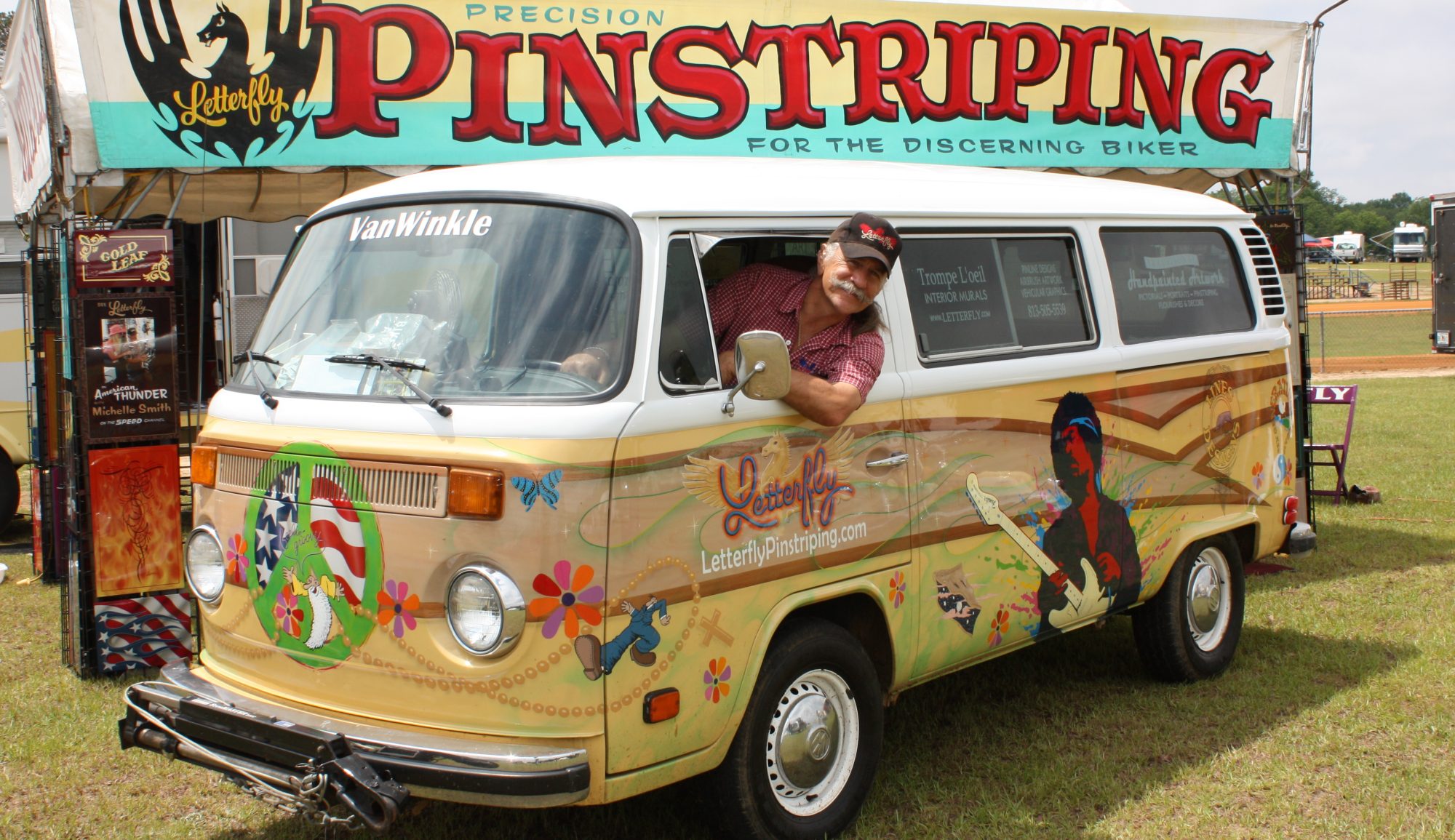
       The first order of business was to decorate this bus. A perfect panel existed next to the jalousie windows to letter the word signs. I was also experimenting with a device called an airbrush. After securing a CO2 bottle for propellant, I emblazoned my moniker “Krazee Davee” across the entire side in an effective way. A bright orange splat became a comical decorative element above and around the driver’s window to suggest that I had been pelted with something orange. To add to the humor, upon this funny shape I lettered, “I got it!” Then the adventure of a lifetime began.

krazee

       I started that summer enjoying the barefoot, casual experience of lettering signs at the Beach Bar, with regular intervals of simply walking across the street and immersing myself in the refreshing water of Clark Lake. Becks was on tap and I made friends with several of the waitresses, one of whom became instrumental with my future.

       Over the years I made additional signs, logos, gilded window treatments, murals and T-shirt designs for the Beach Bar. What became the focal point in the dining room, was the fancy plate-glass piece with glue-chipped fern shapes in the glass with gold leaf designs to showcase an old-time photo of his dad with his dog. The inscription read ‘Best Friends Meet at the Beach Bar.’ My development over the years from an enthusiastic beginner into an accomplished professional coincided with the Beach Bar morphing from a drink shots and get crazy joint into a respectable place to bring the whole family for dinner.   

       Being on display while I worked became an effective way to find the next customer. When the annual summertime festival on Clark Lake occurred, my bus was parked in the middle and I lettered signs while I met the people who lived in the area.

       The magical microbus transported Superdog and myself to many places. Whenever I needed work, I found the downtown drug store where merchants gathered for a cup of coffee at ten o’clock each morning. I became an attraction when I parked the decorated bus outside and began to paint on it. Lettering ‘Mobile Sign Shop’ across the roof of the bus was one such undertaking. This manner for meeting clients was effective.

       Adding to the existing sign work on my vehicle always lead to a job or two from the local merchants. While I painted away on the exterior, someone would ask me to come with them and look at their storefront. Then, I would have a store window, an office door, truck or a van to work on with never a lack of ideas for designs.

       Early in my relationship with the VW, a slight inconvenience occurred. The beloved bus refused to start. After some frustration, I became elated to find out that if I planned ahead and parked on a hill, the situation was easy to live with. When the time came to go, I rolled down the hill and popped the clutch while in gear and this vehicle started right up. Even on a flat area, the small size of the vehicle made it easy to get rolling; I pushed it myself and then jumped into the driver’s seat to repeat the above-mentioned procedure. Soon we roared on our way.

       I saved my money for a new starter. Little did I know that this situation also provided an opening to influence more than just mechanical integrity.

       Hayes suggested I go downtown to Fletcher’s Garage in Jackson to get the starter. I arrived in front of the two-story brick storefront with service bays and out of habit, scanned the available parking spaces for one with a suitable incline to facilitate starting. I then went inside and spoke to the new owner of the business. Kelly Osborne was my age.

       “I would like to buy a starter from you, but I don’t have enough money to hire you to install it,” I began, “Can I buy the part from you and install it myself in your driveway?”

       Evidently this odd request coming from a good-natured individual created a good impression, because his response was to be helpful. When the bus was in front of his bay doors I went underneath to dismount the starter. This was when I discovered I did not have the proper tools to get the job done. Soon I was back inside.

       “May I borrow a socket to remove the rear bolt?”

       My good-natured host provided me with the tool I needed.

       Over the years Kelly not only became a good friend, but his place of business, renamed ‘Kelly Imports,’ soon sported sign work by Krazee Davee.

       During several points in my career, his garage housed a variety of my painted projects. He allowed me to decorate business vehicles there along with making 4×8 wooden signs. I even decorated a complete set of rounding boards for a carousel there one winter. Those were the days of sharing an amber beverage on a tailgate after work with an occasional smoldering herbal accompaniment.

       As the years brought maturity to the fellows at Kelly Imports, in addition to keeping an endless succession of VW buses running for me, they became mentors of clean-living and fine examples of living successful lives.

The Great Chalkmarksman

   The large tented circus of yesteryear making one-day-stands required finely tuned choreography for all its components. I admired the Clyde-Beatty Cole Bros. Circus since I was a kid. The wreck of the truck used to haul my liberty act ponies and my performing horse shelved my ability to perform with any circus.

       I had to assume a job that didn’t require having my own vehicle. The Clyde-Beatty Cole Bros. Circus needed an advance man and the position came with a panel truck in which to work out of. When I arrived at the winter quarters near Deland, I found out more about this job.

       My responsibilities were to remain 24 hours ahead of the show. I would put up the arrows for the fleet to follow, lay-out the lot and make all the last-minute preparations. I would also arrange for fuel, hay and other provisions to be delivered to the showgrounds. The most important of these duties was to lay out the lot or designate the positions of the tents and trucks to optimize the circus configuration in the local setting. Another big part of the job was to rail the road, the term left over from the horse and wagon days when, in advance of the circus, rails from local fences were laid across the roads at an intersection to guide the teams pulling the heavy baggage wagons.

       The modern truck circus used cardboard arrows taped to sign posts and chalk indications on bridge abutments to give drivers directions to the next lot. This influenced the name I gave myself. Childlike artistic urges found expression as I quickly fashioned directional arrows that resembled stylized circus tents with flags flying and elephants with trunks that pointed the way. Images of clowns, girls and horses were all created spontaneously using large pieces of marking chalk. These diversions made the lonely job ahead of the show interesting and became a source of amusement for the show folks too. 

       While driving the panel truck towards the next town, I became quite good at finding a place to jump the curb for a place to park. From this location I walked back to a sign post to tape up an arrow or walk to a bridge post and draw a chalk image.

       One day while immersed in these duties in Maryland a surprise awaited me. I returned to my truck, prepared to leave and looked in the mirror to see a barefoot girl running up from behind me frantically waving.

       “Hey mister” she yelled “can I have a ride?”

        I invited her inside. There must have been something comfortable and curious about the white Chevy panel truck with the three speed on the column. My white Spitz Superdog shifted from the shotgun seat to the middle to make room and the barefoot girl settled in. She was tall with long brown hair. She held her head a little forward and looked down as she reeled from what was going on internally. Sad heavy eyes had a demeanor that seemed to look inward, yet were somewhat playful. She was mildly curious about what I was up to but was clearly wrapped up in a world that I knew nothing about. 

       When she noticed I was looking, her expression perked up and she would quickly smile. Then in an effort to be sociable, she asked an innocent question about the dog, what I was doing, or where we were going. I found out her name was Mary. Our conversation began this way. She was running away and didn’t mind the refuge or the beer. As my tasks along the way continued, my passenger became involved. It ended up that she had no immediate plans so I had a companion for a few days. It was actually fun having someone along while I laid-out the lot and pursued my other duties.

       A journey of a hundred miles took all day. I stopped every couple of miles to put up another directional arrow. Each upcoming turn was indicated with a series of three arrow sets. A system of arrow configurations signaled slow down and turn ahead. A mile before a turn the arrangement began with two down arrows on top with one right (or left) turn arrow. The next set had one down and two turn arrows to say slow down, turn ahead, final warning. At the turn all three arrows pointed the direction the fleet was to go. A mile in the right direction a straight up arrow validated everything was right for the driver.

       By the time all my arrows were in place for the fleet to find the shopping mall parking lot.  Mary was excited about the circus and eager to help. As I stepped off the lot to see how I could get the show to fit, she patiently waited and enjoyed watching Superdog who, filled with zeal, explored the new location.

       The big top was laid out using metal rods driven into the asphalt (or grass) to indicate the location of each center pole. From those locations a light chain was used to form the radius of the round ends of the tent. The spacing between the stakes at the perimeter was accurately determined with the use of an extra length of chain dragged along as an “El” behind the spoke of the chain from the center. Thusly the 150×300 canvas behemoth had a place to go and every stake along the perimeter was designated. To anchor the ridge of the tent between the four center poles, semis were parked in a straight line with the length of the top so aerial rigging inside had secure anchor points.

       The midway, backyard or performers area, various animal departments, cookhouse and various maintenance departments were all arranged around the central big top. Once the lot was laid out and ready to receive the fleet, we could relax and wait. During this time, we enjoyed a cool amber beverage and reflected on the wonders around us in this new location. The first trucks would roll in, depending on the length of the jump, by midnight or so and at that time I would spot them.

       The steady pounding of the stake driver on steel stakes was our alarm clock. The next morning the once vacant lot began transformation into a tented city. With a minimum of sleep, workers began to get the massive tent into the air. The first dramatic feature was the fifty-five-foot aluminum center poles that soon commanded the area that, the evening before was my exclusive territory.  Like the proverbial beehive, many activities were accomplished simultaneously and all was intact and ready for a show by noon, in plenty of time for the 2 O’clock matinee.

       My companion was content while she observed this plethora of activity while I attended to my sideline business that provided me with extra income: my newspaper route. I arranged for feed, hay and fuel to be delivered to the lot along with the inevitable incidental emergency tasks that occurred with an operation of this size. Mary was imprinted that day with my love for the circus.  

       When the band started playing for the big show, Mary saw how the physical elements and preparation activity combined to promise an entertaining show for the throngs of people that now filled the seats.

       A shrill whistle blast came from a dapper Count Nicolas. He was dressed as a traditional ringmaster in black boots, white riding pants, red claw-hammer tails and top hat. My new friend sat up straight in her seat as if not to miss a thing. This was pure circus all the way.

       Lions and tigers went through their paces as well as aerialists, clowns, horses, dogs, jugglers and the large group of elephants that filled three rings with their unique presence. The show culminated with a couple who rode a motorcycle up a cable that went the length of the tent. All of the noise, hoopla, thrills and showmanship climaxed with their final feat of daring.          

       The circus moved to a new location in the DC area every couple of days. In the midst of helping me prepare the way for this large circus, Mary told me about her family and asked for a ride home to get some shoes. During one of the jumps to lay out the next lot, we drove to her house.  After the panel truck crept into a plush suburban neighborhood and I waited, she entered a nice home. She soon returned with a minimum of supplies and was eager to resume her adventure. This glimpse perhaps cemented our connection. I discovered that we had much in common with our backgrounds. We both have an older brother and a younger sister, great parents and came from lovely homes. Yet we searched for something else. We then headed out to be ahead of the show.

       With the help of my new friend, the arrows went up, chalk artwork was created on bridge abutments and lots were laid out. Once again, the fleet was efficiently guided to other locations in Maryland. My route card had the list of the next few weeks of towns we were to play. The show was headed through New Jersey and beyond the city to Long Island. With this information looming, my friend reluctantly sought a ride home.

       Putting the magical sawdust world behind us, the panel truck penetrated the suburbs. Once we arrived at her home, parting became sad. We exchanged tears and hugs and vowed to stay in touch. Then I went on my way. I may never know the full imprint she received those few days at the circus. But in the following years as her correspondent and friend I was happy to observe she had accumulated a love for both the circus and adventure.

       Through the great sprawling city that began in New Jersey and continued with a labyrinth of highways and cloverleaves, my role ahead of the fleet was tested. Putting up the arrows through New York City was only possible at night when traffic was light. Without a shoulder to pull off onto, the panel truck sat in the slow lane unattended while I affixed arrows to the poles.

       Long Island was beautiful. New England quaint, yet the same restlessness that originally brought me to this place would take me away. As the solitary routine wove its way through New England, my skills as a creative artist were established amongst the showmen and I began to desire a different, more stimulating situation. My relentless zeal to create could never be completely satisfied with this routine no matter how many bridge abutments existed.

       The circus management being aware of my artistic gifts begged me to illustrate a book for future twenty-four-hour men. John Pugh commissioned the artwork best created by a 24-hour man with a working knowledge. The artwork for my ‘Lot Layout Planbook’ was completed in pen and ink in a motel in upper New York state.

       I trained a replacement to do my job and became ready to hitchhike to Michigan to launch my career as an artist/sign painter. Before leaving John Pugh requested me to return during the winter to paint the lettering and décor on the entire fleet.

       My plan was for Superdog and I to hitchhike to Michigan and launch my career as an artist. I shipped my stuff to Michigan.  My horse waited there also. The time spent ahead of the circus had been lucrative. This fallow time gave me ample opportunity to create, live and laugh. My chance meeting allowed my love for the circus to be passed on to another. There could not have been a better place for the beginnings of my visual communication attempts and entertaining artwork. During this time providing guidance for the fleet, I received direction for my career. I often wonder how my friend from long ago is doing as I savor those memories of adventure with the circus as the Great Chalkmarksman

       It was during those months ahead of the show that my thought processes combined to point the same direction. When I arrived back in Michigan to share my tales of adventure with Hayes, he was already anticipating what he had predicted as inevitable. He was delighted to hear among the friendly exchange my impromptu announcement.

       “Hayes,” I began in all earnestness, “I’ve made a decision.”
A Fascinating Woman

Dorita’s farm became an oasis spring and fall for several years as the increase in mural work among the RVers provided me with abundance. The idea of developing entertaining acts with my horse and mule remained a constant dream.  I valued the opportunity to work with her. I also connected with the AA community in Sarasota and began to attend services at the Unity Church.

During the day, while at her home in Sarasota, I busied myself with rehearsals and lessons to become a better horseman. In the evening, Dorita and I would share strong coffee and talk about many aspects of classic horsemanship. These discussions rocketed my understanding and appreciation of this fascinating art form. While becoming her friend, I also found out many interesting things about her personally.

Dorita Konyot was a small woman. She was physically fit her entire life with long beautiful dark hair that was unusual for a person her age. Horn-rimmed glasses accentuated the high cheeks on her almond shaped head and a large elderly nose suggested, along with her accent, European origins. While we visited with each other, she typically sat across from the table. Cigarette smoke rose lazily into loops and shapes that eventually coalesced into the haze that stained the interior of her home.

Among the stories shared were anecdotes about her friend the author of the Black Stallion. Several eight by ten photographs of her friend Walter Farley astride a silver dapple Andalusian hung on the wall over the coach. While I listened intently, I found out more about this fascinating woman.

Dorita was born on a traveling circus caravan May 18, 1922 in Talouse, France, into a family of renowned equestrians. Her Scandinavian and Hungarian lineage blended with the flavors of all the countries that made up her playground as a child.  Her father was a stern and capable trainer of horses and an outstanding rider of the highest level. 

At a young age, riding instruction began with the ever-watchful eye of her mother, Manya and her father Arthur, trainers and presenters of High School horses and other kinds of horse acts. 

She and her brother along with mom and dad soon made the foursome astride handsome Lusitano dancing horses that entertained European audiences from the bullrings in Portugal to the major permanent and traveling circuses across Europe.  Related to a larger family with connections in all aspects of show business, her relatives had even built a large successful show before the Great War (WWI) occurred and all the equipment was confiscated for the sake of the war effort.

Her story was interrupted by the sharp bark of her canine companion. Raven, a sleek and

tiny miniature pinscher wanted attention too. His animated loops around the room and back to her side provided comic relief while we sipped our strong coffee. With Raven back in her lap, she continued her story.

                Talent scouts found the Konyot family shortly before WWII and her family quartet with the command of centuries old Haute E’cole horsemanship skills came to America. In 1941, they began performing for Ringling Bros Barnum & Bailey Circus. Those audiences had occasion to witness the finest dancing horses in the world. 

Incidentally, Dorita as a teenager was photographed on a rearing horse and that picture found its way into the book I found at the library when I was a kid in school, just developing my fascination with the circus.  The picture showed a brilliant smile at ease under a large Cossack hat astride a large horse that stood up as straight as a candlestick on its rear legs.

The family also toured with Orrin Davenports Shrine Circus and the Clyde Beatty Circus among other shows. Years later a special moment occurred when Dorita received a standing ovation at Madison Square Garden for her performance with Bouncing Bomba her American Saddlebred High School horse.

One winter in Chicago at an exclusive riding stable, the Konyots stabled their horses during the winter break. A horseman with a background in the cavalry and a reputation for brassy showmanship befriended and became a student of the Konyots.  Chuck Grant took the principles of classic horsemanship learned from them to add to his repertoire. He went on to become, as he coined himself, the grandfather of American dressage.

A school teacher who had never sat on a horse was in attendance at a circus performance in Detroit. So, moved was she by the equine choreography presented by the Konyots, that she selected to make a major career change.  Vi Hopkins not only began to learn classic horsemanship and pursue a lengthy career as a riding instructor but went on to begin the unification of dressage instruction in this country when she initiated the USDF Instructors Clinic at her farm in Michigan.

Dorita’s emerging talent clearly was with the training of horses and horse people. When the Disney movie The Miracle of the White Stallions brought public awareness of Austrian Lipizzan horses to the forefront, Dorita trained a group of riders to present the Quadrille, or precision routine involving eight horses and eight riders for a traveling show that took advantage of the existing frenzy. Many of these riders went on to become stars in tier own right.

Gaylord Maynard performed the hilarious routine that her father used across Europe with his almost human equine partner Chief Bearpaw.  Although the comedy routine contrasts with everything classic about this equine art form, Gaylord was another testimony of the influence and talent that Dorita brought to this country.

                Literally all of my riding instructors and horse trainers had been influenced by this talented family. The Konyots are credited for bringing to America the equine art form known as Dressage. Virtually everyone associated with performing horses in this country today has been influenced by Dorita and her family. Her niece is a regular contender on the US Dressage Olympic team. In my quest to become a classic performing horseman I had been on a trail that led to Dorita.

She spent the final years of her life-giving lessons in the dressage community in addition to helping circus performers who strive to improve their horsemanship skills.

The Awards Ceremony

The indoor coliseum at the fairgrounds had been converted into a banquet facility to host hundreds of circus personalities who participated in or attended the event.

Prior to the event, many couples and groups dressed to the t’s in gowns and tuxedos. When the doors opened, they made their way inside and found a place to sit at the many round tables with formal place settings. Once everyone was seated, the wait-staff served dinner.

Imitating the many famous televised awards ceremonies, this one was no different. Once the ceremony portion of this event began, legions of speakers and attractive personalities made their way up to the podium to share anecdotes about circus history and to announce the winners of each category, followed by those performers who added their rhetoric between spurts of applause.

I was seated with Tino Wallenda and his family. I had mentally prepared a brief statement for when my time came at the microphone. The owner of the Clyde Beatty Cole Bros Circus, John Pugh, who I had worked for two decades ago, was part of the duo that arrived on stage to announce the winner of the category Domestic Animal Acts.

John was short. He had to stretch to speak into the microphone. When he announced my name as the winner of the category, I rose from my seat with the Wallendas and made my way up to the stage.

As I climbed the stairs, John tried to be funny and suggest that I stop before I got to the top where I would dwarf him. His lovely assistant placed my award – a handsome medal on a neck ribbon like Olympic winners get – over my bowed head. John gave me a handshake. Then I made it up to the top of the platform. I had a brief statement prepared in my head.

“I want to thank my heavenly Father,” I began, “who made all this possible.”

“And for this wonderful horse that I have been blessed with.” 

             I let that sink in for a moment and then added, “and John Herriott for all his encouragement and the patient help given me.”

While I made my way back to my table, I received congratulatory gestures from many people who applauded as I went past.

             My heart acknowledged a tremendous truth as I savored all that happened to get me to this place. Although life contains tragic challenges, when I move into harmony with an unseen influence and allow that power to work in my life, amazing things happen.

Herriott Christmas

My role as circus man took me to tropical climates each winter. Warm weather and palm trees made the holiday experience feel different. Without blood family to share this festive time with, the notion of Christmas became watered down since I was on my own. I gave carrots to the livestock on this special day but the magical notion of the Christmas of my youth was over.

In the midst of preparing for my season and taking care of my livestock, I enjoyed being with and observing a special family as they prepared for the holiday. The Herriott family grew up in the active lifestyle of the circus and, like many circus families, worked and lived together in this close-knit situation. They made strong connections and built respect for one another while dedicated to specific traditions passed down from generation to generation, all of which insured they would succeed together and that the show would go on.

The regard freely exchanged in the Herriott home reflected their dedication and connection to each other and all animals. As a guest on their farm, a warm welcome was extended to me. I was invited to feast with them on special dishes prepared in abundance, join in the fun, and get to know all members of the family.

Christmas morning was another sunshiny day with ideal temperatures. Though the chores went on as usual, our customary routine was interrupted by the festive morning ritual to which I was privy. As the driveway filled with the cars and trucks of family members, warm greetings were exchanged and they gathered in the living room. In the middle of the family room was a table made from an old circus wooden spoke sunburst wagon wheel with a round piece of glass on top.

Although the gift giving didn’t involve me, in the midst of the packed living room, I witnessed the expression of joy that occurred as each gift was given and was opened. This prompted squeals of delight and feelings of elation. I enjoyed this glimpse into the life of this loving family and seeing them all behave like little children. 

Soon, torn wrapping paper, ribbons and stacks of unneeded boxes littered the room. Individual attentions paired up or individuals became immersed with objects at hand. Later in the morning a meal was in order.

My favorite part of this unique Christmas experience occurred after the gifts had been exchanged, and everyone had a belly full of good food. One at a time, the daughters began to beg Johnny to “open the trunk.”

Previously unnoticed, an old trunk had a reverent location in the family room. It had been used until then as a coffee table. I had no idea what was inside but guessing from the expression on their faces, the girls all knew. They kept up their vigil. They relentlessly begged their dad to open it. 

After some careful timing and using show biz suspense, John paused to make sure his decision to comply was visible to everyone. Drawn into the anticipation, I, too, became ready for whatever was in that trunk.

                As John unlatched the lid, the daughters drew in close. I too had an opportunity to peer over them and see what was inside. Like a chest filled with treasure, the entire trunk was filled with old 8×10 black and white photographs of circus performers and circus scenes from long ago. The old photos, collected for generations, were the one-time standard of publicity in the circus industry since the advent of photography. Through countless contacts with hundreds of their peers this accumulation of incredible photographs became possible.

As Johnny reached inside and selected one of the old contact prints, the image sparked reminiscence and prompted a story from the archives of his memory. As the accounts unfolded, the bright reflection of glee in the eyes of the members of his family, who hung onto his every word, created in me another reason to be grateful to be included here.

We savored his anecdotes about distant relatives, performers from other famous circus families and the fantastic feats of aerialists, animal trainers, musicians, athletes, clowns and other showmen. His tales involved funny anecdotes that could only occur on a circus, or situations that evolved into gossip about so-and-so, crazy behavior, tragedy, historic moments and the amazing things that animals do. John also told us about humorous situations that occurred during the routine of performing on a daily basis on an old tent show, and the stories about the pranks these dedicated people often pulled on each other.

                The afternoon slipped by all too quickly. Our attention remained filled with story after story until evening finally arrived. With great reluctance, the collective resigned to our regular duties.

As I recall the indelible sight of children gathered around this master story teller and the privilege to witness this unique and intimate peek into the life of one of America’s favorite circus families, the experience easily remains one of my all-time favorite and happiest Christmas holidays of all.

Whether you are alone this year or surrounded by the abundance of those you love, may you enjoy this special time of year and be blessed with the happiest holiday season and most special Christmas of all.

John Herriott

As I headed south toward John’s ranch, I reviewed the plan for the year ahead; maintain rigorous practice with both animal acts prior to the circus festival, compete for the first time in front of the leaders of this industry, and when complete, spend the entire winter season of January, February and March at River Ranch, the luxury RV Resort. After the winter season, I resume practice with the animals to prepare for a five-week circus tour in Canada in the spring. When the tour was complete, return to Michigan where the horse and mule spend the summer on a farm while I paint for the Elliott Amusement company. I would also attend the Blue Bird rallies I had been invited to.

I drove day and night into progressively warmer weather. My thoughts reviewed the immense privilege of working with an admirable series of animal trainers; Bob Grubb, Evy Karoly, Vi Hopkins and Chuck Grant. Now, I get to work with one of the circus greats, John Herriott.

John was born into a traveling circus family, the son of Milt Herriott, an all-around animal trainer. Milt taught his son how to train and handle elephants, horses, camels, llamas, zebras, mules, ponies and other exotic critters. John’s specialty became multiple-horse liberty acts. The Herriott’s performed on both railroad and overland touring shows such as Cole Bros. Circus, Barnes and Caruthers Olympia Circus, the Circus World Museum, Hoxie Brothers Circus, Al G. Kelly and Miller Bros. Circus and a few more. The Herriott’s became renowned in circusdom.  John became effective in the circus ring presenting liberty horse acts and elephants along with other exotic lead stock. His marriage to a tall blonde from Sharon, Pennsylvania produced four daughters.

Years ago, as a teenage drummer on my first big top show, I sat in the cookhouse tent and listened to the fantastic tales that abounded. I heard one story about a family on the Hoxie Bros. Circus. They produced a beautiful display for the show that included every member of the family on a horse. All six members of the Herriott family presented talented circus horses and their display filled all three rings. They wore exquisite wardrobe and performed in unison. The concept of a family that worked in harmony with each other was foreign to me because I came from a dysfunctional family. Although I never worked on the same show with the Herriott family, years later I became acquainted with all of them at an assortment of wintertime functions in Sarasota, where many circus folks live during the off season.

The long, slow trip south allowed plenty of time to review this fascinating livelihood I had found. I came from a contemporary urban culture. As an enthusiastic teenager, I found a completely different society on the circus. Rich with tradition, I was eager to learn and assimilate all I could. My curiosity, dedication and regard opened doors into this interesting way to live one’s life. Certain unwritten rules of the circus actually interfered with being completely accepted into their society. I would always be regarded as an outsider. Regardless, I became attracted to the specialties of the highest regarded of the performers; the riders of the high school horses.

Weary of the long drive and eager to get there, late at night, the last fifty miles took me through the foggy, ghost-like, dimly lit, palm tree-lined interstate highway that threaded past Tampa. The muggy weather was in contrast to the blustery winter weather experienced at the start of this trip. A glowing luminescence on the horizon hinted at the coming dawn as I moved closer to my destination. In the early morning light, my rig found its way down familiar two-lane roads.

Upon arrival at the Herriott home the livestock was unloaded after I pulled down their long driveway. The horse and mule were happy to get out of the trailer. They had stood inside for three days. They couldn’t contain their enthusiasm as I led them through a gate to enjoy freedom and the green grass of the pasture. They kicked up their heels and frolicked at first but soon found the distraction of nourishing green grass.

I arrived at John’s home the first of December. I had plenty of time to receive coaching and rehearse the acts prior to the circus festival.

One morning, the year before, Mary Ruth asked me to go on a trip with her to ride a horse. She was considering a big saddlebred as a gift for her husband. When we got to the farm and found him banging his foot against the stall door, I had some concerns about the horse. Although I rode the horse and did just fine, Mary Ruth didn’t ask me what I thought. She made the decision to get that horse. A year had passed.

 By now, John had trained his big horse to do an admirable march and passage. Our daily routine became working and training our horses together. We both prepared for the International Circus Festival competition which would commence shortly after the holidays.

The result of our intense training would be that these animals would work well.

Standard procedure for living with circus animals is: the animals come first. First on the agenda, while they were out on pasture, was to rig up two tie-stalls underneath the lean-to on the outside of John’s barn. John took me to the building supply salvage yard. I bought three sheets of used plywood – gray from the weather – and three fence posts. At one end of the lean-to, in an assigned area, I planted the posts in the ground and secured the plywood between the barn wall and the posts. I now had two tie-stalls. Rings were also installed to hang water, feed buckets and hay bags. I parked the trailer in the lineup of other equipment, hooked up my water and lights, settled into my living quarters and got some rest. Later in the day, the livestock were introduced to their new stalls, fed, and bedded down.

The activities began on the Herriott ranch early every morning. John had an eight-horse liberty act in training, a big Clydesdale and a little pony that did a big and little act, Henry, the miniature donkey and the big saddlebred he named American Jubilee.

Soon, my daily routine harmonized with all the activity at the ranch. This let me maximize on the opportunity to learn as I watched all the training taking place. When my turn came to use the ring, I rehearsed my acts in the round pen, the same size as a circus ring.  I choreographed my horses’ movements into a sequence that would become the routine I use at the circus festival. I also ran Betty the mule through her routine.

             After the morning feed and muck-out detail and the training sessions were complete, we had fun. John and I both had a saddlebred horse to ride. We saddled up our handsome sorrels and rode them up and down the driveway. We asked our horses for various movements and gave them exercise in the warm Florida sunshine.

When it came to the march, his horse A. J. had an amazing reach I envied. We worked on achieving finesse with our cues and encouraged each other with our progress.

The routine with Betty the mule became a comedy act with me acting like an old prospector. This act was an expanded January act, a routine that appeared as if the animal was outsmarting the trainer with a liberty routine combined. I had been composing patter to support the premise of my mule appearing to defy all my requests. I kept having ideas for more comedy to include and in this environment with John, opportunities for additional inspiration were rich.

One day I asked John, “how would a guy go about putting a hind-leg walk on that little mule?”

John thought for a moment and replied, “I think I would check her down good and tight. Then slap her on the side of the neck and see what happens.”

When I did exactly as he suggested, my mule stood on her hindlegs as upright as a candlestick.

Now that Betty had the idea, I began to develop her hind-leg walk.

As John’s season loomed, he had an idea that would benefit me. He referred me to the idea of meeting Dorita Konyot, a local retired performer and horse trainer whose family brought Dressage to this country. He knew I would receive the advanced riding instruction I sought from her.

The weeks passed. Each day was productive. The bond between us grew. I was able to share tidbits accumulated from experiences with trainers in Michigan and John shared aspects he learned from his father. We enjoyed mutual improvement with our high school horses and our time together.

With each day, a heightened anticipation grew among his family members due to the upcoming holidays. His daughters, now mature circus performers, had husbands and kids of their own. They came from all over to visit to John and Mary Ruth. Soon his family activities included decor and treat preparation as the ladies transformed their home into a fantasyland of holiday happiness and joy.

My dad loved Christmas. Growing up in Ohio, I was familiar with the standard holiday tradition of colored lights on the house, a layer of white snow outside, carolers singing on the front doorstep, special cookies, hot chocolate and the excitement of Santa bringing gifts. The family Christmas morning of my youth was a magical time with plenty of gifts and excitement, now just a memory. In adulthood, Christmas became just another day. Here at the Herriott household I was about to experience a special holiday.

Gold Leaf on Glass

Dale was the owner of two restaurant/bars called The Hunt Club in both Jackson and Hillsdale. He wanted gold leaf signs on the large glass windows at each store, plus a gold leaf name on the glass at his office connected to his airplane hangar at the airport.

For centuries, gold lettering and ornamentation on a glass window was utilized by upper echelon businesses and was considered the epitome of the sign makers craft. Dale commissioned me to accomplish three gold leaf window jobs.

The explanation of why gold sticks successfully to glass remains a mystery. The technique used for centuries utilized heated water with a single gelatin capsule dissolved into it. This mixture was flooded over clean glass and while wet, special handling occurred to lay the leaf against the wet glass. The first part of the procedure was to completely cover the area to receive the sign work with many 3-3/8-inch squares of gold leaf. The window then sported a quilt-like pattern of overlapped gold squares.  As the water evaporated, the gold was sucked tightly onto the surface of the glass and a mirror-like effect resulted.

To prevent the delicate metal from wearing off, the gold was backed up with paint only on areas where the gold remained for the design. This part of the process involved delicate brush work. The lettering and ornamental designs were all painted backwards on the inside of the glass and acted as a protective layer over the gold. The excess gold was removed later with another delicate process involving a mild abrasive.

Achieving the level of proficiency with this particular technique of the sign makers craft elevated my standing in the community. My goal had been to become the best. With these three jobs – what became my final three jobs as sign man in Jackson – I had achieved my goal, albeit with a broken heart, having been rejected by Gail once again. With these jobs complete, I made the remaining preparations to go to Florida. At the stable, I loaded the livestock, hooked the VW bus on the back of the rig, and headed south. There was no sense waiting.

The snow had begun to fall. Every hundred miles provided an improvement in the weather. I had a busy time ahead of me.

I didn’t know it at the time but God had a different plan for my life. Even before I arrived in Florida, I discovered a segue that would rocket me into the next chapter of my life.