
Thank goodness our trip back to Florida was uneventful. Beth and I landed first at the circus winter quarters in Deland and parked near our old friends Captain Freddy Logan and his family. After getting settled, in an effort to make a good impression when asking for a job at a local sign shop I had my long hair cut off. I borrowed Beth’s station wagon and drove into town and found a local sign company and went inside. I showed the owner photos of my work and expressed an interest in learning more about the sign painting trade. I immediately landed a job at ArtDev Advertising. I had plenty to learn.
I became part of a trio of men in the back of the shop that got the work done. Bill was the carpenter, Carroll the crane truck operator/installation man and I became the sign painter. All of our duties overlapped. I also learned how to use crane trucks and help with installation.
Each day began to resemble a routine different from what I was used to. I was up early each morning. After my drive into work I spent the day at the shop accomplishing a variety of duties. The work mentality here revolved around providing a specific number of hours at the shop each day, instead of the timeless, all-consuming aspect of life at the circus.
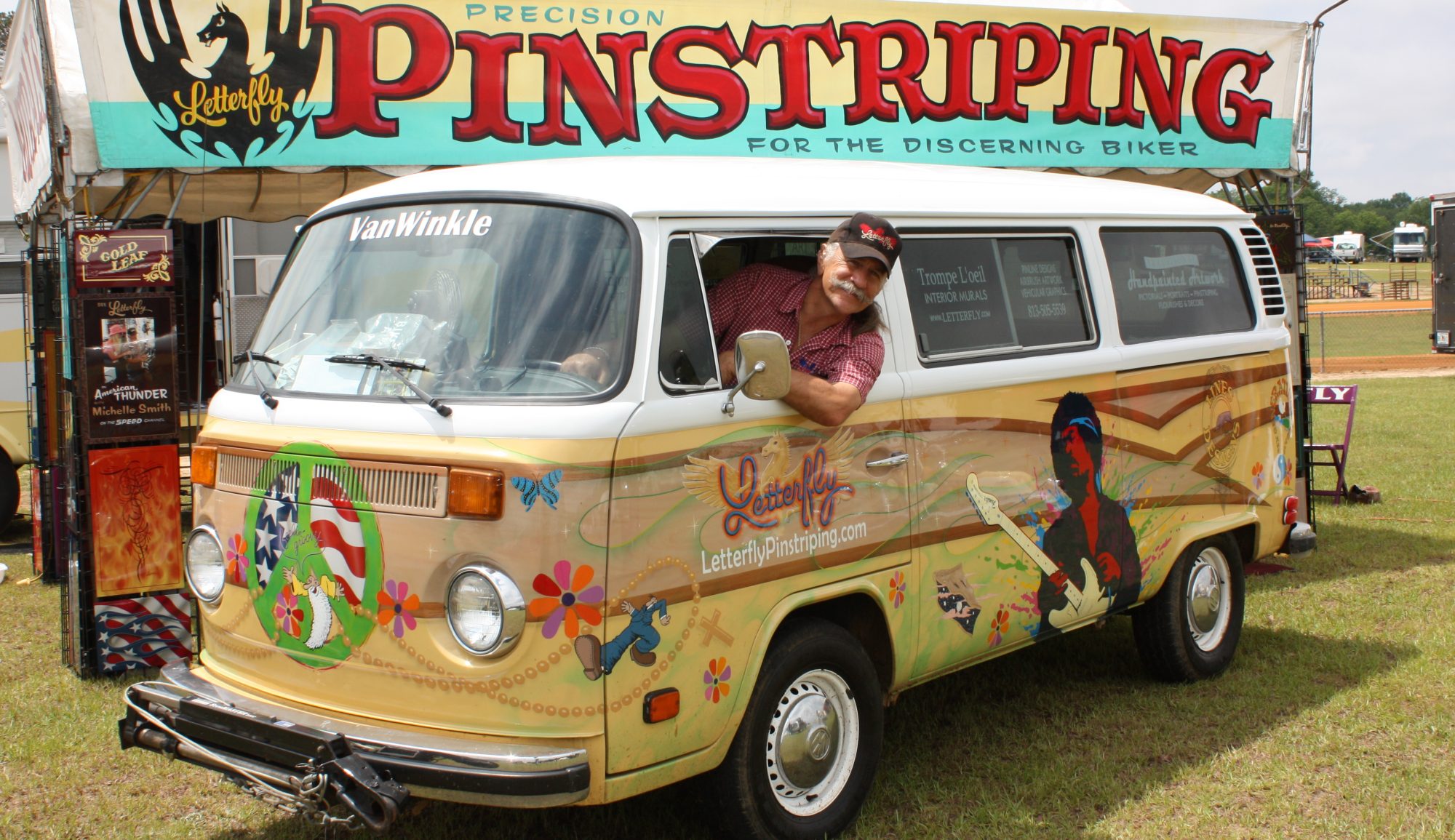
I found and bought an old tomato soup colored VW bus that became my commute to work vehicle. By Christmas time, Beth and I were encouraged to find an alternative place to park the trailer for the winter. A nearby fish camp near the river had trailer sites and room in the woods for Beth to put up her rigging and practice. Working close to where we lived was handy when Beth wanted to see what I was doing. One day the sixty-five-foot service ladder truck was up against a tall building downtown, Beth, the aerialist, climbed the ladder in her clogs, along with the rest of us, up to the roof to see the project underway.
Among the sign making projects going on at ArtDev was the creation of large hand painted billboards that utilized the talents of a local retired pictorial painter named Pete. He arrived at the shop one day with his kit to tackle the waiting blank billboard.
Once he got settled in, he came over to where I was working and looked down at my kit.
“I know some shops that would not hire you,” He said flatly, “because of the condition of those brushes.”
He was referring to my bristle fitches, the stiff brushes used to paint a rough surface like a brick or cement block wall. My fitches were rounded off from wear on all sides. Fortunately, Pete showed me his fitches and how a properly worn brush is supposed to look. He taught me how one corner was reserved from wear and also showed me the discipline of how to hold the brush for cutting in, like with a sash brush. Most painters know to use it flat either way in its entirety but when on edge for crisp lines and points, go one direction, reserving one corner for a sharp tip. Then, that corner is available for a precise point. By using this technique, the rounding wear only occurs on one side and the remaining corner stays sharp.
The manner in which large pictorials were created in those days was referred to as wet-blended and included the use of oil colors that dried slowly. This would allow the artist a long window of opportunity to merge the colors. While Pete was up on the catwalk painting large letters and images on the boards, he was always telling a story about his days as a pictorial man for a large outdoor advertising firm in Las Vegas. His wife would drop him off at the shop in the morning and before going home, she would grab a broom and sweep his work area clean. He would be talking the whole time.
He told stories about painting large portraits of the famous stars appearing in concert at the various theaters in Vegas, often returning to the same billboard before the paint had even dried to paint another portrait on top.
I still laugh every time I think about one story. One day Pete was up on the cat walk lettering five-foot letters with the name of a home builder – let’s say the name he was painting was James Robinson. That day Pete was telling a story about a sign painter he used to know. As he worked and shared this anecdote, his mind went blank as he struggled to remember his old friend’s name. As each letter assumed its finished condition from our vantage point in the shop we could see the large name revealed that I mentioned earlier. As Pete neared the last letter he paused, due to the revelation occurring. Out of the blue we heard him blurt out, “James!”
“I just remembered his name,” he announced, “James Robinson “
Pete took me under his wing and taught me many things including the basics of scaling up from the comp, or composition sketch. He taught me how a sign man enlarges a design using math and a yard stick.
The routine at the sign shop was far different from the around-the-clock routine on the traveling circus. I was only at the shop eight hours a day and every evening was free. Beth and I still continued our regular consumption of beer, and each evening I was expected to bring home a supply on my trip back from work. With little to do in the evening to keep my hands busy, the evening routine soon involved little more than beer and conversation.
I had observed couples that had a relational style of arguing and had never understood it. I recall while lettering a circus trailer on Gopher’s circus years ago, listening in on the conversation between Snooks & Kennedy, who were taking a break from being the band between shows. Their relational style was an argumentative banter that had grown to fill their leisure time together. It sounded like arguing but they seemed to stay calm about it. I hadn’t grown up around such a style. Beth and I began to display a similar argumentative rhetoric fueled by our mutual inebriated condition. I’m sure that a fly on the wall would wonder about our sanity due to the topic of those conversations. I admit that while driving home after working all day, my creative imagination would begin composing rebuttal from where our conversation had left off that morning. So I was certainly a player. I recognized that consumption was part of the problem but didn’t have an alternative to suggest. So, we continued our disruptive doggerel.
Henry Thompson lived nearby in his travel trailer that winter too. The circus used him in the winter time to paint pictorials for the side show banners along with festive clown and animal images on the show trucks. As he drank more and more, he became filled with happy recollections that inspired an attempt at singing the lyrics of a popular song. As he belted out “only yooouuuu,” the stanza would inevitably be followed by drunken laughter. I would often find him and Beth laughing about this at the little tavern near the railroad station after my workday was done.
Beth and I were counting on our jobs with the Great American Circus for the 1979 season that spring as promised by Jim Silverlake. But at the last minute, I was told they didn’t have room for me and my livestock. It was too late to find another circus, so I planned to remain in Florida to continue as an apprentice sign painter for that year while Beth went out on the road. A friend at a neighboring shop to ArtDev, who made dental bridges, had a neighbor who needed a roommate. I could live there. Beth found a pickup truck to pull her trailer and replace her station wagon. At the sign shop, I welded a trailer hitch on the back. I got her on her way and then paused at the brink of the year ahead to consider other opportunities to learn this trade.
I began to do some research, expand my territory, visit other sign shops and ask questions. At a big outdoor advertising place, I saw where the Coppertone billboards were painted. The owner was confident about my emerging career and predicted that he would see me again.
I worked a short time with a talented man creating visual masterpieces for the amusement parks and discovered the stereotypical alcoholic sign man. I heard about a busy shop near Orlando that had a grumpy owner with several journeymen lettering men inside at the bench. Curiosity piqued, I went to the sun-bleached metal building in a strip plaza, met Forrest Brown and his wife, and saw the work that was taking place. I made my decision.

