Exodus

Butch Webb had provided me with several restoration projects to work on at the shop during the summer months. Among the jobs to complete were several antique wooden merry-go-round horses. These were hand-carved out of wood and had seen service on carnivals during an earlier era. Part of the challenge was removal of multiple layers of paint, repairing the broken corners of ears, and making new legs. With all the features in his well-equipped shop and time during the summer months, I began the slow process of restoration. But recovery came first.

Butch Webb evidently had a resentment burning inside due to my not remaining obsessed with completing his work day and night, like I did during my drinking days. When his ‘A’ tour through western Canada was complete, prior to heading to Texas, the fleet returned to the shop.

I had been going to meetings and had begun the long tedious process of recovery and the fog in my brain was clearing. Through the fog, an idea for my future began to materialize. At thirty-four, I had the idea that perhaps I should get a degree.  Through asking the right questions, I found out that Southern Illinois University had the best graphic arts program in the country. 

While perusing a sign trade magazine – Signs of the Times – I found a sign shop in southern Illinois that advertised for a sign painter. I couldn’t stay here forever. As I made my plans to head out, Butch engineered a plan to screw me out of my money but never let on. Using the shifty manner in which he was famous, he found a way to short change me for the work I had completed.

One day he stealthily left on a plane for Vegas. I went to his secretary for my pay and she gave me only a fraction of what I had coming. She was simply doing what she’d been told. This is when I realized what Butch had done. Prior to my next meeting, I took one of the wooden Merry-Go-Round horses, and transported it to a safe location in Wichita in response to being shortchanged.

In Vegas, when he found out, Butch called and had his foreman park trucks around my rig to box me in. This foreman also had plans for the weekend. He left the shop confident that his efforts to thwart my travel plans were effective. With him gone, I had time to figure out a solution. Over the weekend, the Harder brothers helped me drop a drive shaft out of one tractor and pull the truck out of the way so I could leave. With my rig freed up, I left town. I went to get Betty the mule and then, the merry-go-round horse. Once loaded, I began my long trip east.

The long flat trip across Kansas gradually yielded to rolling hills as I passed into Missouri. The end of summer had passed. As I reviewed all that had happened to get me to this place, I entered the rugged coal country of Southern Illinois to assume my role at the shop I had contacted to become their sign painter. I also was in time for the first semester of school. My plan was to take full advantage of everything in Carbondale.

I checked in at the sign company and found he had room for my rig near the shop. He also knew someone who had pasture for Betty. I began a new routine with accomplishing sign work each day at the shop, and during the first lull on a quiet afternoon, I headed over to the campus to get acquainted with the Dean at the university.

While he looked at a portfolio of my work, I revealed my ambition to him.

“I’ve been thinking,” I began, “I should earn a graphic arts degree.”

He looked up from the work, paused for a moment to collect his thoughts and said, “I have students with a degree in airbrushing who can’t do this stuff. You don’t need a degree,” he continued, “just keep doing what you are doing.”

I explored what was available near the campus. I signed up for an English grammar class. I also became familiar with the nearby riding farm. These two learning opportunities became part of my weekly routine. I was still eager to develop my skills and stay in shape riding horses. I began taking lessons that provided access to a number of the school horses.

During that time at the barn, I reviewed the criteria again for a horse ideal for training into another circus performer. Young, but not too young (a five-year old is ideal). A horse who has never had any training means there aren’t any bad habits. Tall, kind and flashy.

 The focus of this barn was dressage. Their string of horses needed to be bombproof and easy going for the novice students. To join in, I became familiar with the procedure for dressage riding and practiced for upcoming tests. A formal horse show was scheduled for a few weeks away. I joined the rest of the students to get ready. The time to prove ourselves was here. 

The weekend finally arrived. We would ride proper tests in front of a judge and an audience. Like most specialties, the student rode through a series of maneuvers and transitions to earn acclaim as the aspects of each level was completed in secession to strict guidelines. This situation was not unlike performing as the seasoned school animals knew the routine.

Not knowing the school horse I rode was crowd-wise to this situation, I soon found out he knew he could cheat when an audience was present. Just like on a circus, when the animal knows the audience is gone they’d better act right, this horse knew that he could surprise the novice, and not do what he was being asked, and due to this environment, not get reprimanded in front of the judge.

When my turn came to ride my test pattern, I was ready and on my horse. I sat straight and proper and waited for the call of my name. After riding into the center of the arena, I acknowledged the judge with a tip of my hat. I then began to ride the sequence of this particular test. As I entered into the beginning of riding a ten-meter circle on one side of the arena, my horse began to veer back to cut off a significant amount of the shape I intended to ride. Using my whole leg, I gave him a swift thump to drive him back out onto the path. That got his attention.  The next circle he paid better attention to me.

Some of the students who knew this horse had been anticipating a scene. They commented on our performance when my ride was over.

I heard, “You got a pretty good ride from Cramer today.”

From the Depths

The time away from the pursuit of my livelihood to care for the mare had depleted my cash reserves. Now I was stranded and broke. This combined with having no direction for my life. I sunk into the deepest emotional devastation ever experienced during this life of continually having the ability to easily accomplish anything I set my mind to.

In this entry phase of my sobriety, I finally met the admission requirement. I hit bottom. From this low point, I found hope. I heard the message repeated from others who had found a life of happiness and productivity. They had experienced a shift in perception where we began to see things a new way through new eyes.

             Although I hadn’t had a drink in six months, my recovery started with the first word of the first step: we. I reached out. We are in this together. I joined the others. My response was to concentrate on going to meetings and asking for help from others. One guy in the group sounded good and what he said made sense. When the meeting was over, I took my hat in my hand and asked him to be my sponsor. We started to meet on a regular basis.  He started a process that began with going through the big book, the manual for recovery. One page at a time, he explained to me what those simple words, in that unique sequence, meant.

             From that start, I found a practical way to find, keep and expand a practical relationship with God by becoming honest, open and willing to uncover what kept me separate, and after discarding that, remain proactive with finding a new direction for my life.

             He introduced me to myself by relating his similar beliefs and the behaviors that kept him stuck. Then he told me about what he had found as the result of working the steps. Then he took me through the steps. Each step gave me a little more relief. Step four suggested I create an inventory of my behaviors, resentments and moral conduct; my greatest handicaps. With his help, I began to make this list. He made me understand their source and how my perception of others influenced the beliefs and decisions I made at that time.

He also showed me how fear drove my behavior. After uncovering this potpourri of kaka and having the written evidence stare me in the face, I admitted every bit to my sponsor, as suggested by step five. This deflation became the perfect segue for him to explain how these decisions, behaviors and beliefs contributed to the obsession I had developed with self that promoted grandiose desires, perceptions and withdrawal from others.

While I began to understand how fear, shame, regret and resentment drove my perceptions and behavior, he introduced me to an upgrade: spiritually driven responses that would also promote a healed perception of my surroundings.  A greater truth. Through this process, I found a design for living that started with a shift in perception called the turnaround. This is like putting on tainted glasses backwards and seeing for the first time all of my surroundings are beautiful.

         Through doing this work and while listening to others at meetings, I became related. I became connected, part of the group.  The concepts that kept me separate from those around me now became our reason for connection – having recovered from these same things. Through admitting my faults, embracing my humanity, and allowing connectedness to take place with my flawed fellows, for the first time in my life I felt the presence of God. I soon found my relationship with my higher power.

From this low point in my life, I found perhaps the greatest gift of all; freedom. For the rest of the summer I attended three meetings a day. I was immersed in the recovery process. I gradually healed. Then when the time was right, I received inspiration in regard to a logical destination to begin the next chapter of my life.

A Miracle Cure

 “Yes, we have experienced remarkable success with reversing the effects of founder,” the spokesperson announced over the phone

                Back at the shop, Butch used the usual pressure to get sign work tasks done on his fleet prior to the beginning of his season. My work ethic had changed now that attending meetings was important. I no longer worked late whenever he asked. This promoted a resentment in my client although he assured me that he understood and had respect for someone who had recognized they had a problem and did something about it. Never the less, my focus on caretaking for my mare and attending meetings interfered with his ambition.

I did get his fleet on its way on time. Then, I made an appointment to take my horse to be healed with the corrective shoeing procedure available in Oklahoma City.

For months I succeeded in keeping Sassy comfortable in her stall. During my regular outings to see her, I used a wheelbarrow to provide soft sand in her stall, topped with pine sawdust. Because of the pain in her feet, she laid down a lot.

In the dark Farrier College building, a dozen students were learning how to make shoes at the forge and anvil. I found the man who made the claim over the phone about being able to help. He had me bring the horse inside. When he looked at her feet, he gathered the class around to see her condition firsthand.

“This is what a horse’s foot looks like,” he stated as he held her foot up between his legs, “when the coffin bone is protruding through the sole.”

The students leaned in for a closer look. He pointed out the obvious. As the class asked their questions, it became evident to me that her condition was grave. Expectant hopes were dashed to the ground. After the session, he pointed toward a place where she could stay.

                He had only crude stalls and musty, old oat hay for bedding. Overnight Sassy developed open bed sores from lying on course bedding. The next day, I received the inevitable prognosis of what I had been in denial of – in the form of a demand by him to put her down. The roller coaster experience of having my hopes ride high during the trip south, shattered upon arrival, and now the command from this egoic, less than sensitive service provider left me in tears.

Still confused about what to do, I called Evy Karoli. I was ashamed to report to her what I had done. I was sure she would be disappointed. Instead, when she returned my call, she was a source of comfort with helpful advice. It was time to end her suffering.

                I couldn’t bear to witness the euthanization of, and the discarding of my beloved, once proud mare. I sobbed while I gave my consent. I was filled with fear. I left that place on a dreary day in a blowing rain with vision blurred by tears. 

Back at Wichita, isolated at the shop, I sank into the most emotionally devastating depression of my life. Alone and completely depleted, I sought relief at the AA fellowship. With no direction to go, resources tapped, and in the depths of despair, I went to three meetings the day I returned.

At the first two, I heard the usual angst about withdrawal, and reports of progress, mixed with confusion and dilemma. When it became my turn to talk, I opened up about my tragedy and the loss of my mare and, perhaps for the first time, began to open up and attempt to describe the depth of sorrow I was feeling. My crude testimony deteriorated into sobbing. The entire fellowship rose to wrap their arms around me in an effort to provide me with comfort and encouragement.

I returned to the next meeting. Again, when it became my turn to speak, this scenario repeated. My condition of untreated alcoholism and delusional thinking was compounded not only by grief for the loss of the love of my life but, not knowing it at the time, withdrawal from something else. I had developed co-dependency with my mare who gave me an image of myself that I approved of. Through finding out about these and other concepts, I became familiar with how I used her as an antidote for my damaged self-esteem. Unknowingly, I found a way to approve of myself while being a handsome prince on a stunning horse. With her gone, I had a brokenhearted void in my soul.

Healing was underway. At the third meeting I attended that day, I began to look at my fellows with relatedness. One fellow was having a tough day during his job delivering pizzas. His plight became the focus of everyone’s empathy as we, including me, rose to console and comfort him. The following days gradually turned into weeks and about all I could do was go to meetings.

Days later I woke to discover Nick, my canine companion, laying paralyzed, quivering and unable to breathe. I laid him in the back of the van and raced to see the vet but was turned away. They were too busy. The only option I had was to put him down myself.

Back at Maize, I went over to the welding shop. I asked the two Harder brothers to help me with this task. They did have a gun but were not able to consider shooting inside the city limits due to some strain with the sheriff in the past. They lent me their .22 rifle. While tears flowed freely, I carried Nicks convulsing body to the grass north of the shop. I had to feel my way to lay the end of the barrel on his forehead because my sobbing obscured my vision. One loud crack and he lay at peace. I dug a hole and placed my friend at the bottom. After replacing the dirt on top, I paused to say a prayer. I was now completely alone. 

Love at First Sight

In the midst of devastation, a wonderful mule named Betty found her way into my life. Betty proved to be a great distraction from seeing the pain in Sassies eyes. During idle time at the farm, I began training Betty to work at liberty, or the style of responding to my positions and gestures in the round pen while completely loose, thus the term. When I began teaching her to bow, I noticed her bright willingness to learn.

I saw understanding in her eyes.

‘Oh, you want this?’ Betty seemed to say as she folded one foreleg back.

When I patted her on the neck, she melted.

‘Oh, I get a pat on the neck?’

That was how my love affair with Betty the mule began.

betty 023

Over the years, this willing animal allowed me to train her to do more than any of my horses ever did. As her repertoire expanded, so did the composition of a routine to use for our act.

Fueled by ambition, the mule represented an opportunity to expand my professional offerings as performer. I aspired to develop another act. My days were filled with horse care and painting sign work for carnival folks in the area with various results, some wholesome, some not. I was distracted by this dilemma with my horse and my head seemed to be filled with cobwebs.

In the midst of all this confusion, I became a regular at the local AA club. I was still driven by intense independence. Although hungry for relief, an internal rigid streak mixed with demand resistance prevented my entering the process of recovery. The process described in the curriculum is achieved by following simple instructions.

          Like the shiny metal ball in a pinball machine, my direction was erratic, aimless, driven by self-delusion, misguided intentions and scattered fears as I continued on a self-induced path of ambiguity.

With the winter season over, the time came to travel to Wichita to paint for Butch Webb and his large concession operation. I loaded up the livestock and headed west. The trek had to be an excruciating experience for my mare, who did not have the ability to lay down during the entire trip. 

When Nick and I arrived at the tree-lined farm situated in the midst of vast flatland where I always boarded my horse, I fixed her stall with extra deep sand and fluffy shavings. It was fun being reunited with my horseman friends I knew from years of coming to this place.  My friends saw my way of going quite different now. Instead of practicing my dancing horse, I doctored her sore feet and nurtured her each day . I provided Sassy as much comfort as I could. No one was familiar with her condition so I received little help. I felt alone. As a group, we only had experience using our horses in health. 

By this time several people had attempted to reach me with the truth in regard to the reality of her situation. This irreversible condition in her feet had progressed into the affliction known as founder. I refused to consider what they were saying. I wanted only to find one more thing I could do that would work.

I was blinded by self-delusion. I over-did all of what I was doing for Sassy. I refused to believe that her dancing career was over. I continued to seek information from every source I could. I talked to university veterinarian schools for possibly a miracle cure or their willingness to use her as a study case to facilitate a breakthrough discovery.

The many conversations educated me to the reality of this plight, but instead of embracing the truth, I stubbornly continued looking for a cure. In the midst of all this misery, as the result of one lead, I received hope. A farrier college in Oklahoma City made the claim of being able to reverse the effects of laminitis. I gave them a call. 

Change of Direction

       The engine in my truck had been getting tired. Bobby Steele agreed to give it a rebuild. While wintering at the Morris family winter quarters, he hoisted the engine out and dismantled the engine. When the engine was almost complete, Bobby needed sawdust for bedding the cages of his bears. I had only one horse. I used the entire width of the back of my trailer, approximately 8×12, to make a stall. Sassy enjoyed the room in the back of the new trailer all to herself. I thought sawdust would be a nice addition on the floor so I joined Bobby on his trip to a cabinet shop.

     While we shoveled the dusty stuff into leaf sacks, he became satisfied with the coupe. Back at the elephant farm, we resumed the engine rebuild. Sassy was getting along fine in her new digs, now enhanced with sawdust. The engine project progressed nicely but Bill Morris didn’t have the ability for me to stay at his farm for the entire winter. Rain was coming. Plus, there was no pasture available for my horse.  I had to go.

    With the engine complete, I moved the rig temporarily to Billy Rogers’s trailer park nearby, during the wet weather. This place was not ideal either; no yard for the horse.  The parking location was on terrain that left the rear of the trailer elevated. While in this situation, the new metal ramp was useless due to the acute angle. Satisfied with the comfort I had created inside, I left Sassy loaded that day and continued my search for a better parking place.

    Having looked at a pair of mules recently, I thought to contact Gee Gee Engesser. I found out she had room for the rig plus a stall and pasture for the horse. I made plans to move out there immediately. That would also facilitate acquiring the mules. 

      Upon arrival, while leading the mare out of the trailer, I was horrified at what I saw. Sassy walked gingerly, obviously in pain. Her front feet were way out in front of her. Gee Gee called the vet who arrived in a hurry but didn’t know what he was looking at or what could have caused her condition.

    He shrugged and said with unenthusiastic resignation, “Let’s wait a few days and see what happens.”

       Not knowing anything else, I proceeded to care for her as best I could in her new stall.

     Not having any experience with this condition and not knowing anyone to confer with that had any knowledge left me at a disadvantage. Gradually I learned about founder. I also found out that the window of where treatment would have been effective had slipped by. 

       Sassy remained in pain. In an effort to get off her feet, she began to lay down a lot. I took every effort to provide comfort to this wonderful mare who also represented an important part of my future ambitions. I refused to embrace the truth. I began the relentless pursuit of finding out about something or anything I could do to eliminate this condition.

       A follow-up conference with the veterinarian who responded first established him as incompetent. Another doctor informed me that with the immediate introduction of an antihistamine, the inflammation could have been reversed, but only during the introductory stages. It ends up that the sawdust Bobby and I retrieved contained certain hardwoods that promoted a fever in her feet. Wood shavings traditionally used for horse bedding are pine or softwood because several hardwoods are poisonous. As the temperature in her feet went up, the laminae became inflamed.

       The resulting inflammation in her feet caused the tissue contained in the hoof to expand. Since the hoof wall acts as a container for this tissue, it can only expand downward like toothpaste coming out of a tube. That was why contact with the ground became painful. This condition gave her the inability to place her feet squarely on the ground and is why she sought to rock back on the heel in an effort to get off the uncomfortable, tender sole.

       I knelt down in the sawdust of her stall and gently stroked her neck. I looked into her kind eyes and saw her yearning to understand what was going on.

       “Everything is going to be okay,” I whispered.

    I was afraid in spite of believing there was something I could do to heal this horse. I spent time with here, gently tending to her every need. My attachment to my ambition of going it alone separated me from the truth. Sassies condition was grave. I bedded Sassy up to her belly every day to make her as comfortable as possible. I also provided her to a regimen of pain relief via supplements.

      As I tended to this wonderful mare, time seemed to slow down. In the first few months of sobriety, I was learning about life. This life is a dichotomy. I was finding out that life was not good or bad but that life is a blend of good and bad. As Sassies condition worsened, I was blessed with another to love.

Mel Winters

I was encouraged by Red to meet this man considered a legend in the carnival culture. He also knew Mel would be interested in some of my creative artwork talents. Arrogant and feisty, he considered only his ideas and made hasty judgments. After our introduction, he wandered over to look at my horse trailer.

“Stupid,” he snarled, ‘such a waste of space.”

He referred to how the horse industry had engineered the best way to provide a safe area for a horse to ride in a trailer. Instead of the trailer body taking every bit of allowable width, my trailer only had floor between the tires. Wrapped up in his thoughts, he was oblivious to the fact that this industry standard was perfect for this type of cargo. I learned that this sort of contempt for anything outside of himself was part of his peculiar persona.

Red was right about him wanting artwork. Mel built his motorhome out of an old milk truck van by splitting it and adding extra metal down the middle to make it extra wide. A clever machinist, he took three rear-ends to make one that was wide enough. The interior had railroad car features like a hinged sink that went up against the wall and ornate cabinets, bunk beds and lighting. He wanted Indian motifs on the sides.

I had an idea to improve my one-ton truck: A custom rack over the cab to carry ladders. I also recognized an opportunity with Mel. Yes, he could build that for me so we engineered a swap. I traveled to York later that summer to do the work.

 A clever man, he seemed driven by contempt. His agitated state prevented him from being a good listener and having regard for others. I visited his shop in Pennsylvania and saw many innovative ride trailer-mounting processes underway, made with Red’s guidance.

Mel was difficult to deal with. Unknown issues drove his demeanor. In my newly found sobriety, being around such turbulence was perhaps not appropriate for me in this fragile condition. In my confused state, my inability to speak around aggressive behavior surfaced. As he built his concept of what I wanted, I was unable to voice observations of what he was doing that would not work.

 He went belligerently ahead with his plan for two metal pans on hinges that, in addition to being too small, the galvanized metal surface was inappropriate for a horse ramp because it was hard and slick.

Intimidated by his manner, something had my voice. I was powerless to insist on what I wanted that would work. I felt as if I were in the twilight zone: an area with no syllables.  I was unable to verbalize what I wanted. The exchange concluded. Unsatisfied, I withdrew. I resigned to the waste of effort and the resources gone. I hadn’t yet learned to use the fellowship as a safe place to sound off with the vagaries of life and get helpful advice. I left with my useless contraption and headed south to a farm of some friends. I eventually had to discard the useless pieces he made. 

I didn’t know it at the time but the scattered mental syndrome that accompanied my new-found sobriety was a normal condition that would eventually pass. I hadn’t yet developed the sensitivity to notice and trust intuition in such matters. As I seemingly trudged along without direction, this fog that impaired my usual diligence would follow me around for a while.

The Bannerman

The Bannerman

Advertising in any proximity that the locals gather is a strategy many businesses utilize. A sense of community dedication associated with civic groups is created with these gestures. Hand painted paper signs with the names and ads of local merchants hanging in the big top is one way of making extra money around the traveling circus. Becoming the banner salesman on the Royal Bros Circus season of one day stands in 1973 was an enterprise that required my sister’s participation to fit into our routine. Our custom was already up early each morning. Paula would wake me and crawl into the cab of the pickup to resume her sleep while I drove to the next town. When we arrived at the next town, I would jump out of the truck downtown with my steno pad and begin to visit the merchants in all the stores. Paula would then drive the pickup truck with camper pulling the calliope trailer to the edge of the show grounds where the big top was being set up. There she would recruit the canvas boss to drive the rig into position on the lot near the back door of the tent.

At the beginning of the season, John Frazier gave me a spiel to use and sent me downtown to do my best. I simply found the decision maker in each store and rattled off my memorized pitch, wrote down the particulars of each sign and announcement and collected eighteen dollars for each one. Downtown, my role took me in and out of each store and business to give the spiel for buying a banner ad that would hang in the big top. The accompanying announcement would give merchants presence during the afternoon and evening presentation of the circus. I was learning presentation skills and also how to get around the employee in charge of intercepting disruptions. I learned to not disclose my purpose until I got to talk to the boss. As the circus banner salesman in a new town every morning, I had the opportunity to meet an endless stream of interesting people.

In Perth, at a candy store, I entered an old-time glass store front through a heavy wooden door that triggered a bell that rang each time it was opened.

After listening to my memorized spiel, the elderly woman who otherwise beamed in response to my presence responded with “I’m not going to buy one of your banners.”

After asking me about my role with the circus, I was then invited to listen as she told me about herself and sat down at the piano. Prior to World War I she had been a piano player for the silent films shown in the local theater. Emotion, drama, excitement, danger and elation were communicated through the flavor of the music created by a live piano player in these theatres. As she played, I heard these examples of how music enhanced this genre of entertainment. My mind was transported to a time when this was state of the art. During the war, she became a bus driver for the war effort and when the war was over, talkies had arrived on the scene. She had to pursue another vocation. This was just one of the many encounters with interesting people that imprinted my heart.

 While I was in town selling banners, Paula had one duty during set up, and that was to take two pullies with long loops of rope and snap them into the lace lines of the big top while it was going up. This facilitated hanging the paper signs later, and was a duty that forced her out of her shell to interact with the crew during set up.

When I got back to the lot with all the orders, I had to scramble to get the rig backed into the tent and the drums set up. Paula got busy painting signs on large pieces of white paper with a shoe polish applicator and hung in the big top before the show.

Paula never did become an enthusiastic showman, partly due to her reclusive nature and partly because I had become a hot-headed teenager who had never learned to be gracious as we attempted to get all these tasks done together on a daily basis. Perhaps I was following the example of our father’s strict perfectionist manner of wanting everything done just right, and that added to the already frustrating situation of her being in the turbulent outdoor entertainment business.  All I could see was the perfect way it could be done.

Our comfort was at the mercy of the weather and plagued with egoic whims, moods influenced by situation and selfish ambitions of others, which was more of what we had found on the playground of our youth, yet on a grander, rawer scale. The rigors of one day stands, relentless demands from me and the multitude of twists that occurred in this turbulent lifestyle began to wear on her. Something in my sister had been hurt. She could not show enthusiasm. She remained frustrated and became referred to as poor Paula amongst my trooper friends.

One morning after having a successful series of banner sales, I returned to the lot to begin with the process of setting up and getting ready for the show, but I could not find the rig on the lot anywhere. I asked the canvas boss if he knew anything, and he sent me to see the elephant man.

When I asked Dick, he said, “The rig is over there” and pointed north of the lot.

So I began to walk.

About a mile from the lot, I found my sister completely frustrated, sitting on the ground. The truck was stuck up to the axels in someone’s front yard. Apparently while driving the rig from where she dropped me off downtown and heading for the lot, she missed the entrance. Thinking she could just go around the block, Paula continued down the road and instead found it went straight for miles with no place to turn around. Exasperated, she pulled up someone’s driveway and attempted to make a big loop in their front yard. But the lawn was soft, and the truck sank up to the axels.

When I got there, I was not the loving, supportive brother she needed at that low point in her life. I became a hot head and screamed and yelled at her. I had to hike back to the lot and recruit the help of the elephant to pull the rig out of that situation. As I look back at my behavior that day, I realize that my response did more to damage my sister, who already had the tendency to shut down and withdraw. That event caused her to retreat even further into the security of isolation. If I had it all to do over again, I would have become comforting, compassionate and lovingly explained to her that we all make mistakes. The damage of that event set the tone for the rest of our lives. My sister never saw an admirable trait in me from that point on. When I did see her years later, warmth and regard was gone.

Holding a grudge seems to be a sin of our father, who had his front teeth knocked out on a family water ski excursion by his brother (interestingly, who became a dentist). Making amends or entering the procedure of forgiveness, as taught by Jesus, was not exampled in our family in spite of our father being a minister. Resentment that persists can become depression.

After an otherwise busy and fun summer season across picturesque Ontario, we had much to relish and savor from our adventure but a contemptuous not knowing for both of us, forced self-reliance to the front and we grew apart. My sister and I survived a turbulent childhood not knowing safety. We were exposed to a vast spectrum of behavior coming from others. We began to prefer a smaller circle of influence. At the end of that season on the circus in Canada, we trucked back to the Quad cities where, after dropping her off, she began her next semester of college. That was her only experience on a circus.

I headed east to pursue a fall tour on another show. I joined a small circus with a five-week season in Michigan that performed in school gymnasiums. At the end of that tour, I ventured to Indiana, gathered up the new crop of pony babies at the Palomino farm, picked up the liberty harness commissioned at Shipshewana and headed for Michigan.

At Hayes farm, I unloaded the weanling babies and gathered up the yearlings. One colt had died.

Hayes told me the story of Lewis Bros Circus, a show owned locally that thrived during the thirties and forties that wintered east of Jackson on Fox Road. He had gone out there in the past to snoop around but the owner of the farm wasn’t keen about visitors. Fortunately, the farm had changed hands again and Hayes made friends with the new owner. He saw the left-over equipment that had sat for several decades but not before many of the rotting wagons had been burned.

Since he was friendly with the current owner of the farm, during one of my visits to Clarklake, he suggested we drive up there and look around. We went to Fox Road in his green station wagon. Behind the large white home in a rural part of the county, a sunken driveway lead past a row of tall trees up to the back where two large barns stood. Inside the first one was a low ceiling and a labyrinth of aisles and stalls, obviously where the animals for the show lived during the winter.

The other barn was a massive, high ceiling structure with sheet metal on the floor where the elephant was housed. Up on the second floor, a large room was where the wardrobe, canvas repair and other preparations took place.

As Hayes and I explored the barn we saw an inverted elephant tub being used as a coal hopper and recognized other pieces of equipment strewn around. The owner told us to take what we wanted. I found a complete set of liberty horse harness and an elephant bracelet.

Part of the challenge of living on the road involved an inability to collect things. My choice to keep something usually meant that another belonging would have to be discarded, but this find was too good to pass up.

 After some additional artistic projects Hayes had accumulated for me to complete, I headed for Oklahoma with four yearlings to begin the creation of my new palomino liberty act. I was about to begin the experience that would positively imprint my life in many amazing ways.

This business I had selected in an effort to make an improvement came filled with extremes; from encouraging friends that became a positive influence for my life, to crooks with agendas that inflict selfish devastation. Instead of receiving wisdom from the lessons learned on the road, my response was more of what I had established as a child. I sought on my own to utilize self-reliance and independence for surviving in this turbulent society. The ponies would teach me something vastly different.

My Kingdom for an Elephant

My Kingdom for an Elephant

Jimmy Silverlake had created an efficient moving under canvas circus for season 1974, and the arrangement of canvas tents and the rolling components on the lot were quite pretty to look at. The image of this tented city on a grassy field conjured up awe, curiosity and intrigue. Yet one element was missing. How could this be a circus without an elephant?

In the spring, Jimmy heard about an opportunity to buy an elephant from Tony Diano, a rogue that couldn’t be let off her chain. The deal came with an old rusty trailer and an antique tractor to pull it but Jimmy had room for the elephant in his animal semi. Soon the elephant was transported to Michigan, tethered and out on display. The rig that came with her was then empty. Bert Pettus was contacted and he became our elephant man.

Having this large empty trailer on the show gave me the ability to pick up the remainder of my ponies from Hayes farm and get them used to traveling on the show. This meant I was tending to eleven ponies.

Sunshiny afternoons with my ponies on their picket line proved to be a magnet for the little girls that lived in each neighborhood. I had a bucket full of brushes that I would place near the picket line and the girls would find them and figure it out. Get a brush and groom a pony. The palominos loved the gentle attention and I had the livestock curried by show time.

Later in the summer, Bert Pettus and his wife Marie had their daughter and her family visit between performing on shrine dates. Jack and Sandy Fulbright had two children, two appaloosa high school horses and a six-pony liberty act. For the brief times they visited, we had a tremendous population of ponies on that little circus. They were happy to show me how they tended to and performed with their ponies. This accelerated my understanding of this specialty.

As the season progressed, so did the proficiency of my pony act. But the show didn’t fare well. It is never good when the circus catches up to the agent. The rhythm of one day stands became erratic, with gaps during the week when the show would lay dead for a day at first, and then with alarming frequency. The tour ran out of route late-summer in the Upper Peninsula, due to the lack of advance personnel. On the last school grounds, where the circus played its final engagement, all the investors that had helped Jimmy launch this show arrived to divide up the assets. I had lent him some money too, but due to the hierarchy was last in line for anything.

Sitting dead on that final lot, the group bounced ideas back and forth for dissolution. They figured out what each one was going to get. Then they had an idea.

 “Let Dave have the elephant,” I overheard.

That statement prompted a flood of concerns. The surprise prompted my imagination to dream several survival scenarios. My mind entered a cycle of thinking trying to figure out, like the rest, how, when and where I was going to manage travel from this place. Sitting on the lot with no way of my own to haul eleven ponies and an elephant, I wondered how I was going to proceed. These thoughts occupied my mind the entire night. I was relieved the next day, when they announced other plans had been made for the pachyderm. But this brief episode does qualify me as having the ability to claim being an elephant owner for a day.

Billy Griffin invited several of us to regroup at his family home in Princeton, Indiana. Jimmy let me use the old dilapidated bull semi to get the livestock to southern Indiana while Audrey from the cookhouse drove my pickup and camper. I had to do something to get equipped to tour with my ponies. I needed a truck. Billy helped me find a truck through the dealers he knew in the area. We found an International Loadstar in Poseyville with an eighteen-foot box that would serve me quite well to carry the ponies.

Once this rig was secure, I began the process of getting it equipped as my pony truck. I rigged up a ramp that hinged down from the side door and fashioned mangers inside for the comfort of the ponies. The truck also needed a trailer hitch welded on the back for the calliope.  I could sleep on the bunk in the trailer for now and have plenty of housing for the three ponies, hay and equipment in the truck body.

While we camped in Princeton at Billy’s mother’s home, everyone was making changes. A clown from the show who made the trip with us lived in an old dodge van and wanted to buy my pickup with the camper. He drove his old van like a daredevil clown would, often screeching to a stop from a tight turn that gave him a thrill.  The living quarters inside would be a big improvement for him but he would have to learn how to be careful while driving this top-heavy vehicle.

One at a time the kinkers left for other digs. The clown found another show to perform on and headed that direction. Audrey planned going with Billy to south Texas. I learned about an upcoming job, a several weeks tour of one-night stands through Michigan on a circus that performed indoors in school gymnasiums.

I could leave seven ponies on a pasture nearby for six weeks and pick them up when my tour was over and head for Hugo. We all said our goodbyes and the headed different directions.

At the end of this whirlwind preparation session, enroute to the school house circus tour, I took frail Teddy to Hayes house in Clarklake where he lived the remaining weeks of his life in his backyard. I often think that celestial beings come to us disguised with hoofs. Knowing and believing this is proof enough that I was visited by an angel. Teddy blessed many children while on the circus during his brief life.

Everything that I knew to do to be ready was done. I thanked my friend Hayes and started the trek towards Detroit. Nothing would adequately prepare me for what I would discover when I made it to the next circus.

The Liberty Act

The Liberty Act

“If you get up the courage to begin, you have the courage to succeed.”

David Viscott

Opening Time

The daily routine of liberty pony training in winter quarters at the fairgrounds in Hugo, Oklahoma had progressed to my being in the ring working the three ponies proficiently. I had just a few weeks until the time arrived to go open with a circus. The final step, prior to this deadline was to get the ponies crowd broke, or used to the noise, music and the applause they would experience in the show.  During our training sessions Bob clanged trashcan lids, played a record player and created other distractions in the barn while I took them through their paces. This introduced them to working amidst chaos and disruption but nothing would get them used to the real thing.

As the new season loomed, Bob did his best to prepare me mentally for what to expect when I began performing in an actual ring on a real show. As I continued accumulating my understanding, Bob explained to me that the horse trainer actually wants the animal to make every conceivable mistake. It is during guiding the pony through these mistakes into the behavior that is desired, that the pony learns thoroughly.  

He told me that the first time a colored circus balloon would land in the ring the ponies would probably be terrified and may bolt out of the ring.  He went on to tell me that I would have to remain calm and guide them through all these circumstances because every conceivable thing that can go wrong will go wrong. With each episode I had an opportunity to teach my steeds again. Little did I know that all this coaching and the encouragement would not completely prepare me for what was actually going to happen. As a perfectionist dealing with the immense variety of combinations of mistakes possible, I had created a future with a cacophony of confusion, blunder opportunities and a performing career that would provide industrial strength frustration.

I made a deal with Jimmy Silverlake to present my 3-pony act on his circus. He had left the family and launched a show called Lewis Bros circus with a partner the previous year. Now as the sole proprietor of his own circus, he was willing to give me a position where I could present my unproven act. Typically, special consideration is given to a rookie animal act due to the training that will continue as the animals settle into their routine.  With a green act and no truck to haul the ponies, I also needed a situation where I could expose these rookie ponies to the pandemonium of working in front of an audience and also have a place for them to ride. Jimmy had room in one of the show trucks for my livestock. Additional preparations were taking place at winter quarters for the upcoming season and he appreciated my painting talents being available prior to opening.

In the spring I moved my camper, ponies and calliope trailer from Hugo to Medora. I was welcomed again to the familiar Silverlake family winter quarters from my Clark & Walters and Fisher Bros Circus days. My ability as sign painter kicked into high gear, as he made other preparations.

The Barnes & Daily Circus opened in the spring of the year in a nearby small town in southern Indiana. I put up the small tent purchased from Buzz Barton as my stable. I provided many skills for the two inaugural performances. Perhaps, as a hint of the unpredictability to come, I had a rude awakening the next morning. Although the show was torn down and loaded, the location where I had the ponies stabled was in a low-lying area on the lot. After a late-night rain and resulting flash flood, my ponies were standing in knee deep water. After sloshing through the water to rescue and load the ponies in the elephant trailer and tear down my little tent, our 1974 season began.

 The series of one day stands began their relentless rhythm and each day ran a little smoother. Our tour opened in southern Indiana and the route took us north through farm country to Michigan. This show was a testimony of efficiency, designed by a man who knew how to move a circus. Traveling on three trucks and trailers, the big top was a bale ring top, as opposed to the push pole tents of previous shows. That meant the poles went up first and the canvas was hoisted up the poles. This method of handling the canvas makes it last much longer. This circus was conceived, built and created by the brother of my original mentor. This was clearly an efficient, attractive, and in my opinion, neatest little circus anywhere.

Each day on a new grass lot, I put the ponies out on the picket line and would turn frail little Teddy loose. He would just hang around. Little children gravitated to his peaceful presence and enjoyed petting him. Although too weak for any other role, Teddy remained loved as our mascot.  Three green liberty ponies were a manageable size group for a novice to handle.

Having my ponies on display in their little stable tent on the midway, along with my Calliope, added to the visual appearance on the lot. I played the calliope before each show as a preamble to the performance and for the blow off, or when the patrons leave after the show. I played old time tunes like “Daisy Daisy” and “Bicycle Built for Two” in the afternoon prior to and between shows.  While the ponies were on display, I observed their magnetism and the kind air that the children enjoyed. Through this exposure to the public, the ponies developed acceptance, tolerance and love for people.

Inside the big top, my drum bandstand went alongside another calliope. Bobby Green provided the music for the show having migrated from the defunct Clark & Walters. Dot and Sonny Burdett added a touch of class to the show with their presence. Sonny always dressed to the tee assisting his tall, lovely wife with her rolling globe act. Billy Griffin worked in the office and dressed as a clown for the performances. Jim’s wife Marilyn performed aerial web and ladder.

Even an ideal social environment is complicated. This is especially complicated around a circus. Egos get fed by the approval of the crowd. The narcissistic tendency that is inside all of us sometimes gets inflated far beyond its intended purpose. Blind to the origins, sometimes tension develops between personalities. Egos clash. Without interruption or intervention, the caustic condition infects others. Sides are taken and chaos reigns.

I had been on circus seasons when the personnel combined seamlessly to form a team that worked well together and the experience along the entire route was heavenly. Then there are seasons where individual agendas take precedence over what is best for the show. Bickering and back stabbing took on a life of their own, resulting in an unhealthy experience.

Jim Silverlake radiated a sincere regard for everyone present. His pleasant, altruistic mindset influenced others and regard prevailed on his show. That season came close to qualifying as heaven on earth. 

At the beginning of this tour, I went through a major learning curve.  The pony act was pretty. The animals had the color of a new penny with contrasting red leather harness and feather plumes. But the act suffered visually when a mistake occurred and I became frustrated and it showed. I would learn to develop skills in my new role as an animal trainer. I had to mix acting along with training as I guided the ponies through each mistake.  Visible frustration was not received well by the audience. The procedure of correcting an animal in the public eye needed a fixed smile. With some encouragement from the circus owner I began to learn finesse.  I became quick to maintain my smile and keep my discipline discreet. As the weeks went by, the ponies caught on becoming more consistent each time we performed. That freed me up to concentrate on acting, the presentation and connecting with the audience during the act.

A few weeks into the season we had a major calamity. The dreaded balloon I had been forewarned about drifted into the ring during the act.  I watched in horror as the lead pony “Buttons” went up to it. He sniffed it.  He then jumped over it and continued the routine.  I was surprised and so proud of him.  The other two ponies “Buster” and “Tex” concentrated their attention on following and doing whatever “Buttons” did. So, although they shied away, they didn’t think much of the balloon either. What a relief.

The circus wandered north, crisscrossing the Great Lakes state.  I was already familiar with this territory due to my first two seasons on the road. In a very picturesque town on Lake Michigan called Harbor Springs, I took a walk into town to enjoy the splendor of the quaint old vacation homes. I enjoyed the tree and streetlight lined avenues and the beautiful natural setting overlooking the water.  On the return hike through utopia, I found a path that went through the woods.  The natural beauty of these surroundings elevated my emotions to an unprecedented height of gratitude. Around each turn on the path, my feelings took flight.

The quiet nature walk among fernish greenery and chirping wildlife allowed me to find a secret place within that promoted oneness and joy. As if in a dream, around the final turn that lead out of the woods, I found a lush grassy field with a pretty little circus set up in the middle.  This lovely picture remains unforgettable in my mind. The one ring, two pole big top with flags flying, an appropriate sized marquee to welcome the patrons in front of it, and the highly decorated trucks and travel trailers efficiently arranged around the lot made a pretty picture. I walked into this scene and four little yellow ponies looked up at me and nickered from their picket line in the grass.

This was a jewel of a show, the masterpiece of a man who, not only knew the logistics of how to properly put a show up and down each day, but how to load equipment efficiently on a minimum of trucks. As a finishing touch on the lot and to add an interesting feature, my calliope trailer and ponies were situated at the outside edge of the midway to greet the patrons as they arrived each day. As the rhythm of up and down each day combined seamlessly with the pleasant attitudes of the personnel, a feeling of oneness grew inside me.  I was truly proud to be part of this show while simultaneously entering a new chapter in my life. Some of the best artwork created to date was on this fleet. I felt that this must be what is referred to as the piece de resistance or quite possibly the “magnum opus” of circusdom.  As the season progressed, I thought; what could go wrong?

Lake Winnepesauka

Lake Winnepesaukah

I left that curious mix of animal trainers and ventured east. With my livestock on board and the orange bus in tow, I headed toward my role as show painter at an amusement park to help them get ready prior to their annual opening in the spring. After the final bend in the road, I found the entrance to the quiet park.

Being familiar with the components of a working carnival, what I found at this amusement park expanded my understanding of this unique business. First, I found Glen Bergathon who was not only the manager but a gracious host. He gave me a tour of the quiet park and pointed out several projects for me to work on. He also found a place for me to keep the livestock. I housed the horses in one of the many picnic shelters.

Lake Winnie, as the locals lovingly refer to her, was a quaint, folksy place. A regional favorite, the park had many permanent attractions in buildings. The park had both features that did not exist on a traveling carnival and old favorites found on every midway.

Among the permanent attractions at the park were a flume ride alongside the lake, a large dark ride in a building with two roller coaster-like dips across the front, an elaborate forty-horse carousel and the wooden roller coaster. Portable rides and park-model rides were set up all around that made an impressive line-up.

Off the main thoroughfare was a road that went behind the attractions and up to several large metal buildings with a variety of equipment, park components, trucks and trailers all parked haphazard.

The shop in the middle was where the work took place. The men handled projects for both the park and the working carnival that were parts of the Floyd and Baxter operation. Although I never painted on their traveling show – called Cumberland Valley Shows – I did decorate rides that came to the park for rejuvenation and repaint. When these were complete they resumed their role on the road.

Inside the dark shop building the crew accomplished various tasks. One old man had a comfortable work station in the corner. Old George rebuilt bumper car motors full-time. Floyd and Baxter had several bumper car rides touring and in stationery locations besides the large one here at the park. All the worn motors were sent here to old George to rebuild. They usually needed brushes and bearings. A friendly fellow, as he worked I heard colorful stories of when he was a young ride man around the Olsen Shows.

I found an area in the shop to make patterns, create designs, cut out fancy shaped sign boards and plaques. I coated-out these boards and decorated them to give the attractions personality. I studied old time advertising examples and created period looking signs for the old-time railroad station, the carousel, rides in Kiddie Land and created an Alpine themed sign for the Sky Ride that took passengers across the lake.

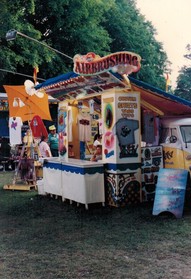
I also airbrushed scenery on several spectacular rides. The Himalaya was one.  I painted snowy mountain scenes with skiers in abundance on all the panels. The Rotor had been renamed the Black Hole. That ride received my painterly touch with images of the galaxy and dimensional lettering.

Over the years the park provided me with a great place to break up the jump from Florida back to Michigan. I left eighty-degree tropical weather each year and found the chilly spring time in Tennessee. Because of the permanent situation here, my signs lasted a long time compared to the beating my art received on a traveling show.

Mary joined me that spring in Chattanooga. We had a plan. She would help out and when the sign work was complete here at the park our T-shirt painting service would resume on the carnival midway in Michigan. 

We entered into our rhythm of horse care, sign making and living our lives together. We were very much alike. I was a workaholic who found satisfaction with my accomplishments. I aspired greatness with my horses. Mary wanted to belong more. When my work was over she wanted me to teach her how to ride Bingo.

The process of learning to ride a horse involves correction before the student starts to produce commendable behavior. I learned the hard way that my attempt to teach the skills of horsemanship to my love interest was not always a good thing to do. After listening to me point out flaws and make demands for her to comply with, Mary became sullen and retaliatory. All I could see was the goal she wanted and what was needed to get there. Those sessions contributed to our not getting along. Apparently, I was suffering from compound ignorance; I didn’t know that I didn’t know. I was not effective with cheerful support. Encouragement and reassurance would have been helpful. We also became aware that our drinking may contribute to the unrest. We had the pattern of drinking every day.

In the midst of this tension we actually agreed that our beer consumption was what interfered with our finding harmony. So, we agreed to not drink but we did not know how to not drink. Regular consumption had a stronghold.

As we attempted to be with each other and not drink, tension mounted. We did not know what to do. After several hours of this tension, we relented and went to get a six pack. Then we experienced an immediate sense of relief. The tension melted away as the amber beverage did its magic. Years later we learned about the typical symptoms that exist with alcoholism. This was one of them. We must have been in an embryonic stage back then. 

As Memorial Day loomed, the park prepared to open. We moved the horses out of the picnic shelter to an area where the public did not go. I moved the horse trailer behind the roller coaster and set up my canvas awning on the side to rig up a stable. This placed the horses near an area filled with grass. The coaster ride was silent most of the time I was there.

Because my two animals had bonded, I simply tied one of them up and let the other wander around to munch grass. They stayed in proximity of each other all day while I worked elsewhere.

As opening time for the park grew near, Jack and the coaster crew had to get their ride ready. The steel track had a thick coat of rust from lack of use all winter. Jack explained to me that when the train went around for the first time each year the rusty track slowed it down. If the train was too slow to make it over one of the hills, he had to climb up with a come-along and winch it over each hill. During the first coaster run of each year, Jack always kept his fingers crossed.

In preparation for the first run of the coaster train, I tied Bingo along the coaster fence and let Sassy walk free. At first, the roaring sound of the coaster train going down the first hill terrified them.  Bingo strained at his tether and Sassy ran away. A moment later the sound came from the other side. Jack was glad. The train made it all the way around. The horses resumed their grazing. As the days went by, the horses actually got used to the noise. They remained calm in the midst of this unusual racket.

I finished up all the sign work about the same time as the park opened. Lake Winnie turned into a bustling center of activity. Busloads of kids and cars filled the parking areas opening weekend. I enjoyed seeing my finished work adding to the fun. I enjoyed this time at the park and all too soon, it was time to go.  We bid adieu to our friends and loaded out. We headed toward my parents in Arkansas prior to going to the next work situation. The concessionaire in Kansas wanted me to create graphic paint jobs on his ice cream trailers and get his fleet ready to go.