
Although watching the kids tease my brother at school, in the Boy Scouts, and at Sunday school, caused contempt to form in me, on another level, I knew it wasn’t right. What they did wasn’t fair. I felt powerless to do anything about it. There were too many of them. But one day, I recognized an opportunity to turn the tables on their rude meanness.
My chance came one Sunday morning while at church. All of the children were assembled in the chapel before Sunday school. The boy sitting directly in front of me was mercilessly teasing and taunting my brother, who sat in front of him. During a time in the program when we all stood up, I stealthily removed the chair from behind that rotten instigator. When the signal was given to sit back down, that kid landed on the floor.
Though that significant victory was short lived, John’s presence was a constant source of frustration for everyone. Events of our childhood were punctuated with a series of mishaps caused by his lack of coordination. He fell once during an important trip to a notable church event where my father was being honored. Having split his lip, John became the focus of that entire outing. One moment we were at the sanctuary. The next moment we were at the hospital where he received stitches.
On another occasion, John went through the glass storm door at home instead of opening it first. That disaster required another hospital visit. Events like these kept John elevated as the central focus of the family’s attention. My frustration went unacknowledged. Personal fantasies of eventual grandeur became a constant deviation for me.
Homecoming Displays
As a child, I observed endless activities taking place at the nearby fraternity and sorority houses. Once a year they built elaborate displays to celebrate the annual Homecoming festivities that culminated with a football game. These displays depicted the university mascot, the tiger, doing a variety of things to their rival, and any number of other motifs thought to improve the morale of the school. Current events and popular songs also became themes. The “Purple People Eater” referred to the popular song of that time. Another clever idea was a huge cow straddling a simulated barb wire fence entitled “udder disaster.”
Not to be outdone, I imitated these efforts by building a homecoming display in our front yard. The first one occurred when I was six years old. I made a simple crayon depiction of a tiger, the Wittenberg mascot, on a large cardboard box. 
I learned to assist the college kids when their displays were being dismantled so I could drag building materials home for my use the following year. Gradually, I learned to sculpt chicken wire into the shapes of characters and stuff the holes with colored crepe paper. Each year my display became more sophisticated. Gradually my striving became mechanized, illuminated and by the time I was eleven, had an accompanying soundtrack that repeated a little ditty that Mom suggested and recorded the three of us singing: “Oh, hang ‘em up to dry, oh, hang ‘em up to dry, Ohio Wesleyan, Hang ‘em up to dry.” This recording played all weekend alongside my display of a mechanized tiger with a washtub.
Being bitten with the drive to create, paint and a dose of insatiable curiosity, my energy focused on a variety of personal ambitions. I explored the neighborhood in search of insects for my science fair project, salvaged components for my annual homecoming display, tree house or fort and developed components for my summertime circus production.
Like most little girls, Paula liked to play with dolls, toy ponies and aspired to compose stories. She once drew a comic strip with a pony as the main character. But she did not understand how to draw the hoof and ankle of a pony’s leg. That did not stop her. She simply made the lines of each leg go down to a point, and “Pinfoot the Pony” was born. She made several adventure comics books during her young career as a cartoonist with this clever equine personality.
We discovered a litter of kittens born in the window-well of a nearby fraternity house. This started our relationship with “lucky” the cat, who became part of the family. Later, our childhood was blessed with her four offspring we named “Salt, Pepper, Sugar and Cinnamon.” After having the litter of kittens, Lucky’s personality turned anti-social and sour. So, she was sent to a local farmer who needed a mouser on his farm and we kept one of her kittens. Pepper became a source of joy for the whole family for many years.
Mother loved singing and rose early to practice. After school, Mother was either teaching piano, voice lessons, or rehearsing for another upcoming opera. We had to be quiet while inside the house, so we learned to invent our own creative activities.
Dad planted a garden in the back yard every summer. One year I was delighted to find a herd of caterpillars devouring his parsley. I disclosed my discovery at dinner. My dad waited until I had gone to bed before thinning out my crop of caterpillars. The few that remained became plump. Then they found secluded places to attach themselves and transformed into a chrysalis. He knew about my interest in insects and found three one-gallon glass jars and placed a stick with a chrysalis in each one. Three jars, one for each of us to take to school.
In the spring of that year both John and Paula’s butterflies were born in their classrooms. Mine never did. I found out later that during the dead of winter my teacher had stupidly placed my jar on the steam radiator to keep it warm. You would think that a teacher would know that this organism was created to withstand the rigors of winter outside without any need for her help.
A year later, while in third-grade, the principal of the school came into our room, had a brief talk with our teacher and pointed directly at me and signaled for me to come with her out into the hall. Out in the hall, I saw two other students waiting with puzzled looks on their faces. We were taken to the gymnasium and given paints and brushes. We were then instructed to decorate the background scenery for an upcoming school play.
I became filled with creative delight as I immersed myself in this large project. At the end of the school day, I returned to my class room to find all my school mates crying. The television in the corner of the room revealed the reason. That day in Dallas, while I was painting, a sniper had shot and assassinated president Kennedy.
4th Lutheran Church
Our introduction to formal routine began early. Once a week, we were dressed in our Sunday clothes, with combed hair and shiny shoes. We walked with our mother a few blocks to a large grey limestone church. This church was filled with ornate carvings, a high arched and trussed ceiling with tall stained-glass windows depicting Jesus performing various miracles and praying in various settings. Our dad was usually away on Sunday making a guest appearance as a supply pastor at another church across Ohio or Indiana.
We sat in slippery wooden pews and fought to stay awake during the service. I learned to recite words of dogma with the rest of the congregation.
Words like exalt, repent, diety, beget and redemption were repeated often. I never knew what they meant but I learned to say them. The teachings did not come with an explanation. I had to guess. Do something today for an eventual payoff. I had trouble making sense out of the dynamic at the church. I had trouble relating how any of this could be good. The preaching was about brotherly love, doing good deeds for others, or the miracles that Jesus performed and forgiveness. I wondered; what about now? I was conflicted. I sat in Sunday school with the same kids that picked on my older brother.
After church, we changed out of our Sunday clothes. Then we had a treat. In the living room we would look at the Sunday newspaper funny comics. John learned to read first. I admired his ability to look at each panel and know what the characters were saying. All I could do was to look at each panel, study the cartoon image, make a guttural sound like I understood what was depicted and then go to the next panel. As the result of studying the Sunday Comics, I developed appreciation for cartooning as a form of storytelling.
Years later at church, I was selected to be an acolyte. Acolytes are the small people who assist lighting candles at the beginning of the ritual. Near the end of the service I would climb the secret staircase that went to a landing where a long rope hung. It extended through the floor to the bell tower above. When a bare light bulb came on, that was the signal for me to jump as high as I could and grasp the rope. My body weight pulled on the rope to get the massive bell up in the tower to move. After several attempts of jumping and pulling on the rope, the bell gained enough momentum to start clanging. This was coordinated with the end of the service. Hallelujah
We grew up during an ideal time. The fifties enjoyed the momentum of post war prosperity. Our urban, university campus neighborhood in Ohio provided the ideal environment in which to grow up. The neighborhood was dotted with fraternity and sorority houses, the central chapel, class and administration buildings always had something going on.
College kids were admired and considered “cool” with their Packards, Ramblers and Nash automobiles. Another admirable trait we noticed was cigarettes. Paula and I used to light the hollow stem of a dried lily and pretend we were smoking. The right mix of interesting features to explore on the safety of campus led to resources galore for the active imagination. These observations transformed into constant play.
Our two-story clapboard house was one of a curious accumulation of older wood, brick and stone homes in various architectural styles and arranged in neat rows on Woodlawn Avenue. Street lights and maple trees lined all the streets near Wittenberg University. Our home was made warm by our loving mother and fun by our dad.
Our living room was tidy, furnished with nice pieces of furniture from the old country and paintings by my great grandfather. Over the mantle hung an oil painting of an autumn woods scene with a babbling brook running through. This was painted in the 1920’s. The vista was pleasant to look at, spurned imaginative thoughts and wonder about the magical scene pictured.
A full-size grand piano dominated our living room. There was plenty of room underneath for us to play. In the safety of the piano, colored blocks in various shapes could be arranged and stacked in any way we pleased. Lincoln logs expanded our architectural options. Later, under the piano became the designated spot to set up the electric train. I fondly remember playing under the piano in my youth.
Many of the features in our home promoted fascination for children. A tropical fish tank in the fireplace was the focal point of our living room. The living room was also where the family gathered on Friday night. Dad was home from his travels. After dinner we enjoyed an evening together. The family gathered in front of the black and white TV and we got to know Red Skelton, Jack Benny, and Lawrence Welk while eating popcorn and drinking our allotted one bottle of pop per week.
History was made during that period. We saw astronauts land on the moon, heard the Dr. Martin Luther King speech I have a dream. And we discovered the phenomenon of the Beatles on the Ed Sullivan Show. While pondering the Beatles as we sat there, our dad complained about how long their hair was.
Every year we saw the television movie “The Wizard of Oz.” I still shudder to this day when I remember the part when the wicked old witch showed up on the screen. Paula and I would crawl behind the couch to peer around from behind while we continued to watch. When mother noticed, she asked; “would you like me to turn it off?” To which we screamed, “Noooo!” From behind the couch we continued to watch the movie in safety.
Our festivities concluded with a piggy-back ride where dad hopped and galloped each of us around like a horse. The ride trekked outside, around the house, back inside and up the stairs where I was flopped into bed. When the giggling finally subsided, I went to sleep with a big smile on my face.
Each night at bedtime mother would recite a poem after tucking us into bed.
As she descended the stairs, we heard; “good night, good night, far flies the light.”
Then she clicked the hall light off.
“But still God’s love, will shine above, making all bright, good night, good night.”
Dad engineered a project to expand the size of the house. He enlarged the basement, remodeled the kitchen, dining room and added the master bedroom. The huge steam shovel that came to the backyard to dig the massive hole become a source of fascination and wonder for the children in the neighborhood.
Our improved kitchen included a dining area on the main floor. The kitchen cabinets were of a white “pickled” wood finish and the central location of the main sink capitalized on the view through the glass on the back of the dining room area, a feature my parents included in every house from that point on. Fascination with fish seemed to be an obsession. Two guppy tanks sat on the island counter that divided the kitchen and dining room and tanks for breeding guppies also populated the basement.
Our father was a strict idealist, a perfectionist with whatever task he was immersed in and difficult to please. Dad was deeply involved in his work and with projects around the house. His stickler characteristic facilitated admirable results for his efforts, but frustrated us with his observation and remarks about our adolescent attempts. Not noticing emotional needs, our dad’s constant dissatisfaction with our best work developed into a frustrated, bereaved defiance. The feeling of being misunderstood and less than esteemed, combined with the frustration of our older brother’s behavior that promoted distance and an apathetic outlook on life.
My father was relentlessly creative, adventurous and driven, always adding one more task to the moment he was in. His already busy schedule stayed full, establishing an ongoing need for his mantra; “hurry up or we will all be late.” A strict perfectionist is perhaps the best way to describe him and his expectation for me. This characteristic set up a positive quality for his creative output, yet manifested a frustrating inability for me as a child, to ever measure up.
He had started building a large train layout, painstakingly built to scale with brass track to showcased his perfectionistic tendencies. This filled the new enlarged room in the basement. His love for trains had been encouraged by friends from his first church assignment. As I grew, he noticed my genuine interest in playing with trains. Seeing my interest, he realized it was not appropriate for me to play on that beautiful layout. So, his scale layout was dismantled and sold to make room for me. He supplied me with toy track sections I could play with. I filled that big table with my versions of a layout. This was evidence of his big heart.
Following in his footsteps, I became creative, fun loving, and driven to produce. Due to the frustrating dynamic in our family, having a handicapped older brother and the negative attention he received in our neighborhood, I avoided becoming social.
Kindergarten compounded the chaos, especially on the very first day. Being dropped off by my mother at school was pure terror. I saw only a few recognizable faces, the same ones who hated my brother. I settled into a resigned routine of compliance. Immersed into that adolescent humanity increased my tendency to withdraw. Although reluctant socially, I had an inner desire to reach out to others but could not seem to act on it. Something seemed to have my voice.
The inclination to create artistically showed up early and my mother noticed my gift.
One day upon returning home from Kindergarten, my mother asked, “what did you do in school today?”
I flatly stated, “Oh, the teacher made us paint something,” and casually handed her the paper I had been carrying.
She gazed at the watercolor painting and was amazed that it looked like a bowl of fruit. She knew then that I saw more of what was around me than the others.
I became a creative dynamo and was encouraged with sketch books, painting classes, piano lessons and hobbies in the workshop. I also exhibited the perfectionistic tendencies of my dad.
As we learned our ABC’s I discovered the way to spell Hi. I soon adopted the pattern of secretly drawing “Hi” on the chalkboard. This became a habit that I extended to most papers, walls, my school supplies and eventually, in text books. One day the teacher reprimanded me in front of the whole class.
“Knoderer,” she pounded her fist, “If I see another “hi” around here on something, you are going to be in big trouble,” as she pointed at me.
All that did was motivate the rest of the class to begin marking “hi” on everything they could think of.
I decided to not walk with my brother to school and expose myself to the concentration of kids who consistently teased him. The walk to and from elementary school became somewhat of a daily horror.
I recall one morning seeing in the distance ahead, a circle of children taunting my brother John, who spun around extending his clarinet case at arm’s length as a weapon. I later learned that in preparation for the walk to school that day, John closed the lid of his case on a drawing compass with the sharp metal point extending out. If contact had been made with any one of the harassers, an impaling injury would have occurred. There was no justice in childhood. John was all alone, just trying to fit in. He had few friends. I being like the rest, avoided him.
Play Time
Paula received the usual gifts for a girl, a Barbie doll, fabric to make doll clothes, games and toy kitchen cooking stuff. John received a belt tooling kit, games of which he was especially fond and books about math and music, along with socks. To encourage my creative tendencies, I received a heavy package that contained an Erector set. Inside were pieces of structural metal, bolts, axels, gears and a motor that could be configured in countless ways. This aggregation of building components would facilitate many projects. I also received a seed planting kit, socks and many how to draw and paint books.
Crayons, paints and sketch books were abundant in our home as creativity was encouraged by our parents. Even though she had dolls and girl stuff, Paula liked boy stuff too. All in all, the foundation for happiness was alive and well in our home and the relentless creativity coming from our loving parents couldn’t help but be contagious.
During our frequent one-on-one, Mother taught me to pause and review something special from the recently viewed movie, event or story I had read. She then invited me to select and share with her my favorite part. Little did I know at the time that I was being groomed to become a seeker of goodness, pursuer of positivity, and appreciator of what the original artist or author intended.
As children, we had an ambition to play outside with toy trucks. Our father cleared out an ivy bed next to the garage so my sister and I had some dirt to play in. A short retaining wall separated the terraced back yards and made a perfect highway for our vehicles to travel upon. As our village in the dirt took form, made from accumulated findings, Paula assumed being in charge of paving the roads that threaded through our town. By heaping up dirt and smoothing out the top with a slurry coat of mud, Paula perfected the process of paving the roads that threaded through our miniature town. Paula earned the nick-name “mudder” at the same time! As we grew, the pattern of conjoined creativity expanded to include a variety of productions, the first of which was a backyard circus.
Tragedy
When we were little children, an event took place that was monumental in our development. Paula was alone one day, inspecting the old ceramic figure brought from Germany that our great grandfather used to keep cigars in. This was in a forbidden area for children: the living room glass display case with other valuable mementos. She was fascinated with the details of the robust woman’s figure and the period garb that lifted to reveal the contents. I saw my sister in passing. Although I knew that wasn’t a good idea, I was just as curious about what she had found. John came bounding along and recognized the breach.
“Put that back!” he attempted control.
“No,” Paula chimed, “You can’t make me.”
He became bossy and told her to put it back, “I’m gonna tell.”
This only promoted resistance to his demands. When he reached for the container, Paula drew back and it fell, breaking into a thousand pieces.
When mother discovered the three of us and the broken heirloom, we were sent to our rooms, to await the wrath of dad when he got home. The task of doling out discipline with a spanking was his to deliver.
When dad got home and learned that we had broken this valuable item, he headed up to our rooms where we waited. After climbing the stairs, he reprimanded my older brother first. I heard screaming and crying as his bare bottom was spanked. I was terrified at what was coming. My dad came into my room and even before it was my turn, I screamed and yelled in terror. Then I cried as my backside received punishment.
When it became Paula’s turn, not a peep was heard. She received the same punishment but didn’t react. I learned later, as an act of defiance, she made the decision to not to feel anything. She felt that the punishment was not deserved because she blamed our brother for the breakage. From that point on, I saw my sister go through life cautious about others and her feelings. She was always reluctant, avoiding any emotional extreme, whether it be happiness or refusing to cry when sad. She essentially maintained a flat line emotionally, for the rest of her life.
Circus Day
As a tyke holding my mother’s hand, while walking onto a grass lot, I saw my first canvas tents in the air with flags flying. I heard the tinny voice of the side show barker over a loudspeaker mix with the distant sounds of roaring lions, the exotic smell of elephants, cotton candy and popping popcorn.
While taking in this sensory overload, I heard my mother confide, “Your dad would love this.”
I was sold on the spot!
I was inspired by my dad’s love for many things. My dad loved railroad trains, photography, dirigibles, and the civil war. Later, I would hear about the circus of his youth. I savored the stories about the remarkable sights he witnessed during the summer when he was a boy. He woke before sunrise to gather with the other boys at the railroad tracks to wait for the circus train to arrive. When the distant headlight first appeared, its piercing light provided the first spike of excitement.
He told me about the early morning feast for their eyes as the circus train moved into position and started the unloading process of wagons, horses, trucks, elephants and special equipment from the flat and stock cars. This process took place with amazing fluency. He watched an incredible enterprise populated with hundreds of people, portable objects of wonder and animals of all kinds unload destined for the show grounds.
A beehive of activity resulted in a canvas city rising into the air before noon. An entire spectrum of preparations were completed by a predictable time. The two shows; a matinee and an evening show were given the same day. After the second show, the entire aggregation was taken down and reloaded on the train. When complete, a steam locomotive began to pull this amazing collection of everything wonderful out of town and into the dark toward its next destination.
Although not the big railroad circus, this version traveling on a fleet of trucks that came to our town was amazing none the less. After seeing this big top circus, I became keen about seeing it every year. When summer came, I began to look for circus posters in store windows and on telephone poles.
Imprinted with the same love my dad had for the circus, I began my pattern of getting up early to see the morning arrival of the Clyde Beatty-Cole Bros Circus, the large canvas big top truck show that made a regular visit to our fairgrounds.
As I grew, I became able to get a job helping set up the tents early on circus day. Then after seeing the show, like my dad before me, I was inspired with the idea of producing an even greater circus production in our backyard.
I created apparatus for my backyard circus and painted the decorative advertising that goes with such a production. I was shaped by new thought, old tradition, love and enthusiasm to find adventure with my creative outlet.
Each summer I produced a different revue. The usual circus performance was made up of children recruited to perform various acts – clowns, trapeze and acrobats. One year, I made cigar box guitars and a potato chip can drum set for a Beatles concert.
After receiving a chemistry set and becoming familiar with several sensational experiments, my best friend Arnold Vila helped me create a show called “Chemistry Magic.” Working with limited resources didn’t slow us down. One demonstration aptly called; purple smoke was produced by cooking iodine crystals over a Bunsen burner. Because we used the same beaker later in the show we had to cook off all the crystals until gone and the cloud of smoke produced almost asphyxiated our audience.
Even though I felt my shows were worth every bit of the dime I charged, my mother always served Kool-Aid and cookies to everyone who attended, so she knew they got their money’s worth.
A blend of these creative activities coalesced in all sorts of childhood endeavors that included display building and painting artwork on virtually everything that moved. After discovering my dad’s boyhood model circus wagon building efforts, I began building my miniature circus from scratch.
Adolescent Society
I grew and excelled on my tricycle. John’s handicap pronounced his awkward nature. As the other kids noticed his clumsy efforts, they teased him mercilessly. This was my first exposure to ridicule in the outside world. I became cautious around the other kids in the neighborhood. They were cruel.
That didn’t change the desire in John’s heart to attempt join in on the play he saw. Perhaps the missing social cog in his brain was a blessing. Instead of being affected by the mob mentality of the kids on our block, he seemed to remain in his own little world.
As I grew, I graduated to a bicycle. I developed a fearless nature on two wheels and explored our neighborhood. John still rode his tricycle. You could see he still wanted to take part in the fun he saw taking place around him.
In an effort to speed things up, he stood on the platform between the rear wheels of his tricycle and pushed with one foot. That way he could keep up with the gaggle. But what about when he needed to stop. He had no brakes. John figured out that by dragging one foot, toe down, against the sidewalk, he could slow himself down. The system worked fine until the leather of his shoe wore through and his toes were exposed. As he continued with this system, he had to curl his toes up more and more inside what was left of his shoe. When dad got home and saw the front of one of his shoes worn off, he exploded.
Such was life with John. Observing what we considered to be his uncoordinated, awkward and less than brilliant mishaps, I unconsciously joined the others in criticizing my older brother. Yet, in spite of the growing separation of the fabric of our family, John developed an uncanny intellect. He began to compose rebuttal to all of our taunting.
John’s response to the teasing fueled rage and transformed into hatred. As his brother, just trying to find my way, I observed these senseless, ugly social interactions. Virtually overnight all the people on the planet appeared to me to be cruel and that prompted my decision; I will be better off alone. I became determined to figure out how to do everything by myself. This decision set the stage for my reclusive, driven desire to create, and became the pattern for my life.
916 Woodlawn
With three infants at home, opportunity knocked. Father took a job in Springfield, Ohio, and moved the family. Dad’s role in Ohio became public relations advocate for Wittenberg College. While there he continued as a supply pastor for the Lutheran synod, and later, a fund raiser for the Osterlein Home for Children. Dad created slide show presentations, had meetings with influential patrons and produced sermons in churches he traveled to across the Midwest. This path capitalized on his talents as spokesman and problem solver and took him on the adventures across the Midwest he loved. Taking to the highway in his Pontiac, the wanderlust that filled his imagination became a trait he eventually passed on to me.
As the wife of a pastor, mother coped with dad’s frequent travel by becoming the choir director for the Fourth Lutheran Church just a few blocks away. Also, during her eleven years with the Civic Opera in Springfield, Ohio, she sang the leading roles in at least three operas including “Samantha Southwick” and “the Old Maid and the Thief,” and supporting roles in many others. She also taught piano as the head of the Junior Piano Department at Wittenberg University for eleven years.
Dad’s work with the university and the Lutheran synod took him across Ohio and Indiana. When I was a child, dad was gone during much of the week. Mother managed with three children and her career with the help of a live-in student of Wittenberg University. Due to her active career in the Opera and with singing groups, mom never developed cooking skills. My father actually taught her how to cook an egg. In addition to all the duties of family and career, mother did the meal planning in advance so Sue Feidler, our nanny, could simply place the stuff in the oven when she got out of class and have dinner ready at the right time.
Mother’s values and personality were formed during the depression when her family occasionally went without food. We were taught to have regard for every morsel on our plate. Dad appreciated her thrifty nature. They shared a special moment with each other when dad brought pastry home, something she considered pure luxury.
We ate at a properly set table. All the plates sat in front of father who, after the blessing, served what mother had prepared and passed them to us. We were taught to sit up straight, how to use our utensils properly and use good manners at the table.
To encourage us to appreciate her cooking, dad enrolled us with exuberant patter to get us to eat whatever was left in the serving dishes.
“Help finish this off,” he would say, as another serving of something was placed on our plates, “Here, have another bite.”
Eager to please my dad, I learned to eat everything on my plate.
I did my part to finish that extra spoonful, but my sister had a different response. She too, was encouraged to eat everything. Yet, once having eaten it all, rather that receiving accolades, she heard, “here, help finish this off,” and an extra portion of mashed potatoes were plopped onto her plate. In disbelief, she became really disappointed. The inner thought “this is not fair,” welled up inside her. She became silently rebellious. Unknown to us, defiance became the foundational force that drove her personality.
Did Picasso Start This Way?
Harried and disheveled, she encircled the house. The green and yellow mid-length sundress, in style during the fifties, was a blur. A stiff, fall breeze brought with it, a nip and spiked urgency in her current task. Along the perimeter, she noticed that the painters had left ladders leaning up against the house, and one near the front porch. Paint spotted canvas tarps spread over the bushes flapped in the frigid wind. She stopped momentarily to review the scene. She noticed a warm shade of parsley colored paint. Redecorating began to cover-up the weathered white clapboard siding. This was my parent’s first house; the color promised to transform their purchase into a warm abode they could happily call home.
But nothing was going as planned with the painting project. Words of discouragement and frustration were not necessary as anyone could see the disappointment in mom’s eyes. For the workmen didn’t show up when they said that they would. And the removal of the old peeling layers of paint didn’t meet her husband’s approval.
Unfortunately, he was initiating a mission congregation for the Lutheran church. His job came first. He would be away all day. To add to his wife’s frustration, she had three children in diapers.
Sometimes mother thought that nothing was worse than managing the innumerable home improvements without father. At other times she didn’t seem to mind. As it was becoming clear, it would be longer than they said before the painting was finished. As she had these thoughts, her white canvas tennis shoes gingerly stepped around things the painters left out in the open. Her ongoing property management review was a source of frustration at the end of each day.
Behind the single car garage, mom found the painting crew wrapping up. These men had full gallons and, a few half buckets of paint, rags, stir sticks, jugs of solvents strewn with empty cans of every shape and size.
The taller of the two workmen rose slowly from his squatted position in the proximity of a bucket full of thinner. He washed his large brushes at a leisurely pace. This act commenced the final act of his workday. His white coveralls were spotted with paint. He paused from what he was doing and looked up as my mother approached them. His attention was clearly focused on his impending departure. His short partner had a dark mustache, curly hair with a receding hairline and a soggy cigar stub in his mouth that had been there all day. Sitting on the tailgate of their old pickup truck, he gently manipulated his brush back and forth in an old towel; evidence that they were knocking off early.
“You men make sure you put all of this paint away somewhere,” Arleen pleaded. She made a sweeping gesture with her hand that held a large safety pin. They displayed the deer in the headlights look as she spoke. Her tone was urgent and peppered with annoyance. Partly because this job wasn’t done yet.
“Yeah, sure lady,” the short one offered, as he exchanged a look at his partner.
“I’ve got young children here. I don’t want them getting into this paint,” she continued as she surveyed the painter’s inventory.
A loud wail from a baby pierced the quiet afternoon and my mother veered back to the house. Moments later, the workmen were in their truck rolling down the alley. They had left their supplies right where they were, so they would be handy the next day.
My dad’s quick pace up the front steps occurred prior to dusk that day. His pressed shirt was tucked in and had a special fold on either side that was still crisp at the end of the day. Every hair was held in place with Vaseline hair tonic and his oxford shoes were highly polished. Well-groomed and beaming, he was anxious to share with my mother how his church activities had progressed that day. When he found her sobbing in a heap, his demeanor changed to caring concern. My mother was emotionally spent. She was normally optimistic and filled with sweetness and gratitude for life. She had reached her limit. She simply did not know what else to do. The regimen of processing diapers, managing the household and pursuing her musical career had taken its toll on her patience. This day threw her into a sobbing heap.
“What’s going on honey?” dad inquired.
Not feeling fully in control, all she could do was point to the backyard.
He quickly left to investigate. Behind the garage he found us and what a sight this must have been. My older brother had found a fascinating pastime. He was very observant after he learned to walk. He had watched the workmen slowly paint the outside of our house. And as a result, he had something to share with me. So, I had willingly followed and crawled along behind him to see the amazing sight.
I was amazed. The backyard held a vast inventory of liquid color. My brother found a six-inch paintbrush and proceeded to show me what he had observed earlier in the day. Holding the brush, he demonstrated what he had seen the workmen do. He dipped the brush to the hilt in the paint. I was proud he had a command of this profession at such a young age! With paint dripping down his fingers from the brush held high, he looked for a suitable canvas. Apparently, my giggle of approval inspired him and I was selected to receive a thorough coat of green paint. The brush strokes were deft, effective and stimulating and soon I was fully covered and barely recognizable.
My brother had spills and drips across his lap and paint all over his hands, arms, bottom and feet when my father discovered us. I proudly displayed a complete coat of paint that would have made any artisan proud. My dad secretly smiled at what he had found: a colorful disaster.
My father settled into the inevitable clean-up. He tried but failed as the family disciplinarian. His careful qualities were appropriate now. He took solvent and rags and began the procedure. His heart went out to his little sons and the mischief they had created.
As time passed, remembering the event became a source of humor for my family. Not only was this a funny point in our lives, the event imprinted me positively. In hindsight, I have plenty to be thankful for. My brother was thoughtful enough to introduce me to the joy of painting.
I’m Glad I Called
“What’cha doing?” I asked innocently in an effort to start the phone conversation.
“Oh, David,” My mother bubbled, “I’ve been having the most wonderful time.”
She went on to explain that during a recent visit, my sister bagged up a bunch of clutter from the attic but before the bags were carted off to the dumpster, my mother wanted to have a look inside. If her enthusiasm was any clue, the discovery she made was significant. Next came the announcement that she had found all the sheet music from when she was in the quartet “The Melodears” back in Chicago in the mid-forties, before she met my dad. Walking on air, she leafed through the cherished musical scores, relived memories of her youth and sang those wonderful songs.
“What timing,” I thought as I listened to her happy story. She went on to tell me she also found a music professor at a nearby university interested in having the antique sheet music for their collection.
“That,” she said, “is much better than all this wonderful music landing in a dumpster.”
The pleasant surprise of finding my mother elated heightened my gratitude. I am fortunate to have a sweet, joy-filled mother. She looked for the beauty that surrounded her every day. Since my father’s passing, I knew she was lonely. I began to call her twice a week. My intention was to provide comfort. Each conversation revealed more to love. As the months went by, we became good friends.
My interest piqued, after a moment I asked when her love for music began and about memorable achievements along the way. She perused the thought, giggled and began to tell me a story.
The first official announcement of her career intention occurred in homeroom class during the height of the great depression. The fifth-grade teacher went around the room and asked each student what he or she wanted to do with their life.
When Arleen’s turn came, she stood and said “I want to sing” and the whole class burst out laughing.
She started with voice lessons. Soon she was in both chorus at school, choir at church and sang occasional solos. Soon with Amy, who became her longtime friend, she became part of a duet.
After High School she received a scholarship to attend the Sherwood Music School. During WWII at the first FM radio station in Chicago she became the program director. She selected peppy, vocal-free music for her program ‘Music for War Workers’ from a library of 78rpm records and even larger commercial discs.
While working at the radio station she also sang in a trio at church. Encouraged by one of her friends, an audition downtown secured a position for a rigorous season with the Municipal Opera of St Louis, where the company performed a new operetta every week. The following year a tour with the Chicago Popular Opera Company took her all over the country and to Denver where the company fizzled out.
Back in Chicago, an audition with an agent started a tour of state fairs and school assembly programs with the ‘Charm Quartet,’ a trio of vocalists with piano.
Becoming independent, the group became the ‘Melodears.’ At a church mortgage burning celebration she met the student intern assistant to the pastor who ended up also being invited to the choir party later on, but he needed a ride. Since my mom had a car, the girls went to pick him up and the rest was history.
Our regular telephone conversations covered a variety of topics. My life on the road provided plenty of news to share with my mother. Plus, many aspects of my path of recovery from alcoholism found similarities with the spiritual path mother was on. I found new fascination with this woman I have known my entire life. I continued with the interview style of call she enjoyed and I learned more.
As the wife of a pastor, my mother became choir director for the church. During thirteen years with the Civic opera in Springfield, Ohio, she sang lead roles in two operas; ‘Samantha Southwick’ and ‘Old Maid and the Thief’ and supporting roles in all the others.
My favorite memory as a child was waking to the sweet melody that drifted upstairs and into my consciousness every morning. Mom rose early to practice singing her scales at the piano. This early imprint established my enthusiasm for the morning and for all the new day brings.
She taught piano as head of the junior piano department at Wittenberg University for eleven years and later when we moved to Bloomington, Indiana she taught piano and voice as well as when we lived in Arlington Heights, Illinois.
When my folks built their retirement home in the Ozarks of Arkansas, her piano playing and singing continued. At age sixty-six she began as a paid soloist at the Christian Science church and continued singing in that role for twenty years. As a testimony of the joy in her heart, she was still singing professionally at eighty-six. During one of our conversations she laughed.
She shared something with me that her voice teacher back in Chicago told her during her early teens; “if you take good care of yourself, you will still be singing at sixty-five.”
My mother’s example made me think back to the sequence of events that molded my career. As the years went by, I grew artistically, spiritually, emotionally, and my motive changed. At one time I was ego driven to be the greatest I could be. Now I realize that true satisfaction is the byproduct of being of service to others. My passion for painting is evidenced by the amount of completed work that continues to this day.
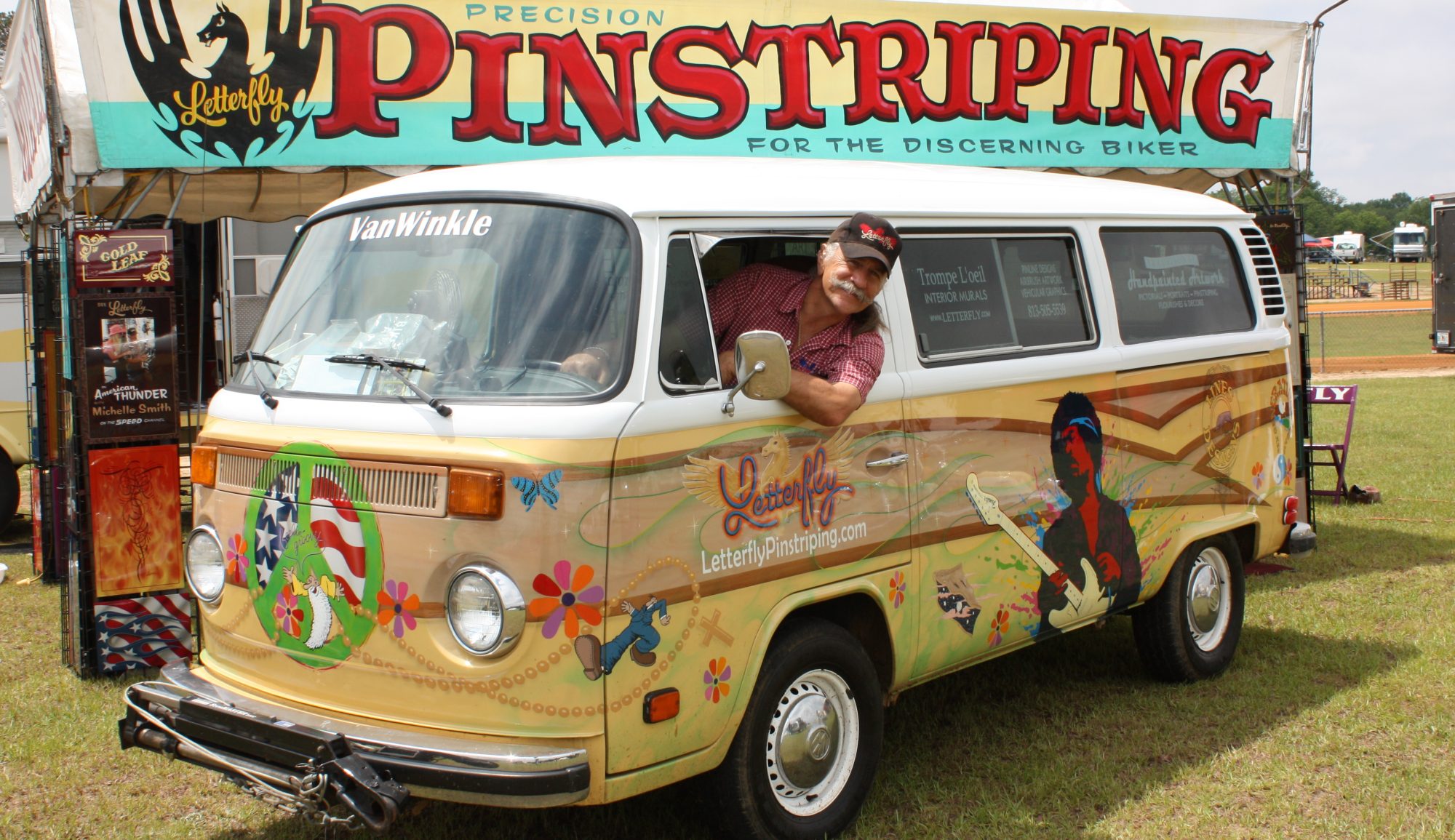
With each passing year, the amount of old time pinstripers and airbrush artists diminishes. This leaves a larger market to a few artisans who thrive creating in the century’s old tradition. One decade at a time my mother’s career was revealed. Like her, the sequence of events that take place continues to reveal new direction in mine.
My mother’s relentless optimism, singing and efforts to inspire others provide me with clarity. My goal is similar; to be a blessing to others, to have fun while interacting with them and to share the gifts I have received. This in turn creates memories for other people to cherish and enjoy.
As I pause this day to appreciate the beauty I am surrounded with and the wonderful people I am of service to, the peace inside increases the level of joy in my heart and I feel like singing a happy tune, just like my mother.
I am glad I called.
 Letterfly Writes