Music City

Upon arrival at the large convention center, I found several dozen Wanderlodges included Duane and Mae Jean’s coach. Theirs was the first one I duded-up back in Jackson. I became immediately busy. I lettered inscriptions, monograms and images of all kinds for their friends.

Because of the link to school busses, the Wanderlodge had a flat, front-end cap over the windshield with an area for a name to go. Similar to the phenomenon with boaters, these couples each dreamt up a name for their beloved coach. That meant work for me.

I lettered names like ‘Bird of Play,’ ‘No Reservations,’ and ‘Iron Bird.’ One coach name referred to its main color ‘Mauvelous,’ and there was also ‘Blue Thunder,’ and the ‘Blue Bird Inn.’  Those quarter million-dollar coaches were pure luxury. In spite of the obvious opulence, these ego-driven folks kept thinking of additional things to make their coach even more special.

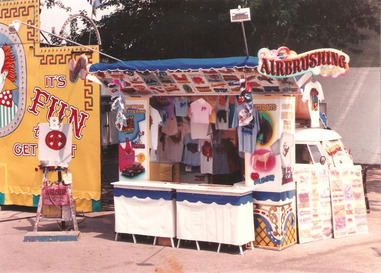
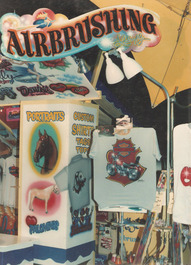
My affluent clients wanted a monogram or a fancy coat of arms on the side and often requested gold leaf. The talents developed as a sign man, antique fire engine gilder, carnival decorator and airbrush artist came in handy with these folks with their appetite for custom works.

Each evening after the long day of delicate paint work, I attended the formal dinner prepared for all in attendance. This gave me an opportunity to network and meet new clients. Many of these couples invited me to come to their home to do the work. This became an emerging pattern of my service to these people. 

I found a new manner of living life revealed a little at a time as I responded to the requests I received from this group. When these projects were complete, I returned to Michigan to prepare for the Jackson County Fair.

The Crazy Dance

Back in Michigan, rather than pursue sign work in Jackson, partly due to the lingering heart break, I sought the friendlier situation around the Elliott Amusement company.

By this time Red had purchased a new major ride. This gave the little show a big, elaborate piece for their summer route of fairs. Plus, Red had a nice piece of equipment to take to the big independent fairs across the country. The ’Crazy Dance’ was a round set of sweeps with tubs dangling between the ends. The entire structure was mounted on a center that had a lift arrangement that would oscillate the whole thing for a unique experience. The controls for revolution, speed, lift and center revolution were operated individually to provide the outer ring of passengers a custom undulating experience.

Red loved this ride. And, so did his crew. He had fun selecting a great song and choreographing a slow, up and down sensation in time with the music for the beginning of the ride. He simply lifted the table and activated the revolve feature with finesse. Then as the song gained impulsion, he turned on the revolve motors and gave them a fast, hectic ride.

He especially liked the Stevie Wonder song, ‘I just called to say I love you.’ While that tune played, he operated the ride in a special way that created an equally wonderful experience for the passengers in time with the music.

His annual route evolved by this time to start mid-winter in south Texas. He bought a winter quarters in San Antonio and traveled west to the big fairs in California during late winter and spring. Then he jumped to Michigan. Spending the summer in Michigan with this spectacular ride on the little show gave the show a big boost. As usual his enthusiasm was infectious and his help was filled with a similar zeal. His business partners had a similar positive attitude.

Tim Bors started in this business as a teenager with ‘Spin-Art,’ – a record turntable modified to lay a piece of cardboard on where the customers squirt paint from condiment bottles onto the spinning card to create a modern art effect. From this simple beginning, he accumulated a fleet of games and rides. He was an aggressive showman with a clear vision of what he wanted. His slogan was: bigger, better, brighter.

Every year he added another game to his line up and in his position as a full partner on the show, he also began to acquire rides.  Although he revealed his request for the next painting to me months in advance, I wasn’t completely privy to all of his plans for the future which logically pointed toward owning his own show.

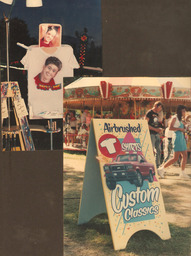
I kept busy creating spectacular paint jobs that summer. When the fair season began, I included my T-shirt booth in the show’s lineup. Before that happened, I excused myself and went to Nashville to attend a regional Blue Bird rally.

Rosalind

Because my role as a sign and mural painter took me away from the horses, I formed the idea of a mutually beneficial situation for them. A situation where my horse would receive regular exercise and somebody else shared the expense. One concept was a share, or ’lease’ arrangement. Essentially, another person pays board in exchange for the privilege of riding him. The benefit was exercise and care while the other person enjoyed him. I did not want anyone who would interfere with my specific ambitions with horsemanship. I sought someone who would simply ride.

I put an ad in a regional horse magazine. I met Rosalind as the result. She enjoyed competition trail rides and because she was tall, she wanted a tall horse. We entered into what became a satisfactory arrangement.  My horse and mule spent the summer months near South Haven with Roz.

Roz had an Australian outback saddle and a two-horse trailer. She took Souveran on long rides and that helped keep him muscled up and bright while I was away creating beautiful paintwork.

During our occasional visits made between rallies and festivals, she reported things discovered while riding him. When the trail rose to a clearing and they could see for miles, if he saw another horse way off in the distance, his desire was to catch up and pass the other horse.

Occasionally she’d borrow another horse and we’d go on a ride together. There was a place north of South Haven where we could park her horse trailer, unload and ride our horses down a steep bank to get to the sandy shore of Lake Michigan. We enjoyed this opportunity to expose our horses to new sights along the shore.

 At first, I attempted to ride Souveran into the shallow water, but each time a wave came in, he quickly side-stepped to avoid the scary wave that came at him. Gradually, I coaxed him into deeper water. These new sights and experiences with my new friend were fun.

Sharing my horse with Roz freed me up to pursue the emerging market I had found. Creating airbrushed murals on motorhomes was an opportunity that required extensive travel. 

For several summers, the horse stayed with my friend Rosalind in South Haven, who rode the trails and kept him muscled up. Roz ran a beauty shop and over the years of continuing this exchange, we became good friends. I returned to the Elliott Amusement Company to paint festive works of art until my brief excursion to the Blue Bird rally. When their festival route started, I returned to set up my T-shirt painting booth.

Heading North

I motored north with my entire entourage in the spring. I stopped in Fort Valley, Georgia and placed my portfolio of work created over the winter on display at the Bird’s Nest. Two Wanderlodge owners intercepted me and described the inscriptions they wanted on their coaches. I jumped right on those projects.  I also found out about the upcoming Blue Bird motorhome rallies. I made plans to participate at one rally in central Tennessee early summer. Then I resumed my trip. 

During those days I used an answering service; a company where my phone number rang. They jotted down each message received and a phone number for me to call back. Having a phone number became necessary when I launched my sign business in Jackson. Now the service became especially valuable as I served the itinerate motorhome clientele.

I received a phone call from Decatur, Indiana. When I returned the call, I discovered the caller had found out about me through a couple who visited River Ranch. Randy wanted me to stop by the Fleetwood RV plant to paint an eagle on a brand-new motorhome for one of their guests.

“Yes, I will be happy to do that,” I stated, “but I have a request.”

“I need a place to stable my horse and mule.”

“No problem,” came the reply, “one of our guys has trotting horses.”

I then received directions to an old farm south of Van Wert. The next day I arrived at Jeff’s farm, got the stock settled and parked the rig. Jeff filled me in on the details. I made preparations to go to work with my new friend. Early the next day, I made the commute with Jeff to the Fleetwood plant.

The flagship of the Fleetwood RV fleet up until that time was the ’Limited’ a medium size, gas-powered motorhome. Fleetwood had just developed their first forty-foot diesel-pusher and named the new product line: the ‘American Eagle.’ The transom of this coach had a big blank spot.  Among the first customers who bought this state-of-the-art motorhome off the assembly line was a customer who wanted an airbrushed mural of an eagle on the back.

Although the vast Fleetwood operation covered hundreds of acres in several locations around Decatur, the service facility where customers brought units in for repair was a small four stall building. A dozen technicians scrambled to complete a variety of projects while I received orientation for this project. Soon my step ladders and work plank were set up behind a motorhome. I got the surface cleaned and scuffed. I made the colors I would use. Soon I was up on the plank laying out what became the first eagle of many created for this genre of coach owners.

I started with the depiction of sky and mountains. When complete I worked on the details of the eagle. When the image was complete, I had a concern about spraying clear-coat in the service bays but Randy assured me that would be just fine. I sprayed on the clear protective layer.  The bays were filled with the fog of my efforts. All the doors were open anyway and the breeze pushed the cloud away. The customer beamed. He was pleased with the results and my reputation received a big jump start with this segment of the RV community that day.

I found out about a Fleetwood rally that would take place early fall in the Smokey mountains and made plans to attend. After bidding my new friends’ adieu, I returned to Jeff’s farm. I made the last of my preparations, loaded the livestock and headed north. 

Dorita Konyot

The winter season was over. I packed a lot of activity into the month of April. I had time to pursue my passion. One day after rehearsing my acts at the ranch of Doris and Russ, with great costuming for the act was underway, I drove to Sarasota. I did not go back to John Herriott’s ranch. He was up north working his Shrine Circus tour. I went to find Dorita Konyot, whose father brought dressage to this country from Europe years ago and, interestingly, inspired and mentored both Vi Hopkins and Chuck Grant. I wanted to talk to her about my horse and perhaps show her what I had him doing.

Dorita had a small farm outside of town. I drove the VW bus to her home. After I pulled into her driveway, I saw a short house on one side of the property, a riding arena in the center and a long horse barn stretched across the back. I knocked on her door. When the door opened, I met a short, proud woman and immediately noticed her deliberate manner. Her long hair was neatly bundled into a top-knot, the smoke from her cigarette made lazy, rising loops, and she had a little dog in her arms.

I introduced myself and made my request to show her what I had my horse doing and to possibly become her student. She thought for a moment and then suggested a time for me to return and make my presentation.

I returned at the appointed time. With my rig parked in her driveway I prepared my horse. In the riding arena on her small farm, I put Souveran through his paces. Dorita looked on as she sat in the small observation booth with a thatched roof.

After my exhibition, I cooled down the horse, removed the saddle and gave him a break. I turned him loose on her pasture. She invited me into her home for strong coffee and to ask questions about the training I had received thus far. After listening to my answers, she pondered how to proceed. She made several conclusions as the result of watching my demonstration, among them was that I did not know how to use my legs properly. To begin my training, drastic measures would be taken first. 

Soon thereafter, my lessons began with Dorita without spurs. The primary emphasis stressed was the proper use of my legs to direct and bend the horse. She began with a careful explanation of how the rider’s legs were supposed to be on the sides of the horse. She used the visual explanation of pouring oil on the horse’s back and how the oil moved down each side. The oil was on the location of the rider’s legs but there was no pressure. The legs were to always be on the horse with no pressure and never lose contact. Dorita started with this foundation.

I learned minute movements had impact that influence the horse and promote impulsion. It would be two years before Dorita let me ride with spurs again, and when I did, I used them with finesse.

Our sessions continued with the lateral disciplines of Traver and Renvers. These are used to develop specific muscle groups in the horse that, once enhanced, enable the ideal engagement or stance of going. The shift in the distribution of weight allowed for a lighter more elevated forehand.

When Dorita was satisfied with how I handled my legs without spurs, we practiced the portions of the dancing horse routine that were enhanced with quiet and effective leg use.

With a minimum of signal, while my legs held the horse in the promenade, or proper posture, front leg extensions became more animated without interrupting the most important part of this movement which is the forward momentum.

Dorita learned horsemanship from her father, a gruff and demanding perfectionist. As a child, while she endured his bad-tempered conduct, she realized there must be a better, kinder way to instruct the student. As the result she became gentle and patient with her students.

While I worked with Dorita, I heard stories about her childhood trouping throughout Europe. I also heard about her years in Spain and Portugal where her family accumulated the wealth of information about the classically trained Haute E’cole horse from the horsemen who rode the bullfight ring. Those highly trained horses were used, not only as an exhibition feature but to taunt, evade and assume mastery over an angry bull. With her mother, father and brother they performed a foursome high school horse exhibition prior to the bullfights in the many arenas across Portugal.

I asked about her favorite place of all. She admitted she enjoyed her time performing in the Azores the most.

Dorita also fine-tuned my understanding of the liberty discipline used in my mule act. Among everything Dorita taught me was the last piece of the puzzle of the hind leg walk.

                We perfected the hind leg walk with Betty by going up and down her driveway. Once an exact understanding was established in the mind of the animal, the result of consistent behavior on my part, the signal I provided became steadfast. I could then attend to my posture, presence and charisma while Betty mastered her role on two legs, taking each step confidently.

Working with Dorita was part of a logical progression. She did not have to teach me the fundamentals adequately covered by my previous mentors. She concentrated on the aspects of the training that needed fine tuning. She provided me with many pieces of the complex puzzle that yielded a clearer understanding of the art of classic horsemanship.

With this introductory phase of our training complete, the time came for me to motor north to assume my sign painting duties back in Michigan. It didn’t take long to get ready as the temperature had assumed a constant ninety degrees. Before I made it back to where I call home, a surprise request provided a detour.

The Birth of a Name

After the three-month frenzy of activity at River Ranch, John Herriott and I had a whirlwind training exchange that concluded with his getting ready to hit the road for yet another season.  When he hit the road, I went to the farm of Doris and Russ to practice my horse and mule acts for the upcoming tour. They had a circus ring and a barn with stalls. I had composed dialog to provide comedy for the January mule act, where the animal appeared to be stubborn and refuse to comply with the antics of the character. 

My friend Jim McKenzie came to camp out with me until his tour with the Wade Shows resumed. He found sobriety one year after me. We had a special connection because of our friendship on the carnival. One evening we went on a road trip to a meeting. While I drove, I invited him help me think up a clever name for my mule act. He had also grown up in Jackson and went to school with Gail. In spite of my breakup with her five months earlier, I still struggled with the memory of the loss. Even now, I continually attempted to let go.  

He knew I was grieving. In spite of the frenzy of activity found everywhere I went; I could not get the thought of the immense love I had for Gail out of my mind. The project of thinking up a name for my act would perhaps be a good diversion. As we motored down the road, I spouted off a name here and there and he would too – but nothing we came up with seemed to work. 

At last Jim perked up and blurted out, “Gold Dust and the Old Cuss!” 

“That’s it!” I exclaimed. 

I now had a name for my act with Betty the mule. 

He watched as I rehearsed the act the next day with new patter to support the comedy. 

One day after rehearsal, I sat on the ring curb and confided to my friend, “I haven’t thought about Gail all day!” 

Of course, that started the cycle of thinking about her all over again. But noticing that brief respite qualified as progress.  Then, I put the focus of my attention back on developing my act with Betty.  

I had a vision about how I wanted to appear in the ring and decided to consult a true show business professional. In the interest of having an outstanding costume for my act, I contacted Dale Longmire. I asked him to design something spectacular. Although Dale was best known as a clown, his talents as a gifted costume designer kept him in the kudos. During the interview he conducted, I described all my ambitions for the act, and my idea for the personality of my character “the Old Cuss.” 

He let that concept steep in his mind. Once inspired, he painted a watercolor and gouache image of the costume he visualized. With his painting complete, we visited Joanne Wilson at her costume sewing shop in her home in Gibtown where he described his vision. I commissioned a costume. 

Pictured in his vision were the typical long underwear of the prospector with a flap over the rear end. He also wanted a vest made from bright colors and full, baggy pants with many patches on them to create the feel of worn clothing. Key to the conclusion of my act were breakaway pants. Joanne knew exactly how to engineer pants that would come completely off quickly when the mule pulled on a feature on the back. This was augmented by a release mechanism on the front I would yank to ensure they came completely off at the right time. 

Being in the midst of the enthusiastic and flamboyant energy of Dale the designer and the wisdom, joy and talents of an all-around circus girl, my friends elevated my appreciation for the unique skills of this culture and brought my dream a little closer. 

While Joanne built my costume, I taught Betty the mouth tricks needed for this trick to work. I began teaching her how to pull a blanket off her back a year ago. Now I put a sturdy towel in my back pocket and taught her to reach out, bite and pull, in exchange for a reward. 

I soon had a plan for the conclusion of the act. Once Betty completed the waltz, hind leg walk and the bow, the cantankerous prospector would step in front of her to ‘take all the credit’ and style for applause. As I took my bow, Betty would reach up and tug the ‘rag’ hanging out of my back pocket and appear to rip my pants off. On the back flap of the long underwear, Joanne stitched the letters ‘the end’ for a funny final effect. I would deliberately expose my fanny as I acted surprised. 

Joanne also made an accessory for Betty to wear over her red liberty harness. Using a red patent leather fabric, she fashioned a back pack to support the prospector in the field premise. In addition to straps, flaps and side pockets stuffed full, there was a place to tie a bedroll, an old frying pan and a ladle that would all flop around and clank for ambiance at the beginning of the act.   While all these improvements, I had an act that proved even more entertaining than the horse act.

The Bonanza

The long, lonely two-lane road finally yielded its prize. White board fences flanked the lane. A small airport also served as golf cart central next to the guard shack at the entrance. Past that small complex, I found a festive atmosphere with a beehive of activity in a dude ranch setting. I found a saloon, rodeo, marina, hotel and campgrounds with swimming pools galore. 

Hayrides behind tractors took wagons full of people through the luxury RV haven under great oak hammocks with manicured flowerbeds. Sparkling bass boats roared off in search of big fish. People gathered at the stables to go on a trail ride through the themed complex and out to the edge of the tropical wilderness. Golf carts meandered over the 18-hole golf course. Motor homes rolled in and rolled out, all the result of the hoopla that attracted the camping crowd to this luxury resort.

I adopted a new pattern of behavior. I drove my decorated 76 VW bus in search of yet another masterpiece to paint. I couldn’t believe it. Here I was, a lone brokenhearted yet determined artist, in the midst of high-energy opulence.

I landed in this wonderful scene the year before as the result of an invitation from a motorhome owner who sought a mural for his coach. I had no idea what I would find. Upon arrival, I found opportunities galore to ply my trade. I made plans to return.

Again, a frenzy of activity began once I landed at this luxury resort. Word got around that an artist had arrived. One by one, I met interesting and friendly people from all over the country and learned to fit in as the artist in residence, a concept I had not explored before.

I have a background as a sign lettering man. Now my days were filled with lettering names on motorhomes. I also painted small dog portraits on entry doors and prepared large surfaces on RV’s for airbrush artwork and finish paint. My specialty became airbrushed murals with depictions of patriotism and other custom themes to reveal the personality and elevate the status of the owners along with gold leaf emblems and monograms that serve to distinguish the motorhome. I caught on quick with this demographic and focused all my attention and energy on doing my best. 

I was introduced to the RV culture while mending from a broken heart. Only a few months had lapsed since, what I refer to as, my first true love relationship had ended. I was devastated and remain to this day mystified as to why it was over. What I needed at this time in my life was a distraction. To stay busy at River Ranch met that need nicely.

I recall a thought I had that first day. After I parked my rig on a camp-site, I paused to look around at the beauty around me. I perused the comfortable features of this wonderful place and the coup that had occurred. A thought came to mind: “Gail would love this place.’ The thought just prompted more sadness for the loss that seemed to be my constant companion.

Slowly the luxurious surroundings and the abundance eased my pain. My portable housing was the tiny but comfortable living quarters in the front of my gooseneck horse trailer. A one-ton truck pulled the trailer here with the VW bus hooked on behind. Success was simple. Basically, all I had to do to find work was to get up in the morning and step out the door. Once outside, someone saw me and asked me to paint something.

As the weeks went by, completed images of wolves in the snow, tigers in the jungle and eagles flying in a colorful sky dotted the campground and provided proof that an artist was here.

         Being visible was valuable. I frequented all the places where people congregated. A small congregation had started in a makeshift chapel area. I fit right in. This dude ranch was truly a people person place and I was becoming a people person.

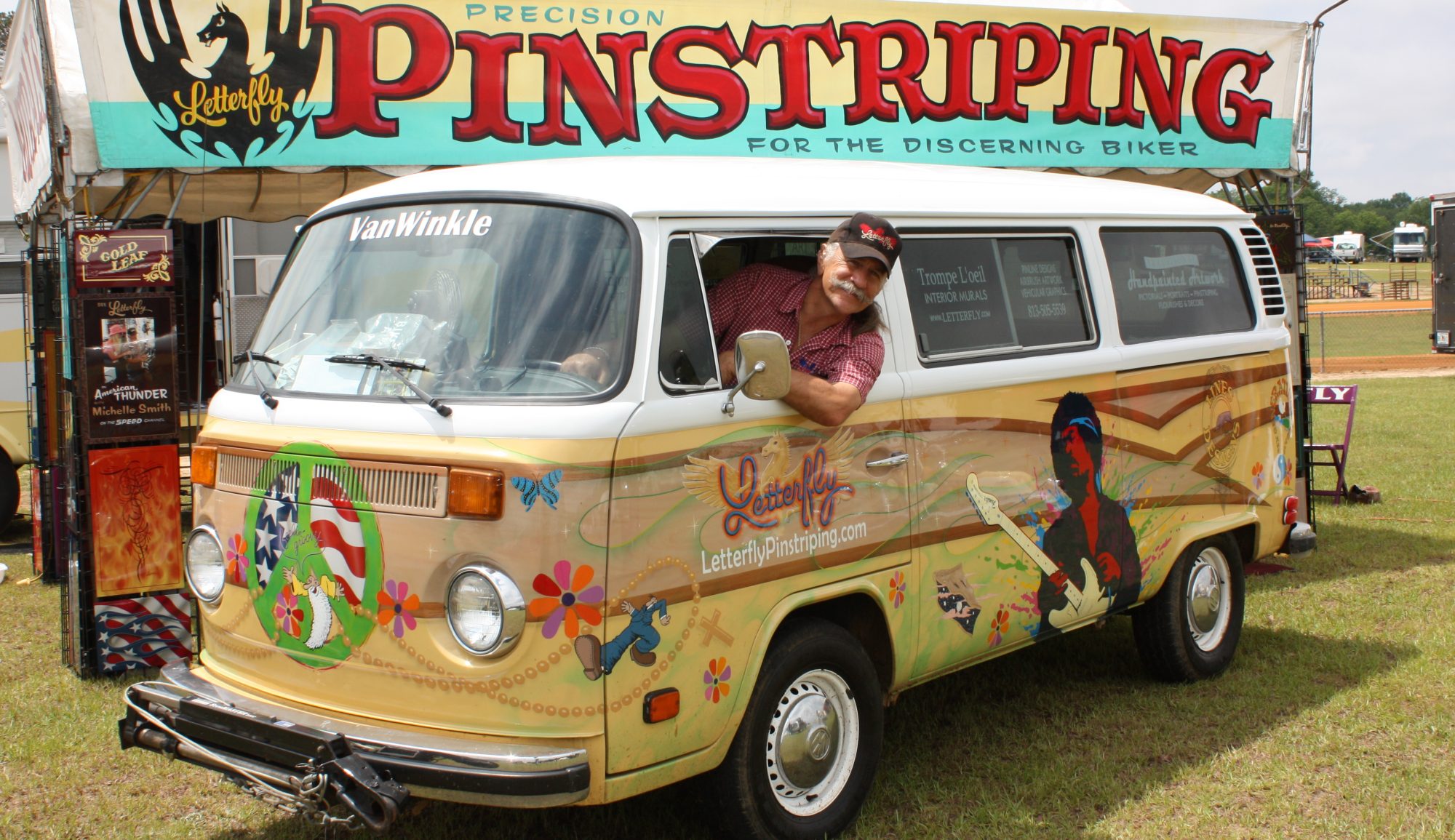
Volkswagen vans, through the years, had provided not only housing and transportation but also an area in which to organize my paints and supplies. The Volkswagen’s interior housed a drawing table on which I made patterns.  Underneath this surface was ample storage for paints and brushes and a small air compressor.  Add a couple of stepladders and a work plank and I had everything needed to put an airbrushed mural on the back of a motorhome. It all packed inside this van. With one exception.

High quality clear-coat was the final step of the process for an airbrushed mural on the back of a motorhome. The spray equipment necessary to clearcoat large areas required more volume of air than the small compressor in the van could handle. The final protective finish involved using the larger air compressor mounted on my truck. 

Typically, the procedure for creating a mural on a motorhome went like this; I arrived on the campsite in the van with two ladders and a plank. I set up the ladders and placed the plank between them to stand on. Then I began the prep work. The prep work consisted of cleaning, sanding and application of masking paper. Next came the artwork. I laid-out the artwork with a stabilo pencil and when satisfied, I used the airbrush to lay in the lines using pink lacquer. When all the lines of my design were intact, I erased the stabilo marks with a damp towel. Then I started the paint process. I painted in the background first. Features in the foreground were last. These processes were also a form of entertainment. Many times, I looked around from these tasks and found a semi-circle of people sitting in folding chairs watching me.

When the airbrushed depiction was complete and met the approval of my clients, the time came to spray on the protective clear coat. I moved the van out of the way, retrieved the truck, plugged the compressor in, rolled out the air hose and mixed the clear. After my trusty spray gun was loaded, I climbed up on the plank with my face-mask on and started to spray.  This usually drew a crowd. 

The audience loved watching this step take place right before their eyes. Contrast occurred. The magical transformation from the dull into the shiny finish coat proved spectacular. Three coats of clear urethane made the back of the coach look shiny and wet.  Many times, with the last bit of paint applied, I turned and saw the crowd that had gathered. I acknowledged them by raising my spray gun as if to toast them and received applause. Then I made the cowboy-like gesture of blowing the smoke from the end of the gun just fired to get a laugh.

It was after one of these sessions that I met Gene. Gene became one of my best friends. He was among the others overcome by curiosity and joined the crowd to watch another RV get a mural. I rolled up the hoses and put the spray equipment away and was about to drive the truck back to its parking spot but it wouldn’t start. Incidentally, at River Ranch, the second-best way to draw a crowd was to pop open the hood on a vehicle.  With the hood up, the next thing I knew, I had a semicircle of onlookers who all suggested what could be the culprit of why it wouldn’t start. 

I checked all the obvious things and some of their suggested culprits to no avail.  The truck still wouldn’t start. The frustration of not knowing mixed with a feeling of helplessness that replaced the remnants of pride for a job well done.

My predicament was clear. I was not going to be able to get the vehicle out of this luxurious part of the campground and back into its parking spot.

Finally, a man turned to me and asked in a stern manner, “well, …what are you going to do?!” 

I turned to him and replied in front of the entire group, “I’m going to go paint an eagle!” which got a laugh.

I turned and walked away.  I found out later Gene was in the crowd. Later he confided to me how much that episode impressed him.

As we became friends, Gene became helpful with advice on conducting myself in this, foreign to me, environment.  His days were filled with caring for his 1948 Navion airplane and the other vehicles he loved. He made it a point, along with lots of the other residents of River Ranch, to regularly see what the artist was up to today.  The friendly curiosity and affirmations from my fellow residents made me feel like I fit right in.

Gene was the first of my growing circle of friends to have found River Ranch. He had tipped off his life-long buddy Art about this paradise in the tropics. They enjoyed the hayrides, the large groups of aircraft that met for a ‘Fly-In’ and the endless stream of motorhome traffic that came for the ballyhoo.

“Hurry, hurry, rodeo every Saturday night” was part of the message along with, “make sure to dance to the cowboy band blaring out country music all weekend long.”

Gene had a friend named Art. They were both from upstate New York. They had mixed with and made friends with people from all over who were impressed with the charm of this luxury destination. The source of all the hoopla was Outdoor Resorts, a corporation selling individual campsites to the visitors. They gave away free nights of camping and hosted rallies of all kinds to get people here.

Big motorhome rallies came here too. Mid-winter, the airport shut down to make room for the Family Motor Coach Association Rally. Three thousand motorhomes came to the Ranch for four days. That represented a huge boost of exposure for me.

The Blue Bird folks had a rally here too but not on that large of a scale. Many sites were reserved for their luxury coaches. Because of my presence established with this demographic, I became quite busy.

One couple from the Adirondacks wanted an airbrushed mural of a Labrador retriever with a duck in his mouth on the back of their coach. As I started and enjoyed the crowd of affluent admirers who gathered around to watch, I received requests to come look at other coaches. My client realized a coup. Before I was complete with his wild life depiction, he commissioned two more. That kept me from serving his friends. His ego got a big boost and he stayed the focus of the gathering.

One couple from Ohio wanted a special image of a baby snow seal laying on the ice with the northern lights overhead to compliment to pastel colors in their coach stripe graphics. Brenda handed me a magazine called Wildlife Art where she found the striking image.  Inside I found page after page of images I could use as reference for other projects.

The weeks of production passed quickly that winter and many spectacular works of art on numbers of motorhomes were completed. I took photos and began to make portfolios.

The first of April meant a mass exodus of RVs from Florida going north. The season was over. I retrieved my livestock and headed back to Sarasota to resume my other passion.

Interesting Contrast

Perhaps the short-lived International Circus Festival and Parade was doomed to failure from the get-go. The event only occurred three times. The premise behind this event was for everyone to work together to benefit the industry. The populace of this industry is full of runaway egos that have individual agendas. But with no supervision – such as exists on an organized touring show – the rig parking, animal arrangements and consideration for specific thrill act equipment and logistics for everything else became a haphazard free-for-all with little regard for the original premise to benefit the whole. Without the ability to let go of individual agendas, internal struggle eroded what little adhesive there was to bind the altruistic concept. Our industry was also threatened by entertainment alternatives. The next day, a massive exodus took place as many performers’ rigs headed out to other destinations. I had a gig too.

I had discovered a market for hand painted airbrush murals and lettering work on motor homes at a luxury dude ranch turned RV resort in the middle of the state. That gig kept me busy for three months until the first of April. Yes, John Herriott said I could work with him again once my gig was over. He also added that it may be brief in the spring because his season started then.

With the festivities in my rearview mirror, I made my way to a completely different world. I found an excellent place to make a living as the resident artist for the next nine winter seasons. My entire entourage headed east. After I dropped off the livestock at a boarding facility nearby, I made my way to begin a significant chapter of my life.

The Awards Ceremony

The indoor coliseum at the fairgrounds had been converted into a banquet facility to host hundreds of circus personalities who participated in or attended the event.

Prior to the event, many couples and groups dressed to the t’s in gowns and tuxedos. When the doors opened, they made their way inside and found a place to sit at the many round tables with formal place settings. Once everyone was seated, the wait-staff served dinner.

Imitating the many famous televised awards ceremonies, this one was no different. Once the ceremony portion of this event began, legions of speakers and attractive personalities made their way up to the podium to share anecdotes about circus history and to announce the winners of each category, followed by those performers who added their rhetoric between spurts of applause.

I was seated with Tino Wallenda and his family. I had mentally prepared a brief statement for when my time came at the microphone. The owner of the Clyde Beatty Cole Bros Circus, John Pugh, who I had worked for two decades ago, was part of the duo that arrived on stage to announce the winner of the category Domestic Animal Acts.

John was short. He had to stretch to speak into the microphone. When he announced my name as the winner of the category, I rose from my seat with the Wallendas and made my way up to the stage.

As I climbed the stairs, John tried to be funny and suggest that I stop before I got to the top where I would dwarf him. His lovely assistant placed my award – a handsome medal on a neck ribbon like Olympic winners get – over my bowed head. John gave me a handshake. Then I made it up to the top of the platform. I had a brief statement prepared in my head.

“I want to thank my heavenly Father,” I began, “who made all this possible.”

“And for this wonderful horse that I have been blessed with.” 

             I let that sink in for a moment and then added, “and John Herriott for all his encouragement and the patient help given me.”

While I made my way back to my table, I received congratulatory gestures from many people who applauded as I went past.

             My heart acknowledged a tremendous truth as I savored all that happened to get me to this place. Although life contains tragic challenges, when I move into harmony with an unseen influence and allow that power to work in my life, amazing things happen.

The International Circus Festival

The culmination of the holidays found me at the fairgrounds in Sarasota preparing for Circus Competition. During the five performances that took place that week, every participant competed in one of several categories; aerial acts, juggling and acrobatic troupes, exotic performing animals, domestic animals, balancing acts, clowns, musicians and ringmasters. Every facet of the sawdust entertainment realm from all nations were represented.

By this time, I had a confident horse with a good work ethic. I learned on the tour earlier that year, wherever I aimed this horse, he willingly went, and when we got there, he was ready to go to work.

A year ago, I brought him here to get him used to the sights, smells and sounds. This time we were ready with an animated rehearsed routine. The rings in the mega circus tent were on grass, better footing than hockey floors. We were able to trot and canter freely. I had an admirable posture in the saddle, thanks to Vi and a spontaneous brassy attitude for whatever vicissitude should occur, thanks to Chuck. With John’s help, my routine was polished, and in front of all the critics in this business, I aspired to shine.

New red wardrobe had been created using the claw hammer tail tuxedo style jacket with strategic rhinestones sewed on for accents. When the time was right, I mounted my glistening steed. The pre-arranged musical score was provided to the brass circus band. I waited behind the backdoor curtain for my announcement before our entrance.

Finally, the preceding act reached its conclusion. The applause settled down.

After a brief pause came the booming voice “Keeping alive the timeless circus tradition of performing horses, please welcome the American Saddlebred dancing high school horse ‘Souveran’, trained and presented by Dave Knoderer.”

The curtain was thrown open. My horse became immediately animated and we floated at a trot into the ring. Our routine was accompanied by the captivating chords from the theme song of Star Wars, translated by the bevy of brass in the bandstand. A volte in either direction preceded the flawless side pass through the lateral center of the ring.

I knew that every one of the Herrmann girls of Lipizzaner horse show fame were watching and became extra light with my aids to facilitate a seamless transition from the forward to the lateral movement. At the conclusion of the trot work that opened our routine and established that we had a handle of this aspect of horsemanship, we halted at the center of the ring. I sat straight. I knew the horse knew what was next. All I had to do was signal with a muscle tension in my groin and he began to lean back. He lifted his leg as he did and came to rest on one knee. As he did so, I struck the style pose and the audience provided thunderous applause.

The most important part of this movement is the hold. Many rookie horsemen are satisfied with simply getting the pose but the horse learns to do it and bound right back up. The movement has three parts; going into the pose, holding the pose, and coming up from the pose. Knowing horse trainers were in the audience, I made sure to hold the bow for an extended amount of time just to show off the fact that we had a handle on this thing.

Next in the routine was the three-step where the horse moved forward and, at every third stride, a foreleg was elevated and extended in an exaggerated motion. Special care was necessary to not interrupt the forward momentum with too much of the aid that asked for the leg extension. Finesse is what facilitates a good three-step. The movement continued all around the ring. After one revolution, we dissected the ring from back to front and reversed direction. In this other direction we began to march, or do a leg extension every stride, all around the ring.

Special care was needed to prompt, in careful rhythm, the forward walk with a leg extension every stride. During the march I radiated a confident air and remained in contact with the crowd. The march then assumed a track through the center and toward the front of the ring where we faced the grandstand. While up against the ring curb, our proximity seemed to promote the question in the mind of the audience, what’s next?  We began the double-backwards three-step, which is three backward strides and a double foreleg extension which was repeated regularly as we backed through the ring.

In the rear of the round exhibition venue the horse was already sensitized to go in reverse. I provided an invisible cue from my seat and signaled him to glue his front feet to the ground. I then coaxed him into the camel stretch or circus bow where his front feet were out front and his chest was inches off the ground. Again, timing was what allowed the public to notice his magnificence. As he held this pose like a living statue, we provided a picture of the classically trained horse and rider.

From this pose came the exciting conclusion. Beginning with the trot, the goal was an elevated leg extension at every stride. This was called the high trot and was a difficult movement that took years to do consistently. Because our training was still underway, I just asked for three strides. I got the conditions right and began to ask. For whatever reason, the response from him would either be quick or his understanding of what I asked went unnoticed. So, I asked again. When I got a few strides in a row, I discontinued asking and rewarded him with some verbal thanks for being a good boy. I had learned this from Evy Karoli in German years ago; “yo brae.”

To utilize the accumulated compulsion, a transition to canter was next. The gait traversed and went into a figure eight with a change of leads at the center of the ring. We concluded the act by cantering up to the front center to halt. We took a bow and saluted the crowd. Then, while the announcer re-introduced our names, we backed through the ring and bowed again in front of the backdoor curtain.

The act was well received, but I didn’t know just how well until later in the day. Back in my street clothes with the horse and mule bedded down. Philip Anthony rushed up to me.

“Dave, Dave!”

“You won!” he blurted out, “you’d better make plans to be at the black-tie awards banquet tomorrow night.”