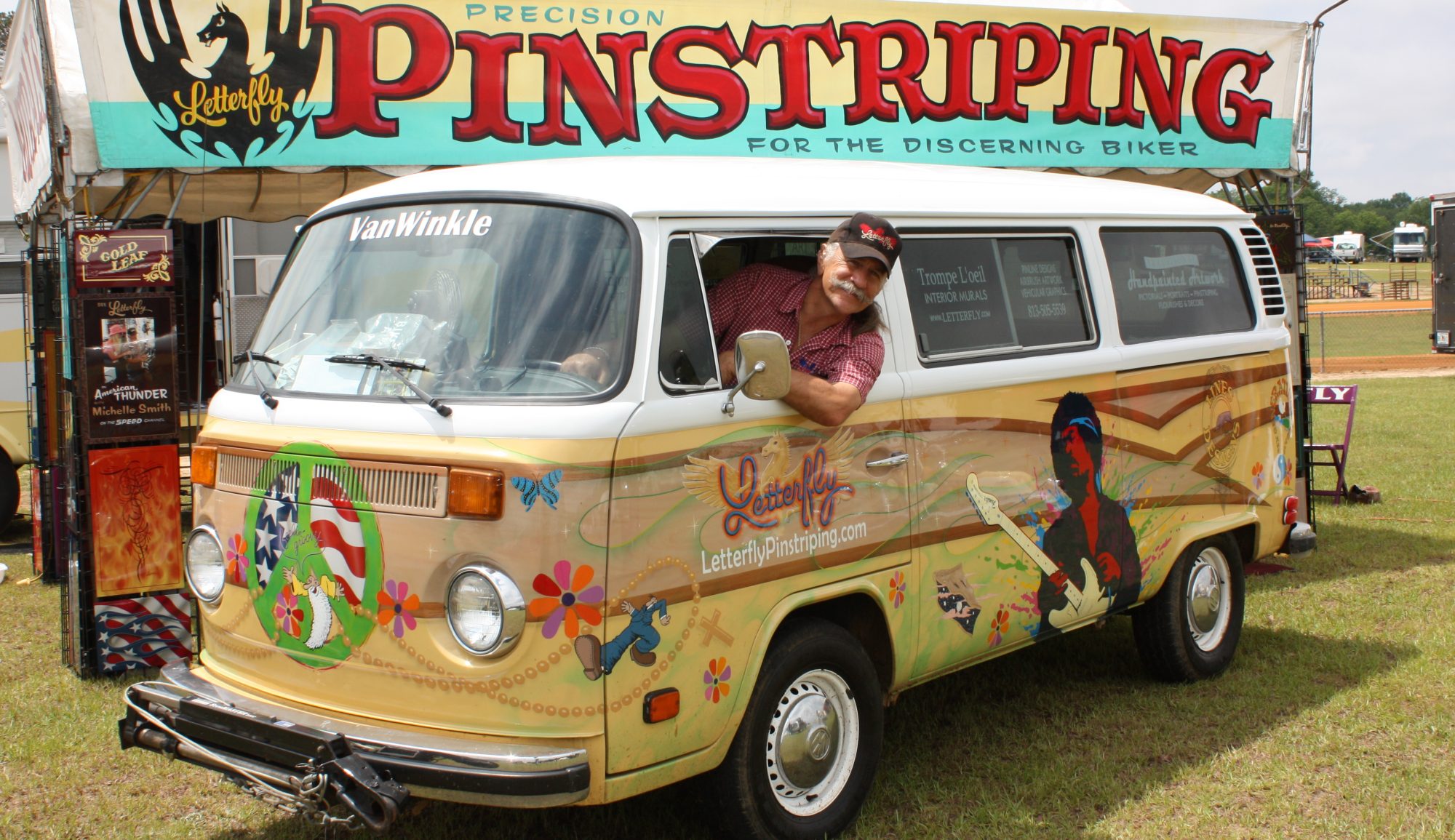
Dale was the owner of two restaurant/bars called The Hunt Club in both Jackson and Hillsdale. He wanted gold leaf signs on the large glass windows at each store, plus a gold leaf name on the glass at his office connected to his airplane hangar at the airport.
For centuries, gold lettering and ornamentation on a glass window was utilized by upper echelon businesses and was considered the epitome of the sign makers craft. Dale commissioned me to accomplish three gold leaf window jobs.
The explanation of why gold sticks successfully to glass remains a mystery. The technique used for centuries utilized heated water with a single gelatin capsule dissolved into it. This mixture was flooded over clean glass and while wet, special handling occurred to lay the leaf against the wet glass. The first part of the procedure was to completely cover the area to receive the sign work with many 3-3/8-inch squares of gold leaf. The window then sported a quilt-like pattern of overlapped gold squares. As the water evaporated, the gold was sucked tightly onto the surface of the glass and a mirror-like effect resulted.
To prevent the delicate metal from wearing off, the gold was backed up with paint only on areas where the gold remained for the design. This part of the process involved delicate brush work. The lettering and ornamental designs were all painted backwards on the inside of the glass and acted as a protective layer over the gold. The excess gold was removed later with another delicate process involving a mild abrasive.
Achieving the level of proficiency with this particular technique of the sign makers craft elevated my standing in the community. My goal had been to become the best. With these three jobs – what became my final three jobs as sign man in Jackson – I had achieved my goal, albeit with a broken heart, having been rejected by Gail once again. With these jobs complete, I made the remaining preparations to go to Florida. At the stable, I loaded the livestock, hooked the VW bus on the back of the rig, and headed south. There was no sense waiting.
The snow had begun to fall. Every hundred miles provided an improvement in the weather. I had a busy time ahead of me.
I didn’t know it at the time but God had a different plan for my life. Even before I arrived in Florida, I discovered a segue that would rocket me into the next chapter of my life.
Through Society horse contacts across the country, conversations occurred for performing opportunities in that demographic. A producer in Chicago explored options for a performance show at the Big D Saddle Horse Show in Dallas. I received a phone call with an invitation to perform at that major horse show. The Big D included not only Saddlebred horses but Morgans, Hackney ponies and Tennessee Walking horses with plenty of categories for each breed.
The four-day event took place annually at the coliseum on the fairgrounds in Dallas. The reason for the special program of acts was to add entertainment as an attempt to appeal to an outside audience, sell tickets and fill the seats. She wanted my act as the performance feature. Class n Sass received top billing among the other performing acts that included Paso Finos, roman riders, rope spinners, a cowboy square dance team on horses and a girl that had a horse that did some tricks.
I recognized this as a major opportunity in my career as a dancing horse trainer and intended to do everything I could to do an especially good job. With plenty of time to prepare before the autumn show, training sessions with my horse took on a new dimension. I had extra energy and motivation with this goal in sight.
An awareness grew in regard to my alcohol consumption and how it might interfere with this professional aspiration. I had developed the pattern of drinking every day. This awareness mixed with my desire to do the best possible job, so I quit all beer intake three weeks prior to the event. The advance publicity efforts designed to generate excitement in Texas did also in me. I enjoyed hearing the news and seeing ads with ‘Class n Sass’ billed as an equine ballerina.
When I arrived in Dallas prior to the event, I had ample time to assess the situation, collaborate with the announcer and the music and lighting fellows. With this team, we came up with the criteria and agenda for presenting my act. The following is what we planned.
Prior to my entrance, the building went dark by killing all the house lights. I was poised in the entrance chute. Our announcement came next.
“Ladies and gentlemen, calling your attention to a special presentation,” the ring announcers voice echoed throughout the cavernous building, “the one and only equine ballerina; Class n Sass, the beautiful American Saddlebred dancing horse.”
“Brought to you here for the very first time for your entertainment pleasure, trained and presented by Dave Knoderer,” he continued, “please welcome this dancing duo.”
Synchronized to start at the end of the introduction, the organist played the theme music from Star Wars. Two follow spot lights came on at precisely the same time. This illuminated one specific area in the pitch blackness and revealed the horse and rider as we entered the arena floor doing the spectacular, elevated trot known as the passage.
We began to cover ground in the cavernous arena with a path that included several voltes, or small circles, along the way. Her gait in perfect time with the music, showcased just one ability Sassy was proficient with. This manner of starting the act also allowed me to acknowledge the entire crowd while we moved in front of the seating to eventually arrive front and center to begin our usual routine.
At the circus, I used every bit of the forty-two-foot circle called the ring. Here, the vast expanse had an obstacle in the middle; a latticework, extensively decorated arbor-like area for the officials, trophies, their attendants, a photographer and the organist. I modified the path of my routine to present all the features of the act in front of as many in the audience as possible. As the loopy path of alternating voltes yielded to the lateral side-passes, the announcer made his running comments about the training of the Haute E’cole or High School horse.
After the final side-pass, the first of the leg extensions began. The first movement was the triple-three-step – three strikes with the same leg followed by two forward steps. The movement looked like left, left, left, walk, walk and then right, right, right, walk, walk etc. The nice thing about this introductory extension exercise was that forward momentum was established and continued as we changed to the other variations that included the three-step, which was similar.
The three-step looked like; left, walk, walk, right, walk, walk, left, etc. The path of the three-step encircled the entire arena so everyone could see. When we once again arrived at the front side, the three-step changed into the march – leg extension every stride – up the front straightaway. We marched forward up the front side and eventually reached the place where we changed direction from a stop.
Our backwards-extension movements were next. The backwards-double-three-step looked like: strike, strike, back, back, strike, strike, back, back, etc. We backed across the arena in this fashion. This preceded the spectacular breakdown bow where I gave her the cue to plant her front feet and she leaned backwards until her front feet were well out in front of her and her chest was just inches off the ground. As she held this position, the organist played a long chord and I made my sweeping style gesture that promoted applause.
We rose up and came out of this pose. The organist did a tease with the staccato opening notes of the popular show tune ‘New York, New York’ and Sassy began her elevated, hesitation-trot gait known as the passage, seemingly in time with the music. She could do this movement all day long. The stunning animation of this exercise was the strongest feature of our presentation. The horse aficionados in the audience really sat up to take notice of this. The focus of their training was typically elsewhere as they perfected rapid animation and speed with their horses.
After the passage around the entire arena floor, we took a bow. She raised one fore leg and curled it underneath her, leaned back until her knee rested in the sawdust. Again, I styled to the crowd as I insisted she hold this position. When we came up and out of this pose, the organist struck up the lively tune ‘Runaway.’ This tune fit as Sassy coiled up and exploded into a canter depart.
We galloped across the front area and around the north end. This animated gait stood out in contrast to the graceful and elegant demonstration of the recently completed passage. When we were halfway down the back side the time came to begin the canter rears. On cue, she stopped in her tracks, reared straight up and struck out with her front legs as I leaned back in the saddle to assist her with weight distribution. Upon landing on all fours, another canter depart transitioned her back into the gallop, but only for a few strides. Then it was time to stop and rear again.
Several canter rears took place across the back of the venue and then several across the front. Racing around the north end, we cantered the last leg of our routine up to a location adjacent to the announcer’s stand where we stopped. Sassy then bowed and when she was down on one knee, I asked her to curl up the other leg. She kneeled on both knees for our conclusion.
After the final announcement, we rose from our pose and began to make our way to the exit gate at the passage. At the last moment, we turned around to stop. We faced the interior of the arena. We made one last acknowledgement to the crowd while the parting announcement took place. I bowed my head with my hat in my hand. I extended my right arm in the fashion that a formal dressage rider uses to conclude his ride. With my head bowed in gratitude, the spot lights went off. I exited in the dark. That was the routine we provided each day of the event.
During dress rehearsal, everyone involved did great job learning and doing their part. The presentation of our act went smoothly. Once cooled out, I put Sassy away in her stall. I Thought I was done until showtime the next day. A couple came to me with a special request. They wanted me to perform that evening at a saddlebred stable north of Dallas in Plano. Prior to the horse show each year, Milligan Stables had their annual Open House and Fish Fry. Their event was scheduled to take advantage of the visiting horse folks who arrived to participate at the Big D Horse Show. The aficionados could see their farm and their livestock. I recognized this request to perform in front of their guests an endorsement of sorts. Instead of relaxing, I had to get ready.
A few miles north of town, I found their horse farm in the affluent suburb of Plano. The party would be for just a few hours. Upon arrival, I was introduced to their plan. I would show my act to the crowd during the only time they would be assembled. That was when they stood in line for the meal provided. In sharp contrast to the high-tech rehearsal now complete, the demonstration I provided here had no announcement, no music and no lighting, Although the horse and I were dressed to the tees, this was a high-grass presentation that took place on the lawn alongside the long line of people who waited for food.
We performed the side-pass, three-step, passage and all the other elements of our routine and received applause from the patient yet hungry crowd. Once Sassy was cooled-out and cross-tied to the side of my horse trailer, I had an opportunity to get some grub and meet the other folks who enjoyed the festivities. By the end of the evening I was back at the stable at the fairgrounds and settled in.
The horse show coliseum was surrounded by metal roofed buildings that contained a labyrinth of concrete walls, a web of metal plumbing, a network of electrical and commercial lighting fixtures combined with rolling wooden doors and barred dividers that made up row after row of horse housing in a maze of stalls. Dirt throughways for horses and their companions covered with sawdust sliced through these areas.
Depending on the size of the participating stable, whole aisles were devoted to a single enterprise as evidenced by the color-coordinated canvas valence with the barns name affixed high on top of the entire length of the stall row. Fancy signs were mounted at each end of this arrangement with a main display in the center. Tack trunks and color coordinated folding director chairs peppered the aisles between stalls along with tables covered with veggie snack trays, small sandwiches, plastic stemware, coolers full of drinks and the occasional coffee pot.
On many of the main intersections of these sawdust arteries were extensive displays brought in by the major stables that included water fountains, floral arrangements, potted plants, stunning horse sculptures. Mounted photos of the exotic features of the faraway stabling facility and their featured stallions inspired awe.
Some of the stalls were completely canvassed off and used as dressing rooms. During the frenzy of the horse show, participants of all kinds were primped into impeccable condition by the many attendants who, like devoted servants, combined efforts to get horse, rider and all the leather, metal and fabric accouterments in pristine show shape. Many of the horses had matching color, false wig pieces that were woven into the horse’s tail to add pure luxury.
The traditional saddlebred tail was surgically altered to prevent clamping down over the bung. Under saddle, this modification caused the tail to assume an elevated position and the augmented, carefully picked out massive feathery appendage undulated while the horse ran through his gaits. It really did add to the appearance in a beautiful manner, especially in the breeze caused when the order was given to rack on, the most rapid of the five gaits.
Two stalls were provided for my needs. I had plenty of time to care for and prepare my horse for our daily presentation. This also gave me ample time to meet the folks around me. As I became familiar with my fellows, I noticed a vast demographic I was not familiar with. These were society horses, referred to as such, for a reason. These equine status symbols were historically considered an appropriate pastime for royalty, and in this case, the very rich. Being around this segment of the demographic, I shared a secret amusement with the professional horse trainers and workers who knew their way around a horse and were here to make a living, and that was that we sometimes watched the obviously inept on incredible horses.
The resulting connection with a portion of the populace who had a handle on how to function and gracefully interact with a horse prompted several friendships in the stable area. During the early morning hours, the grooms, handlers and individual private horse owners were the only ones who stirred, many of whom also slept here. I learned long ago to attend to my animals immediately upon waking and these people were of the same discipline. Stalls were being cleaned and picked out while the peaceful sounds of chewing, nuzzling the bottom of a bucket and the occasional snort added to the meditative state. For the humans, percolators added a refreshing fragrance to the mix.
As the morning grew, the wealthy participants arrived from their hotel rooms and became involved in myriad activities. Special tailored saddle-suits were donned, boots were polished and hair arranged in a bun. Tack was shined, the horse shoer quickly nailed lead weights onto the soles of a horse’s feet, while muzzle whiskers and ear hairs were trimmed. The skin surrounding the eyes were rubbed with oil to produce a deep shine and a special spray sprinkled a slight metal-flake sparkle went on the horse’s slick, curried finish.
I was busy with the grooming practices learned on the circus. I checkered Sassy’s haunch. With careful short strokes using a short comb going against the grain in the slick hair on her haunches, I created a special effect; a checker board pattern on her rump. Next, I glued small mirrors in alternating squares of the pattern.
White leg wraps were securely and accurately wrapped onto each leg between the knee and ankle to accent the visual effect of the action from a greater distance. A special white saddle pad with gold tube edging went onto her back before I laid my dressage saddle with straight flaps down onto her back. The martingale, or breast collar, went over her head and onto her neck next, and then the whole affair was lovingly secured.
With the mare pristine, it became my turn to dress. My dad was a perfectionist and a sharp dresser. His neatly arranged closet was his testimony. Special cuff-clamp hangers held his pants inverted to hold the crease sharp. Padded hangers for his suit jackets were arranged in an orderly row and when he tucked his shirt tail in, an even overlap occurred in precisely the same location on either side of his girth, a technique he learned in the military.
I carried on this family tradition albeit far from the uniform of the clergy. First, I put on the ruffled front formal shirt with a bowtie, tucked smartly into white breeches. I covered my waist with a cummerbund. Then I pulled on my black Dehner boots and strapped on my spurs. Then I reached for my peach colored tuxedo jacket with glass jewels and gold piping sewed onto the lapels, cuffs and tails. After I slipped on this heavy jacket, I snapped into the proper posture and the costume assumed its position. I finished off my look with a matching color Mississippi river boat gamblers hat.
The time then came to introduce Sassy to the double-bits of the full-bridle. I slipped the headstall over her ears, guided the bits into her mouth, attached the throat latch and hooked the delicate curb chain. I circled her one last time to make my final inspection of every detail. The time came to lead her into the aisle and ask her to bow on one knee as I placed my foot in the stirrup. She held this pose as I rose and swung my leg over her. Then she rose. My posture settled straight into the classic seat developed under the tutelage of my many mentors. From this position, we were ready to make our way to the warm-up ring to prepare mentally and physically for our performance.
Lavish parties took place all around these activities as each day morphed into evening. A jovial atmosphere permeated the long days filled with, not only animal care but grooming the horse and rider to impeccable condition along with handling the pipeline of various personal incidentals and necessities consumed by this cross-section of humanity. The variety of age groups attending combined their enthusiasm and were regarded as an important contribution to showmanship.
One couple had a talented Morgan stallion who participated in several classes. They had the same number of stalls I had. They also had all day to primp one horse. They had lots of time during the day to visit. Their home-spun manner of handling the related tasks of life at the show combined with their appreciation of the peers who became friends over the years. Their interest for what I did with my horse prompted much conversation.
The genuine regard apparent in their demeanor was the perfect segue for a shy guy at a new threshold. I was careful in this situation to make a good impression. In this strange new world, Billy and Joanne made me feel welcome, accepted, and significant. They went out of their way to include me in their ever-growing circle of acquaintances. We became friends. After the show, they extended an invitation to visit their farm nearby, called Chesspeice Morgans, to see the operation, the other horses in the barn and camp out for a while.
In the midst of all this conviviality, I refrained from the ongoing offers to have a beer or glass of Champaign but I certainly enjoyed the food and especially the lively rapport. The topic we all loved – horses – spurned many stories from all around. As I listened, I learned much about this facet of horsemanship.
They were curious about my passion too. Encouraged to share anecdotes, we sat on trunks, bales of hay, chairs or simply leaned on a stall door. Nuance of our experiences while training the horse or personality quips of our equine individuals sparked other stories of the past and present from everyone. This heightened the feeling of being accepted and part of this genre.
A nice red-head who was a friend of Billy and Joanne became a regular part of these daily get-togethers. She piqued my interest. Soon we created a welcome excursion for just the two of us. We walked through the many thoroughfares of stalls and acknowledged the many parties underway throughout the facility. We paused at each stall to inspect magnificent horse flesh.
We enjoyed the wonder of the moment, the magnificence all around and especially the sparkle in each other’s eyes. I welcomed her presence each day as I prepared for my act. Her interest in watching me perform while I found my place in this fascinating industry opened up an avenue of hope in my heart.
I learned the discipline of being ready one act before my time to perform on the circus. This habit was necessary for a smooth uninterrupted show, especially when an emergency occurred with the act before. Here at the horse show, my slot to perform was after a different class each day. The length of time a class took was influenced by how many horses were in the class and how long the judges took to select a winner.
With this previously learned way of participating, I was under saddle, warmed up from the session in the outdoor ring and waiting by the rail with the current class underway for differing amounts of time each day.
The first dancing horse performance that took place at the Big “D” Saddle Horse Show was interesting. With the routine in its beginning segment, as I did the three-step around the back of the officials stand, I noticed the mare acted funny. I discovered she was being spooked by one front leg wrap that had come loose and was flapping around. I immediately jumped to the ground and removed the rest of the wrap. With this dangerous situation handled swiftly, to resume the act, I had her bow, then put my foot in the stirrup iron. With the graceful remount that followed, I got an applause that was not planned. I realized this way of getting on a horse was novel to these people.
The emotion that accompanied being on an impeccably groomed horse in front of this large horse-loving audience who peered from their seats and over the rail along the sides prompted the feeling of having arrived. This over-wrote any lingering damaged esteem issues that accompanied me through life and gave me an image of myself that I approved of.
Motivated to excel, I learned long ago that I get my value from what I produce. The acceptance, applause and approval that came from this community pumped a new elixir into my bloodstream as I became a handsome prince on a beautiful and talented steed.
When the first performance was complete, I cooled Sassy out, wiped her down and put her away clean and dry. I had arranged with the video service at the show to capture footage of our routine each day. My new friend and I made our way to the commercial booths in the foyer section of the building adjacent to the main seating area. There we found booths filled with horse related products and information about services.
We saw brand-new tack and saddles, tailored wardrobe, boots, hats, custom barn builder displays, breeding lineage information services, plaque makers, portrait painters, equine books and magazines, truck and trailer brokers, wagon, cart, harness and buggy makers, along with every horse trinket and clever device to make life easier at the barn from the top of your wheelbarrow to the soles of your feet.
As we threaded our way through these hawkers and merchants, we eventually found the video booth of the crew who filmed all the horses and riders to see the recently captured footage of my act. My perfectionistic desire to be the best horseman I could possibly be was aided with the footage I now obsessively pored over.
The first session revued, I discovered the bow had occurred in a place hidden by the central latticed obstacle in the middle of the floor. Now I knew where the camera operators were and calculated the angle they shot from. During the next performance I made a special effort to play to the camera so my footage included all the features of my act.
As each day passed, another performance occurred in the midst of horse classes of every type and filming my act continued. The captured footage became a visual record, a valuable training aid to me and an all-inclusive memento of this highlight of my life.
Early in my relationship with this stunning mare I noticed a mean streak when the time came to cinch up the saddle. I could lay the saddle on her back as she stood calmly but when I started to buckle the girth and tighten up the straps, her ears went back. With teeth bared she tried to reach around and bite me. I realized this was probably the result of a negative experience that occurred in her past. I made a vow to never reprimand her for this behavior and instead respond with pure love, especially because she was so willing to excel with everything else I asked of her.
Gradually, over the years this conduct turned into a game. The cinching process was not painful to her and because I loved her through the process, gradually she changed. After her ears went back and she tried to reach me, she then tried to affectionately lick me. I gradually became able to put my hand in her mouth and she lovingly gummed me. As this behavior became consistent it also evolved into a source of fun around strangers.
One evening after the horse show was quiet, I was alone. I walked from stall to stall and looked at horses. I saw a couple at the other end of the same row headed my way. Sassy’s stall was halfway between us. We stopped and looked into each stall along the way. As they got closer, I was near my mare.
I looked into her stall, feigning not having any familiarity with her.
I said “Wow, this is a nice horse.”
Then thrust my hand and arm between the bars of the stall and up to her face and said, “I wonder if he bites?”
I placed my hand into her mouth. She lovingly gummed me. I acted in a ridiculous manner. I flailed my other arm and acted as if I was being eaten alive. While I secretly laughed at the stunt, I’m sure these stunned people continued their walk thinking I was very strange.
My cousin and her husband lived in the area and planned to attend one of the shows. I hadn’t seen Phillis since we were kids at the annual family Thanksgiving get-together back in Ohio. I was delighted with their presence in the seats on the third day of the show. We were reunited after umpteen years. After the show they invited me to come over for dinner. When I drove over that evening to see their lovely home, Fliss had no way of knowing about my personal non-drinking experiment.
After turning down her offer of a cold beer, she said “one won’t hurt.”
I then went ahead and enjoyed a wet green bottle full. Back at the coliseum, before bed, I found a party still going on and had more.
The next morning, the resulting compromise to my physical and mental prowess was apparent in the video footage taken that final day of the show. Seemingly caught in time lapse, I lagged a moment behind what Sassy was doing. I lost my sensitive feel and the adept ability developed as the result of relentless practice and sobriety.
Taken by surprise, I bounced ungracefully in my seat during the canter rears. This was just one consequence of the fog that impaired my brain. In spite of this, true to form at the horse show, much pomp occurred at the end of the act. In a gesture of appreciation, we were awarded a blue championship ribbon and a silver tray for our unique contribution to the show.
That night with the performance contract honored and having received accolades from legions of horse folk, there was no reason to refrain from the consumption of this accepted and widely available beverage. The final celebration took place with my new friends during the load-out of unneeded horse accouterments while the mare enjoyed one final night in her stall.
Advertising in any proximity that the locals gather is a strategy many businesses utilize. A sense of community dedication associated with civic groups is created with these gestures. Hand painted paper signs with the names and ads of local merchants hanging in the big top is one way of making extra money around the traveling circus. Becoming the banner salesman on the Royal Bros Circus season of one day stands in 1973 was an enterprise that required my sister’s participation to fit into our routine. Our custom was already up early each morning. Paula would wake me and crawl into the cab of the pickup to resume her sleep while I drove to the next town. When we arrived at the next town, I would jump out of the truck downtown with my steno pad and begin to visit the merchants in all the stores. Paula would then drive the pickup truck with camper pulling the calliope trailer to the edge of the show grounds where the big top was being set up. There she would recruit the canvas boss to drive the rig into position on the lot near the back door of the tent.
At the beginning of the season, John Frazier gave me a spiel to use and sent me downtown to do my best. I simply found the decision maker in each store and rattled off my memorized pitch, wrote down the particulars of each sign and announcement and collected eighteen dollars for each one. Downtown, my role took me in and out of each store and business to give the spiel for buying a banner ad that would hang in the big top. The accompanying announcement would give merchants presence during the afternoon and evening presentation of the circus. I was learning presentation skills and also how to get around the employee in charge of intercepting disruptions. I learned to not disclose my purpose until I got to talk to the boss. As the circus banner salesman in a new town every morning, I had the opportunity to meet an endless stream of interesting people.
In Perth, at a candy store, I entered an old-time glass store front through a heavy wooden door that triggered a bell that rang each time it was opened.
After listening to my memorized spiel, the elderly woman who otherwise beamed in response to my presence responded with “I’m not going to buy one of your banners.”
After asking me about my role with the circus, I was then invited to listen as she told me about herself and sat down at the piano. Prior to World War I she had been a piano player for the silent films shown in the local theater. Emotion, drama, excitement, danger and elation were communicated through the flavor of the music created by a live piano player in these theatres. As she played, I heard these examples of how music enhanced this genre of entertainment. My mind was transported to a time when this was state of the art. During the war, she became a bus driver for the war effort and when the war was over, talkies had arrived on the scene. She had to pursue another vocation. This was just one of the many encounters with interesting people that imprinted my heart.
While I was in town selling banners, Paula had one duty during set up, and that was to take two pullies with long loops of rope and snap them into the lace lines of the big top while it was going up. This facilitated hanging the paper signs later, and was a duty that forced her out of her shell to interact with the crew during set up.
When I got back to the lot with all the orders, I had to scramble to get the rig backed into the tent and the drums set up. Paula got busy painting signs on large pieces of white paper with a shoe polish applicator and hung in the big top before the show.
Paula never did become an enthusiastic showman, partly due to her reclusive nature and partly because I had become a hot-headed teenager who had never learned to be gracious as we attempted to get all these tasks done together on a daily basis. Perhaps I was following the example of our father’s strict perfectionist manner of wanting everything done just right, and that added to the already frustrating situation of her being in the turbulent outdoor entertainment business. All I could see was the perfect way it could be done.
Our comfort was at the mercy of the weather and plagued with egoic whims, moods influenced by situation and selfish ambitions of others, which was more of what we had found on the playground of our youth, yet on a grander, rawer scale. The rigors of one day stands, relentless demands from me and the multitude of twists that occurred in this turbulent lifestyle began to wear on her. Something in my sister had been hurt. She could not show enthusiasm. She remained frustrated and became referred to as poor Paula amongst my trooper friends.
One morning after having a successful series of banner sales, I returned to the lot to begin with the process of setting up and getting ready for the show, but I could not find the rig on the lot anywhere. I asked the canvas boss if he knew anything, and he sent me to see the elephant man.
When I asked Dick, he said, “The rig is over there” and pointed north of the lot.
So I began to walk.
About a mile from the lot, I found my sister completely frustrated, sitting on the ground. The truck was stuck up to the axels in someone’s front yard. Apparently while driving the rig from where she dropped me off downtown and heading for the lot, she missed the entrance. Thinking she could just go around the block, Paula continued down the road and instead found it went straight for miles with no place to turn around. Exasperated, she pulled up someone’s driveway and attempted to make a big loop in their front yard. But the lawn was soft, and the truck sank up to the axels.
When I got there, I was not the loving, supportive brother she needed at that low point in her life. I became a hot head and screamed and yelled at her. I had to hike back to the lot and recruit the help of the elephant to pull the rig out of that situation. As I look back at my behavior that day, I realize that my response did more to damage my sister, who already had the tendency to shut down and withdraw. That event caused her to retreat even further into the security of isolation. If I had it all to do over again, I would have become comforting, compassionate and lovingly explained to her that we all make mistakes. The damage of that event set the tone for the rest of our lives. My sister never saw an admirable trait in me from that point on. When I did see her years later, warmth and regard was gone.
Holding a grudge seems to be a sin of our father, who had his front teeth knocked out on a family water ski excursion by his brother (interestingly, who became a dentist). Making amends or entering the procedure of forgiveness, as taught by Jesus, was not exampled in our family in spite of our father being a minister. Resentment that persists can become depression.
After an otherwise busy and fun summer season across picturesque Ontario, we had much to relish and savor from our adventure but a contemptuous not knowing for both of us, forced self-reliance to the front and we grew apart. My sister and I survived a turbulent childhood not knowing safety. We were exposed to a vast spectrum of behavior coming from others. We began to prefer a smaller circle of influence. At the end of that season on the circus in Canada, we trucked back to the Quad cities where, after dropping her off, she began her next semester of college. That was her only experience on a circus.
I headed east to pursue a fall tour on another show. I joined a small circus with a five-week season in Michigan that performed in school gymnasiums. At the end of that tour, I ventured to Indiana, gathered up the new crop of pony babies at the Palomino farm, picked up the liberty harness commissioned at Shipshewana and headed for Michigan.
At Hayes farm, I unloaded the weanling babies and gathered up the yearlings. One colt had died.
Hayes told me the story of Lewis Bros Circus, a show owned locally that thrived during the thirties and forties that wintered east of Jackson on Fox Road. He had gone out there in the past to snoop around but the owner of the farm wasn’t keen about visitors. Fortunately, the farm had changed hands again and Hayes made friends with the new owner. He saw the left-over equipment that had sat for several decades but not before many of the rotting wagons had been burned.
Since he was friendly with the current owner of the farm, during one of my visits to Clarklake, he suggested we drive up there and look around. We went to Fox Road in his green station wagon. Behind the large white home in a rural part of the county, a sunken driveway lead past a row of tall trees up to the back where two large barns stood. Inside the first one was a low ceiling and a labyrinth of aisles and stalls, obviously where the animals for the show lived during the winter.
The other barn was a massive, high ceiling structure with sheet metal on the floor where the elephant was housed. Up on the second floor, a large room was where the wardrobe, canvas repair and other preparations took place.
As Hayes and I explored the barn we saw an inverted elephant tub being used as a coal hopper and recognized other pieces of equipment strewn around. The owner told us to take what we wanted. I found a complete set of liberty horse harness and an elephant bracelet.
Part of the challenge of living on the road involved an inability to collect things. My choice to keep something usually meant that another belonging would have to be discarded, but this find was too good to pass up.
After some additional artistic projects Hayes had accumulated for me to complete, I headed for Oklahoma with four yearlings to begin the creation of my new palomino liberty act. I was about to begin the experience that would positively imprint my life in many amazing ways.
This business I had selected in an effort to make an improvement came filled with extremes; from encouraging friends that became a positive influence for my life, to crooks with agendas that inflict selfish devastation. Instead of receiving wisdom from the lessons learned on the road, my response was more of what I had established as a child. I sought on my own to utilize self-reliance and independence for surviving in this turbulent society. The ponies would teach me something vastly different.
The plan for the second season was to spend another summer in Michigan, and then pursue a route that would take us to Texas where we would winter in the sunshine of the Rio Grande Valley. The season opening meant that I changed roles, morphing from fabricator and decorator into assuming the set-up and tear down of the side show on the one day stand routine that brought circus entertainment to small towns. During the Fisher Bros Circus season of 1972, I was moving a 30’x60’ tent, had eighteen animals on foot, eighteen animals in cages with two men working for me. Soon a hippopotamus would be among the component of animals.
The second season also introduced twin bandstand trucks to flank the back door of the big top. Marie Loter was on organ and myself as drummer and announcer.
Another attraction was added to the concessions for the second season of Fisher Bros Circus. Jim Kernan brought his small Wienie Wagon concession stand. Jim’s presence offered candy apples and hot dogs to the audience in the seats. Each afternoon Jim would sing in a pleasant baritone while he made the candy apples.
Jackie also showed up from the rodeo scene with her tight and bright metallic looking western wardrobe. She presented a whip cracking act and commanded a lot of favorable attention. Jackie was a good-looking lady and her traveling companion was a large white dog.
During the first season, our show had no water wagon. Raymond Duke was the show’s agent who always booked the show on a lot with a water access. One of the new pieces of equipment in season two was a water tanker. In order for my camper/bandstand pickup to qualify for paid fuel on the show, I was recruited to pull the water wagon. The wagon was made from a pickup truck frame with an elongated square tank resembling a box. Towing the water wagon required that I stop prior to coming onto the lot to fill it each morning. I quickly learned how to divine water from unfamiliar towns and counties.
I discovered that getting water for the circus would get bogged down in red tape if I sought permission. I figured out how to speed things up. During the week, all churches were mostly vacant. To find a church with a hose bib on the outside of the building provided fast and easy access to water. Weekends, when church was busy, I would look for a school to get water in the same manner. But filling up a several hundred-gallon tank with a water hose took time. So to not hang around looking suspicious while the water filled the tank, I began to take early morning walks once the tap had been turned on. This allowed me to enjoy exploring the new town while not arousing suspicion that water stealing was going on. On the walks I discovered old remnants of feed mills, thriving downtowns and lunch counters in the local drug stores. Neighborhoods provided an endless variety of visual wonder for me to observe. I found I could enjoy olfactory stimulation while the water tank was filling.
Circus entertainment in the early seventies still had influences that lingered from the day of horse and carriage. Famous jungle explorers had brought exotic animals to the forefront of the imagination of every child. The exploration of the world brought many live attractions for touring entertainment productions.
Northern Ohio contained the winter quarters and farm of exotic animal showman Tony Diano. The opportunity to purchase his hippopotamus included a large animal cage semi-truck that sported a large water pool and a platform for the feeding and comfort of Ava the hippo. She was named after a popular movie star of that era.
Ava the hippo needed a change of water in her pool daily. I received more cherry pie with the support duties of Ava. Every morning the swampy water had to be dumped on the edge of the lot to lighten the load before the jump to the next town. Once at the next lot, I began the erection of the side show tent and one of my men scooped the hippo cage clean. Then, I took the hippo semi downtown to the fire department and asked them to hose down the hippo and fill the tank. This task was always met with enthusiasm and drew a local crowd. When the tank was full, the heavy rig was carefully driven back to the lot and positioned adjacent to the side show for the paying patrons.
Animal presentations with various creatures accomplishing all manner of feats were part of traditional circus performances during the golden era and they were appreciated because the general population still had horse sense, due to their connection with horses. People revered and cherished the special gifts of a trainer who coaxed his animals to accomplish amazing feats. I developed a passionate interest observing the unique skills of the trainer of circus animals while drumming for these acts during the show. Discussions between shows and particularly at the cookhouse with trainers reflected this.
Billie Grubb was our cook. She was plump, short and her perpetual smile accompanied plain cotton clothes. She had a sprout of short grey hair. Her country accent radiated from the kitchen in a converted white school bus with red lettering and scrollwork down the sides. A small tent with portable tables was set up beside this galley each day. Breakfast was a challenge sometimes, depending on the lay of the land. The largest and flattest area on the lot was primarily used for the big top and seats, and the show cookhouse tent was sometimes set up on a hill. Because of this, the dining tables were often slightly tilted, creating a challenge when eating pancakes. Instead of pouring syrup onto the stack and having it run off the side of the paper plate, we learned how to first cut a square hole in the middle of the pancake stack and pour the syrup into the hole.
A peek at my future occurred while standing in line at the cookhouse. Billie always graced us with encouraging conversation. She noticed my interest in trained animal presentations. As I inched toward the kitchen window, I heard an innocent enough observation about my interest with performing livestock.
“Hey Drummer Boy, you ought to have a pony act of your own” suggested Billie the cook as she dished up my meal.
The others on the show observed my fascination with Liberty Horses. The harmony between the trainer and a group of horses performing At Liberty, or without any tethers or restraints of any type. This is traditionally regarded as being the most elite of the circus performing arts. From the bandstand, I observed these liberty routines at every show and in the backlot, interacted with the same animals as I helped the trainer with his chores.
“My husband could train them for you,” Billie continued as I left her proximity with my meal and sought a seat.
Our cook was from Hugo, Oklahoma. She was the wife of Bob Grubb, an old-time cowboy and horse trainer. Together they had a liberty horse acts and other performing horses in many shows over the years. She suggested that I might want to meet her husband Bob someday and see if he could help me train an act of my own. This invitation prompted a new flood of ideas.
This is the first post on my new blog. I’m all about the circus, living my life as a creative artist and how wonderful my life with horses has been. I have many stories to share about my interesting life and have finally begun getting this new blog going, so stay tuned for more and let me hear from you. Subscribe below to get notified when I post new updates.