
The Circus

“It takes courage to grow up 

and become who you really are.”

e. e. cummings

Cherry Pie

Bill imprinted his son with a love for the circus due to the experience he had as a boy. The primary reason for this fascination was the enormity of the tented city and the swiftness of moving every day by rail. Several trains brought attractions from all over the world, the infrastructure to support hundreds of people, and the venue for the audience along with an amazing number of animals.

The amount of work accomplished rapidly on the giant tented circus during the golden age of the big top, utilized many clever devices unique to the culture to facilitate these accomplishments. For those brave enough to join, in the midst of this staggering amount of work getting done every day, every new rookie was asked a question, “Do you want some cherry pie?”

Have you have ever been the greenhorn? Perhaps you remember the anguish of learning a new job, wondering “will I ever fit in?” and the struggle to learn an unfamiliar skill from a new boss. The offer of a delectable confection interrupted those distractions for a moment, and promoted a predictable response.

“Yeah!”

He next received instructions to announce this eagerness to the nearby canvas boss, menagerie superintendent, side show captain, or prop hostler overseeing part of the many set-up processes all going on at the same time. Once this eager worker announced he wanted some cherry pie, that was the inside cue to give him an additional task.

Assessing the workload, available labor and balancing progress, the boss looked around and evaluated tasks that needed additional help; driving stakes, unloading and carrying ring curb, arranging prop trunks, moving seat planks into position, or any part of the many routines going on. The expectant rookie was assigned an additional task, followed with instructions to get it done every day and at night make sure he got it loaded onto the right wagon.

This creative way of assigning specific tasks was just one of the reasons the circus was able to accomplish so much each day. The rest of the troop then had a laugh at the expense of the bewildered recruit. They welcomed him to the crew, and the tented city went up a little faster from that day forward. 

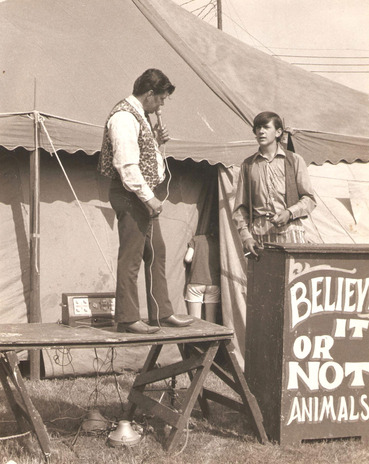
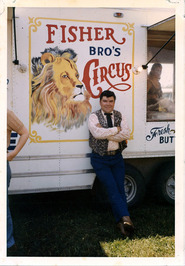
The year was 1970. I spent fourteen glorious weeks, from June until September, on the Clark and Walters Circus. The Silverlake family operation had been purchased a few years prior from a showman in Oklahoma. Brownie was the Patriarch of all things circus. As was typical with circus families, all members of the Silverlake family had an act and a specialty task. They all pitched in with the operation of the show and worked together as a team.

I was eager to learn all I could in order to become a valuable showman. Franklin taught me how to splice three strand manila rope. I learned the proper way to install a twist lock plug on the end of an electric cord from Jimmie. And Melvin showed me how to solder a damaged microphone connection. I also learned how to sew a baseball stitch to repair a hole in the big top from Jack, the canvas boss, and even how to twist a whip-popper, the special part on the end of the whip that makes the noise, among other specialties.

 Brownie had time to share stories as he took care of the animals, so I typically followed him around as his helper. I learned about his wagon show days on the M L Clark Circus when he was a boy. I remember his story about when the Mighty Haag Circus was confronted with a steep and dangerous highway grade. This is when the elephants were literally walked over the mountains through to the other side, even though the teams and wagons kept to the roads.

Brownie tutored me with the same kindness he showed the animals in his care. As a newcomer to the show, my job was to play the drums during the show to accompany the calliope music of Bobby Green.  The rest of the time I was all over the circus lot involved in a litany of creative tasks. These included the set-up, maintenance, caretaking of animals, but my creative drive found expression with paint as I lettered Tickets, Jungle Beasts, Alive and decorative accents on the rolling stock. While we toured Appalachia, they tried the cherry pie trick on me, but because I was motivated and eager, the trick was irrelevant.

That summer whet my appetite to live a more interesting life. It filled me with an enthusiasm and a decision to continue my career in show business. Returning home at the end of the summer, I took welding at night. In January, after graduating from high school early, my fascinating career began. My creative drive, ambition and gift as a painter took precedence over all else and, I began to combine being an artist with travel.

Drummer

I was obsessed with becoming a better drummer as I began my sophomore year. I had taken lessons at Indiana University and practiced every day during the previous year.

                Bloomington High School had a gifted band teacher who motivated his students to pursue music as a career. At the beginning of the year Mr. Traub placed me in the band room during an hour the classroom wasn’t being used so I could practice and he monitored my progress. He noticed my improvement and by mid-football season he started me through the ranks. I was placed in the marching band as a tenor drum player and by the beginning of the second semester I was the first- chair snare drummer for the Symphonic Wind Ensemble. This was the equivalent of joining the college orchestra.

I met Karen while in the band that year too. She was an aggressive red head. She knew what she wanted. I had been a sheltered, reclusive and socially clumsy kid. A whole new world opened to me. Karen always had something in mind and she knew exactly what to do. After school and all summer long, she taught me all physical aspects of relationship between the sexes. Eager to be with her, I would do almost whatever she wanted me to do.

This university town had no jobs for a fourteen-year-old because of the abundance of college students. It was early summer when the Deggeller Shows brought a bunch of carnival rides to the university campus for the Fun Frolic. I was there early looking for a job. Despite this not being a traveling circus, it did qualify as show business.  I got a job helping set up the Merry-Go-Round, working with a man and his son with whom I became friends. Together we worked and eventually hung the last horse on the ride. We then started to assemble the kiddie rides. Unloading the specially-shaped steel components from trucks with broken bulb glass on the floor revealed an interesting contrast to the form of show biz I was familiar with. Behind the scenes, I was seeing the amusement business as it really was. Once the rides were ready, I returned home to clean the dirt and grease off of me. I was told to return the next day, so I must have done a good job.

When the festival started, I ran one of the kiddie rides. My job was to stand at the controls, welcome the patrons, and make sure they were settled into their seats before turning the switch to start the ride. If no one was waiting in line, I gave my passengers an extra-long ride. I was grateful to have employment for the week and it filled me with a feeling of accomplishment.  Karen hung around while I worked, but something was clearly bothering her.

“I think it’s terrible,” she wailed, “that you work all the time.”

Her inability to empathize with the value of this opportunity combined with a feeling of frustration that grew in my gut. This strong sensation literally reached up inside me and grabbed me much like the reaction that took my voice when I watched bullies pick on my brother. Karen maintained this negativity all the time I did my job. She insisted that I take a day off and accompany her around to all the rides. Reluctantly, I did what she asked.

The next day, I explained to my boss my plans to escort her around the festival grounds instead of returning to my post. When I returned the following day, I discovered my job had been filled. I learned two valuable lessons on one day; never let them discover that they can get along without you, and career always comes before girlfriend.

While excelling at math, John learned the machine language computers spoke. At Bloomington in high school, he wrote elaborate programs using punch card sequences that would solve mathematical problems. He understood and developed a mastery of complicated systems using binary code.

My father’s climb through the ranks and his ambition with newly acquired graphic skills landed him a job in the Lutheran synod offices in downtown Chicago. The family would move again, this time to the suburbs of a sprawling metropolis. My family moved twice during my high school years. First to Bloomington, Indiana so Dad could expand his skills at Indiana University with a second Master’s Degree. Then, two years later to Chicago, Illinois so he could fill an important role downtown. He used the Airstream to move the bulk of our possessions, with the exception of the piano.

John graduated from high school as the family moved from Indiana to the Chicago suburbs.  John stayed behind and began his college years at Indiana University. The students were older but still mean to John. He chose to withdraw and excel academically. He took classes for many years until exhausting the curriculum. From there he launched his career as a computer programmer.

All the summer school college students eventually went home. A short window of opportunity existed so I started looking for a job. I went into the Lucky Steer Steak House. The boss asked me if I could start immediately. He then showed me the dish room with hundreds of dirty dishes piled up to the ceiling. I started immediately. Three days later I was cooking steaks. Dad learned of and appreciated my ambition. He was busy moving the family’s belongings to Chicago with the airstream and waited for the last minute before taking me with him.

I arrived at our new home late at night and slept a few hours. The next day was my first day of school. In the morning, I was dropped off early in front of an unfamiliar school. I received my class assignments at the administration office at Arlington Heights High School. I searched up and down the hallways for the room numbers on my list, and finally gave up. I could not find them.

Not knowing which way my home was, I had no options. Frustrated, all I could do was sit down on the front steps of the school while the classes were going on. A friendly counselor saw me from a distance and came to sit down next to me to find out what was going on. He looked at my admissions card and he too realized that I had been given room numbers that did not exist. Confusion at the Chicago school system started with this debacle on my first day and spiraled down from there. As I entered my junior year, the tainted perception of my new school and surroundings bred a new-found apathy and defiance.  Expecting the same positive experience that I enjoyed in band in Indiana, I soon realized that Fritz Shmoyer, the band teacher, was incompetent and simply coasting along on tenure. He was apathetic about his job and didn’t encourage any students. Because I made this comparison, I knew he was a slug and began my defiant response to his pathetic efforts.

Fortunately, John stayed in Bloomington. Paula and I were relieved that none of our new colleagues would ever know about our brother, but we found a new set of frustrations. The big city pace of suburban Chicago, the dysfunctional school system, and the beat among our fast-paced peers had its own mix that led to a new exasperation for myself and Paula. 

Also fortunately, the art department at my new school was outstanding and far better than any previous art classes. Mr. Pink became an advocate for my ambitions. He encouraged my emerging skills and created many artistic opportunities for me.

The Move

During the years of evolving in his profession in Springfield, Ohio, my dad became aware of how rapid graphic technology was developing. Changes were taking place with photography, film making, sound technology and education. His beloved boss was retiring and that would change his position in the hierarchy. He recognized a possible opportunity. He desired additional education to augment his skills with new audio-visual knowledge. That meant change.

The family moved to Bloomington, Indiana as I entered junior high school. Dad attended classes at Indiana University. The move into a compact home in a neighborhood with a dense population of kids also required us to ride a bus to school.

Moving away from the environs of childhood in Ohio at a tender age, we had to make new friends in another town. This disruption frustrated our meager attempts to fit in. The home situation remained frustrating and my sister and I realized being associated with John was a detriment. As we advanced through the grades, we formulated a way to stay far away from him and be safe. When Paula and I passed one another in the hall at junior high school, rather than acknowledge each other, we remained anonymous in an effort to avoid the risk of association. We would resume being fast friends at home in safety.

At that time, I was on fire to become a good drummer. The music department at IU provided me with an opportunity to take lessons from a great drumming college student. After my junior high school classes each Thursday, I went over to the IU campus to take my lesson. Afterwards I met dad, who was working in the graphics lab. He would show me what he was doing with photography and sometimes set me up in an empty darkroom with an enlarger and show me how to make my own prints.

By this time my circus producing abilities matured. By summer I would put on an even larger production, adopting the name my dad and his friend Fred used many years ago; Spark Circus.

I began building cages for chickens, rabbits and the turtles I accumulated. While I painted promotional signs, Paula began making hats and necklaces out of packing peanuts and paper bowls. The neighborhood kids were curious about what we were doing and were recruited one by one to help. Soon we had two crews; the boys helping me with manly activities and the girls making prize and craft items under Paula’s watchful eye.

The masculine duties were pounding stakes into the ground and setting up and climbing the center pole we erected in the backyard. Stretching a rope tight enough to walk across became a challenge that required accumulating ever larger stretching-devices. We practiced Indian dancing routines, acrobat tumbling and hanging upside-down from the trapeze bar on the swing-set. We rehearsed these acts until we achieved an admirable level of perfection.

thumbnail 2

During the girl’s production of a mountain of prizes, Paula would pause to rehearse one of the skits she created. We had learned about skits on family vacation. The Lutheran church had a family summer camp near Lakeside, Ohio. While there, mom and dad would compose a clever skit and the entire family would act it out in front of the others. Paula had begun writing stories in her Pinfoot the Pony comics. Now inspired by our family vacation skits, she created routines for her peers to perform.

One routine Paula created for our circus utilized a chorus line of her girls pointing in rhythm, one at a time, and then changing their pose and repeating a cute-over-there dialog that ended with all of them falling in a heap.

Thanks to an abundance of Beatle wigs and a neighbor kid with a buzz haircut, the circus had a barber shop skit that began with a very furry head and ended up with a faux surprised kid with a bald noggin.

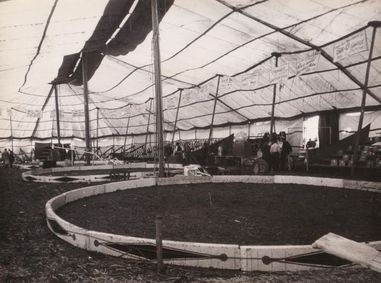
All this rehearsing united us on circus day when, like a real show, all of our equipment and our big top (a converted army surplus parachute) was marched, carried or pulled to the vacant lot next to the local swimming pool to be set up. We arranged the set-up to occur in the morning by our team of kids, followed by presenting five shows. The activity brought the entire neighborhood together. My circus benefited the community pool and produced a considerable profit for my investment. It also gave me the idea for a career path to pursue.

Circus Day

As a tyke holding my mother’s hand, while walking onto a grass lot, I saw my first canvas tents in the air with flags flying. I heard the tinny voice of the side show barker over a loudspeaker mix with the distant sounds of roaring lions, the exotic smell of elephants, cotton candy and popping popcorn.  

While taking in this sensory overload, I heard my mother confide, “Your dad would love this.” 

I was sold on the spot! 

I was inspired by my dad’s love for many things. My dad loved railroad trains, photography, dirigibles, and the civil war. Later, I would hear about the circus of his youth. I savored the stories about the remarkable sights he witnessed during the summer when he was a boy. He woke before sunrise to gather with the other boys at the railroad tracks to wait for the circus train to arrive. When the distant headlight first appeared, its piercing light provided the first spike of excitement. 

He told me about the early morning feast for their eyes as the circus train moved into position and started the unloading process of wagons, horses, trucks, elephants and special equipment from the flat and stock cars. This process took place with amazing fluency. He watched an incredible enterprise populated with hundreds of people, portable objects of wonder and animals of all kinds unload destined for the show grounds.  

A beehive of activity resulted in a canvas city rising into the air before noon. An entire spectrum of preparations were completed by a predictable time. The two shows; a matinee and an evening show were given the same day. After the second show, the entire aggregation was taken down and reloaded on the train. When complete, a steam locomotive began to pull this amazing collection of everything wonderful out of town and into the dark toward its next destination.  

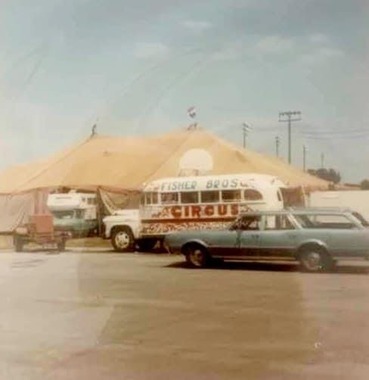
Although not the big railroad circus, this version traveling on a fleet of trucks that came to our town was amazing none the less. After seeing this big top circus, I became keen about seeing it every year. When summer came, I began to look for circus posters in store windows and on telephone poles. 

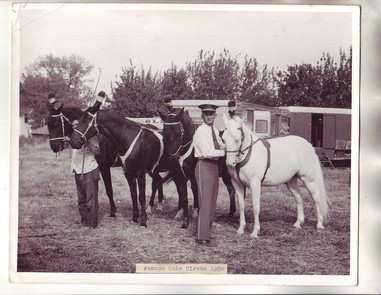
Imprinted with the same love my dad had for the circus, I began my pattern of getting up early to see the morning arrival of the Clyde Beatty-Cole Bros Circus, the large canvas big top truck show that made a regular visit to our fairgrounds.  

As I grew, I became able to get a job helping set up the tents early on circus day. Then after seeing the show, like my dad before me, I was inspired with the idea of producing an even greater circus production in our backyard.  

I created apparatus for my backyard circus and painted the decorative advertising that goes with such a production. I was shaped by new thought, old tradition, love and enthusiasm to find adventure with my creative outlet. 

Each summer I produced a different revue. The usual circus performance was made up of children recruited to perform various acts – clowns, trapeze and acrobats. One year, I made cigar box guitars and a potato chip can drum set for a Beatles concert.  

After receiving a chemistry set and becoming familiar with several sensational experiments, my best friend Arnold Vila helped me create a show called “Chemistry Magic.” Working with limited resources didn’t slow us down. One demonstration aptly called; purple smoke was produced by cooking iodine crystals over a Bunsen burner. Because we used the same beaker later in the show we had to cook off all the crystals until gone and the cloud of smoke produced almost asphyxiated our audience.  

Even though I felt my shows were worth every bit of the dime I charged, my mother always served Kool-Aid and cookies to everyone who attended, so she knew they got their money’s worth.   

A blend of these creative activities coalesced in all sorts of childhood endeavors that included display building and painting artwork on virtually everything that moved. After discovering my dad’s boyhood model circus wagon building efforts, I began building my miniature circus from scratch. 

Corn Country Show Biz


The Circus Hall of Fame was situated on the one-time home of several touring railroad circuses.  Many artifacts remain from the historic winter quarters of this large circus conglomeration that resided here a hundred years ago. A circus fan aspired to make this a tourist attraction. He wanted live circus attractions among the old wagons and artifacts. A big top was erected next to the last of the remaining barns that at one time housed the animals. Another barn housed wagons, costumes, and had a sail loft where canvas production used to take place. 

Now, a handful of performers were employed each summer to provide two shows a day. The single location for the summer meant a vacation from the travel regimen I was used to. I liked the idea of having a stationary place to work my performing animals but from the get-go, I discovered that the momentum and function of this place was fractured and would probably remain so through to the end. 

By this time my animals had solid routines. I had appropriate costumes, clever choreography, patter and pratfalls. The mule act developed into a fun act that required the participation of the announcer as a straight man to support the comedy with the lines that I had written.  

With rehearsal appropriate, John Fugate, the ringmaster, deflected my request by declaring, “We are all professionals here. We don’t need to rehearse.”  

We entered into our performing regimen of two shows a day with John fuddling his lines as he read off index cards in front of the audience. The plethora of mistakes he produced proved frustrating to me as he missed crucial parts of the comedy. Fortunately, the high school horse act did not require his participation.  

With the use of a live organist, I developed an interesting interlude for the middle of the horse act. After the first two segments of the routine and after the bow, I assumed a striking pose in the middle of the ring to acknowledge the audience. The announcer then invited everyone to participate. 

“Please join Souveran the horse as he high-steps to the music,” John bellowed, “clap along as he dances for you.” 

As the musical strains of the Mexican Hat Dance began, I had Sir walk sideways a few steps and at the right moment in the song, had him do a double leg extension coordinated to the music which prompted the audience to clap two times. Then, as the music resumed, we walked sideways the other direction and did it again. This was repeated four times to complete the stanza that resulted in a logical conclusion and good reception.  

The conclusion of the act was next. By this time in his career a few elevated strides of the high trot occurred, followed by our now consistent canter work. After his halt at the front of the ring we bowed.  

With the concluding announcement complete, we backed through the center of the ring. In front of the curtain at the back of the ring, we took another bow prior to our exit. In spite of the constant bumbling of the ringmaster, the grassy venue, permanent stables and luxury of two shows a day all summer, I had a wonderful opportunity to perform and enjoy my animals. 

Some of the personnel at this place, starting with the director, were hopeless. They were retired fans who wore clown faces and had no clue about this culture. In spite of their pathetic contribution they still wanted to be treated like stars. The elephant guy seemed to resent being here. He had inherited an elephant from his father along with a couple of camels. In contrast to the exact efforts of most animal caretakers, his work ethic was sloppy. The elephant got loose one night and walked over to the water faucet and turned it on. In the morning the entire floor of the barn including my horse and mule stalls was flooded. I didn’t do anything wrong but I had to shovel out the mess his elephant created. He never did apologize or offer to provide replacement shavings. He just moped. He didn’t like anything about taking care of animals.  

Late that summer his wife and daughter joined him. Little Dallas fell in love with my horse. She hung around and offered to help me groom him. I’d lift her up onto his back so she could brush his mane.  

Often times after my act she waited by the back door. She knew after I dismounted, she could sit on him and get a ride while I lead him back to the barn. 

Not everyone at the Circus Hall of Fame was dysfunctional. Circus animal training greats Vince and Pom Pom were here with their collection of tigers. The steady pace of loving animal care provided the heartbeat in the backyard. We were all used to the hectic pace of travel and one day stands. With ample time here for the summer, we all found extra activities to keep ourselves busy. Michelangelo Nock was here and his enthusiasm was infectious. Having grown up in this business, he displayed a flexibility and a regard for others that helped ease any tension that occurred.   

I had spare time each evening and sought to develop new skills.  I hired a tutor to teach me computer skills. I went into town to make friends. I went to AA meetings. My life had changed as the result and I now had nine years sober.  

  One Sunday morning I met a great guy at the Presbyterian Church and began to attend the weekly Lions Club meetings with him. Tom was amazed that I performed with my dancing horse and comedy mule act at the Circus Hall of Fame for the summer.   

The Lions Club of Peru, Indiana met in the banquet room at a local restaurant every Thursday. During those meetings they searched for ways to benefit the community. I attended as a guest of my new friend Tom.  

Among the activities at the meeting were sending encouraging notes in greeting cards for people we didn’t even know. Each member received three cards and three envelopes. A notebook with names and addresses of unfortunates were passed around for us to copy from. There were also announcements about others in unfortunate circumstances who would benefit from our encouragement.  

During those weekly meetings the Lions considered new ideas to benefit others. When an assisted living home for those suffering from terminal medical conditions came up, they discussed possibilities. I had an idea. I volunteered to bring Betty the mule and perform for them. The plan was to work my comedy mule act for the assembled patients outside on the lawn and then take the mule inside and visit patients who couldn’t leave their rooms.  

The Lions Club members welcomed this idea. This created a stir with most of the club except one, a curmudgeon who seemed grumpy about everything. Harold scowled at the idea. 

The rest of the group asked about doing this little show and made a list of what was needed. Soon volunteers came up with a P.A. system, wooden stakes and ribbon to cordon off a ring area. They made plans to coordinate this event with the personnel at the facility and one member acquired a stock trailer to move Betty. This activity fit into my schedule after the matinee on an upcoming Sunday.     

The entire club rallied to make this work. On show day several men arrived early to stake off a circular area for the ring and stretched boundary ribbon around the circle. They acquired chairs for the patients who could walk. My friend Tom became the announcer. He learned the lines of the straight man to support the comedy. On show day he became acquainted with the P.A. system while I showed Betty the venue.  

Other club members went inside the facility to get our audience. They pushed patients in wheelchairs outside and onto the grass to completely surround the ring. When our audience was intact, we began our show.  

Tom the ringmaster began with his introduction, “Ladies and gentlemen, we welcome you here today to our little show.” 

“Introducing at this time,” Tom bellowed, “direct from California gold mining country, here to launch their career in show business, please welcome Gold Dust and the Old Cuss.”  

I led Betty into the makeshift ring and waved at all the patients. Our routine began with liberty work. I had Betty trot around the ring, reverse direction, trot the new course a few rounds and then reverse again to a stop. Since there was no ring curb, we didn’t do the ring curb walk. Tom set the hurdle in the ring. I gave Betty the cue to lead off and she resumed running around the ring.  

With the hurdle in the ring the desired response was obvious but she was trained to do otherwise. As Betty neared the hurdle she veered off and avoided the jump. I acted as if in disbelief. I feigned frustration. I gave her the benefit of the doubt. As she rounded the ring and came up to the hurdle the second time she veered away again. I acted miffed and took the whips in both hands. I bent them as if in frustration. As she neared the hurdle for the third time, I shook my finger at her and she jumped the hurdle to the delight of all in attendance. Tom was really having fun. Then just for good measure Betty rounded the ring one more time. As she neared the hurdle the fourth time, she veered around it again as if being mischievous. After I stopped her at the back of the ring, we took a bow.  

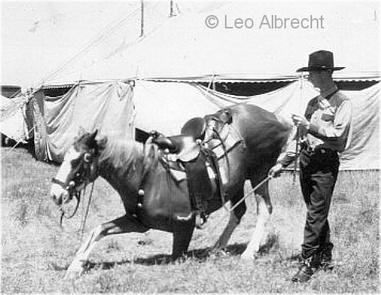
Next Betty came to the center of the ring. While she stood next to me, I gestured to the audience as if I was going to have her do another trick. While I looked away from what she was doing, Betty kneeled and then laid down.   While I made gestures to the audience, Tom called out to me. 

“Hey Cuss,” he stated, “it looks like you may have a problem.” 

I looked around and acted surprised to see the mule lying flat on the ground.  

“I think she fainted,” Tom surmised. 

“You are going to have to get her up,” he suggested. 

I stepped away, scratched my head and acted as if thinking about what to do next.  

Tom spoke up, “What are you going to do to get her out?” 

I perked up as if a thought had occurred. I stepped over her, reached down and grasped one front leg and the ring on the bit in her mouth. I pulled gently. I inverted her onto her back. She soon had four legs sticking up. I straddled her while she was upside down to steady her. I took her front feet in my two hands.  

“How are you going to get her out like that?” Tom asked. 

“I’m going to peddle her out,” I responded and gyrated her front feet in twin circular paths as if they were bicycle pedals.  

This generated a laugh especially from Tom who enjoyed every minute. I then laid her back down onto her side. I had to wait until he calmed down enough to remember his next lines. 

“You’re still going to have to do something,” he blurted between laughs. 

This was when I went into position next to her between her outstretched legs. I faked losing my balance, waved my arms and fell backwards over her and did a backwards somersault. This was her cue to go into the sit up position.   

I got up and dusted myself off. Tom continued with the patter. 

“Hey she’s sitting up,” Tom reported, “she’s sitting up.”  

“Hey Cuss, she’s sitting up!” He was excited. 

I scanned the situation and blurted out, “Oh no she’s not!”   

“Well if she’s not sitting up, then what is she doing?” 

“She’s sitting down.” 

That prompted a groan from Tom and the audience. 

“Cuss,” he continued, “you are going to have to do something to get her up.”  

I stood at the front of the ring and scratched my head as if in thought.  

“Hey Cuss, why don’t you just pull her up?” Tom wondered, “just give her a jerk.” 

   I went in front of her, lifted the reins up over her head and stretched them out in front of her in preparation for my next move. Two of the Lion’s club members had noisemakers and waited until my next move to add sound effects to the fun. I firmly planted my feet.   Being careful to not hurt her in anyway, I exaggerated a gesture with my entire body that looked like I had given her a tremendous yank. The attempt did not produce any result. 

“Give her another jerk,” Tom commanded. 

I repeated my wild antic to no avail. 

“And another jerk.” 

I did it again. 

“Another,” Tom repeated. 

Nothing. 

“Well Cuss, it looks like you’re the jerk.” 

Tom paused for effect while he thought of another idea. 

“Hey Cuss,” he continued, “why don’t you try to lift the back end up and get it even with the front?” 

I resigned to this idea and shrugged my shoulders. I pondered his suggestion and moved into position behind Betty. I did a quick muscle-man pose to flex my muscles. Then I leaned over and placed my hands beneath her rump. I strained and made another gesture that coincided with the funny noise makers and a loud grunt. 

“Try it again,” Tom said. 

I grunted along with the funny sounds again. 

“One more time”  

Groan. 

I limped away, stooped over, like I may have over-exerted myself. I walked clutching my back as if it were hurt. 

“I guess that is not going to work,” Tom observed before he reminded me, “you are going to have to do something!” 

He repeated, “you are going to have to do something to get her out of here.”. 

At this time, I walked over in front of her. As if under pressure with frustrated anger, a thought came to mind. I began swinging my clenched fist in a big circle as if to hit her. 

“NO! Cuss!” Tom intervened, “not that.” 

I relaxed and stepped away.  

“Hey Cuss,” Tom continued, “why don’t you think of something nice to say?”  

  I acted quizzical, as if I didn’t know what he talked about. 

“You know,” he continued, “something nice. Like the magic word.”  

I still acted miffed. 

“You don’t know what the magic word is?” Tom spewed forth, “I bet the boys and girls know what the magic word is.”  

He scanned the audience and shouted, “Don’t you?” 

They responded as well as they could. 

“Well what is it?” He yelled. 

The crowd responded “please!” 

I acted enlightened.  

I moved from the position maintained throughout this portion of the act in the quadrant of her starboard side. My position in the ring was the cue for her to remain sitting. When I moved around behind her, I came into an area where she saw me with her other eye – the get-up eye. She knew to get up next but not until I gave her the cue to do so.  

“On three everybody,” Tom shouted, “let’s say the magic word.” 

“One.” 

“Two.” 

“Three.” 

I placed my hands together as if to pray and bent my knees in an ask gesture as everyone shouted, “Please!” 

Betty got up. 

I stepped in front of her as if to take all the credit as the audience applauded. My posterior in front of her was the cue to give me a nudge with her nose.   

I exaggerated being nudged out of the way and then spun around to acknowledge her being there.  

“Now that you have said please,” Tom continued, “why don’t you say thank you?” 

I pulled out the carrot that was in my back pocket the whole time and showed it to the audience. Then I gave it to Betty. That got a big hand.  When the applause subsided, Tom turned to the audience with his question. 

“Have you ever seen a dancing mule?” 

I picked up the whips that had laid near the back all this time and got ready to lead-off again.  

“Maestro please,” Tom gestured to the man with the music machine.   

The music began. I used a wonderful orchestra piece for this part of the act that started with a little dainty sequence that implied a ballerina routine.  

As Betty rounded the ring, at the right place I gave her the cue to waltz. The waltz was where she turned 360 degrees in her tracks. Betty loved to waltz. We repeated the waltz movement several times until the music led up to the beginning of the crescendo portion of the orchestra movement.  

I stopped her at the back of the ring and gave her the command for the hind leg walk.   She stood up as straight as a candle and took careful steps that resulted in her walking from the back of the ring all the way to the front.  

The music culminated in a grand conclusion as we neared the front of the ring. I let her come back down and gave her the cue to bow. With her taking a bow, I styled to the audience for applause. When I gave her the cue to come up from the bow, I stepped in front of her. That was her cue to bite the rag attached to the back of my break-away pants. As she bit that rag, I pulled the buckle that released the securing Velcro closure. I stepped forward as the pants released making it appear that she had pulled them off.  

The backside of my inner costume was made to look like long underwear with the flap on the back. The flap had the words the end stitched onto them. I became frantic as if embarrassed. I moved to the center of the ring and took a wide stance with my legs apart and my backside to the audience.     

I whistled. That was Betty’s cue to come running. She came right at me and put her head down and ran between my legs. She scooped me up onto her back as she went. From that position – I sat on her back and waved – we rode out of the ring.  

Tom gave our concluding announcement, “ladies and gentlemen there you have it.” 

“The talented and entertaining personalities brought to you direct from the California gold mines,” he bellowed, “let’s send them off with a great big round of applause.” 

There was no reason to be in hurry when the act was over. Afterwards Betty and I browsed and said hello to many of the patients in wheel chairs. One lady spoke up to me. 

“I’d love to pet your mule but I have M.S. and can’t move my arms.” 

I guided Betty close to her and placed her head on this woman’s shoulder. Betty seemed to understand and carefully laid her head against her. The lady wept with joy. The local newspaper cameraman captured this moment in a photo that showed up in the paper.  

When the act was over, our plan was to take the mule into the care facility to personally visit the patients who couldn’t come outside to see the show.       

By this time the Lions had dismantled the ribbon ring and put away the sound system. The army of caretakers pushed wheelchairs back into the facility. Those able to walk went back inside after they stopped to see the mule.  

The Lions club members took bags of carrots into the facility and went into each room. They gave each patient a carrot for Betty. Betty would go from room to room and get a snack at each stop. This created excitement in the place. The Lions seemed to be just as excited.  

When I led Betty in through the foyer to begin going from room to room, I was stopped by a woman who wanted to chat. As I stood and answered her questions, one Lions Club member saw this friendly rapport was holding up the works. Wouldn’t you know it. It was grumpy old Harold. 

“Gimme that mule,” he demanded. 

I watched as Harold gently led the mule down the hallway to get started. Sure enough, they disappeared into the first room. After a few moments Betty emerged with her new friend and went into the next room.  

The afternoon went well. Betty enjoyed the tour of the place and all the carrots. This became a bonding experience for all of us, especially Harold.  

I received the report at the next Lions Club meeting that the patients were still talking about the day that the little mule came, did all the circus tricks for them and even visited them in their rooms.   

Overall, the summer tending my stock, performing twice a day, joining the community and making progress with other areas of my life qualified as a delightful experience. Right on schedule too. The largest RV dealership in the country had made it attractive for me to be their resident artist. This opportunity was priority. The severe incompetence of the Circus Hall of Fame provided a reality check; it got the desire to perform with the circus out of my system. 

A Fascinating Woman

Dorita’s farm became an oasis spring and fall for several years as the increase in mural work among the RVers provided me with abundance. The idea of developing entertaining acts with my horse and mule remained a constant dream.  I valued the opportunity to work with her. I also connected with the AA community in Sarasota and began to attend services at the Unity Church.

During the day, while at her home in Sarasota, I busied myself with rehearsals and lessons to become a better horseman. In the evening, Dorita and I would share strong coffee and talk about many aspects of classic horsemanship. These discussions rocketed my understanding and appreciation of this fascinating art form. While becoming her friend, I also found out many interesting things about her personally.

Dorita Konyot was a small woman. She was physically fit her entire life with long beautiful dark hair that was unusual for a person her age. Horn-rimmed glasses accentuated the high cheeks on her almond shaped head and a large elderly nose suggested, along with her accent, European origins. While we visited with each other, she typically sat across from the table. Cigarette smoke rose lazily into loops and shapes that eventually coalesced into the haze that stained the interior of her home.

Among the stories shared were anecdotes about her friend the author of the Black Stallion. Several eight by ten photographs of her friend Walter Farley astride a silver dapple Andalusian hung on the wall over the coach. While I listened intently, I found out more about this fascinating woman.

Dorita was born on a traveling circus caravan May 18, 1922 in Talouse, France, into a family of renowned equestrians. Her Scandinavian and Hungarian lineage blended with the flavors of all the countries that made up her playground as a child.  Her father was a stern and capable trainer of horses and an outstanding rider of the highest level. 

At a young age, riding instruction began with the ever-watchful eye of her mother, Manya and her father Arthur, trainers and presenters of High School horses and other kinds of horse acts. 

She and her brother along with mom and dad soon made the foursome astride handsome Lusitano dancing horses that entertained European audiences from the bullrings in Portugal to the major permanent and traveling circuses across Europe.  Related to a larger family with connections in all aspects of show business, her relatives had even built a large successful show before the Great War (WWI) occurred and all the equipment was confiscated for the sake of the war effort.

Her story was interrupted by the sharp bark of her canine companion. Raven, a sleek and

tiny miniature pinscher wanted attention too. His animated loops around the room and back to her side provided comic relief while we sipped our strong coffee. With Raven back in her lap, she continued her story.

                Talent scouts found the Konyot family shortly before WWII and her family quartet with the command of centuries old Haute E’cole horsemanship skills came to America. In 1941, they began performing for Ringling Bros Barnum & Bailey Circus. Those audiences had occasion to witness the finest dancing horses in the world. 

Incidentally, Dorita as a teenager was photographed on a rearing horse and that picture found its way into the book I found at the library when I was a kid in school, just developing my fascination with the circus.  The picture showed a brilliant smile at ease under a large Cossack hat astride a large horse that stood up as straight as a candlestick on its rear legs.

The family also toured with Orrin Davenports Shrine Circus and the Clyde Beatty Circus among other shows. Years later a special moment occurred when Dorita received a standing ovation at Madison Square Garden for her performance with Bouncing Bomba her American Saddlebred High School horse.

One winter in Chicago at an exclusive riding stable, the Konyots stabled their horses during the winter break. A horseman with a background in the cavalry and a reputation for brassy showmanship befriended and became a student of the Konyots.  Chuck Grant took the principles of classic horsemanship learned from them to add to his repertoire. He went on to become, as he coined himself, the grandfather of American dressage.

A school teacher who had never sat on a horse was in attendance at a circus performance in Detroit. So, moved was she by the equine choreography presented by the Konyots, that she selected to make a major career change.  Vi Hopkins not only began to learn classic horsemanship and pursue a lengthy career as a riding instructor but went on to begin the unification of dressage instruction in this country when she initiated the USDF Instructors Clinic at her farm in Michigan.

Dorita’s emerging talent clearly was with the training of horses and horse people. When the Disney movie The Miracle of the White Stallions brought public awareness of Austrian Lipizzan horses to the forefront, Dorita trained a group of riders to present the Quadrille, or precision routine involving eight horses and eight riders for a traveling show that took advantage of the existing frenzy. Many of these riders went on to become stars in tier own right.

Gaylord Maynard performed the hilarious routine that her father used across Europe with his almost human equine partner Chief Bearpaw.  Although the comedy routine contrasts with everything classic about this equine art form, Gaylord was another testimony of the influence and talent that Dorita brought to this country.

                Literally all of my riding instructors and horse trainers had been influenced by this talented family. The Konyots are credited for bringing to America the equine art form known as Dressage. Virtually everyone associated with performing horses in this country today has been influenced by Dorita and her family. Her niece is a regular contender on the US Dressage Olympic team. In my quest to become a classic performing horseman I had been on a trail that led to Dorita.

She spent the final years of her life-giving lessons in the dressage community in addition to helping circus performers who strive to improve their horsemanship skills.

The Awards Ceremony

The indoor coliseum at the fairgrounds had been converted into a banquet facility to host hundreds of circus personalities who participated in or attended the event.

Prior to the event, many couples and groups dressed to the t’s in gowns and tuxedos. When the doors opened, they made their way inside and found a place to sit at the many round tables with formal place settings. Once everyone was seated, the wait-staff served dinner.

Imitating the many famous televised awards ceremonies, this one was no different. Once the ceremony portion of this event began, legions of speakers and attractive personalities made their way up to the podium to share anecdotes about circus history and to announce the winners of each category, followed by those performers who added their rhetoric between spurts of applause.

I was seated with Tino Wallenda and his family. I had mentally prepared a brief statement for when my time came at the microphone. The owner of the Clyde Beatty Cole Bros Circus, John Pugh, who I had worked for two decades ago, was part of the duo that arrived on stage to announce the winner of the category Domestic Animal Acts.

John was short. He had to stretch to speak into the microphone. When he announced my name as the winner of the category, I rose from my seat with the Wallendas and made my way up to the stage.

As I climbed the stairs, John tried to be funny and suggest that I stop before I got to the top where I would dwarf him. His lovely assistant placed my award – a handsome medal on a neck ribbon like Olympic winners get – over my bowed head. John gave me a handshake. Then I made it up to the top of the platform. I had a brief statement prepared in my head.

“I want to thank my heavenly Father,” I began, “who made all this possible.”

“And for this wonderful horse that I have been blessed with.” 

             I let that sink in for a moment and then added, “and John Herriott for all his encouragement and the patient help given me.”

While I made my way back to my table, I received congratulatory gestures from many people who applauded as I went past.

             My heart acknowledged a tremendous truth as I savored all that happened to get me to this place. Although life contains tragic challenges, when I move into harmony with an unseen influence and allow that power to work in my life, amazing things happen.

The International Circus Festival

The culmination of the holidays found me at the fairgrounds in Sarasota preparing for Circus Competition. During the five performances that took place that week, every participant competed in one of several categories; aerial acts, juggling and acrobatic troupes, exotic performing animals, domestic animals, balancing acts, clowns, musicians and ringmasters. Every facet of the sawdust entertainment realm from all nations were represented.

By this time, I had a confident horse with a good work ethic. I learned on the tour earlier that year, wherever I aimed this horse, he willingly went, and when we got there, he was ready to go to work.

A year ago, I brought him here to get him used to the sights, smells and sounds. This time we were ready with an animated rehearsed routine. The rings in the mega circus tent were on grass, better footing than hockey floors. We were able to trot and canter freely. I had an admirable posture in the saddle, thanks to Vi and a spontaneous brassy attitude for whatever vicissitude should occur, thanks to Chuck. With John’s help, my routine was polished, and in front of all the critics in this business, I aspired to shine.

New red wardrobe had been created using the claw hammer tail tuxedo style jacket with strategic rhinestones sewed on for accents. When the time was right, I mounted my glistening steed. The pre-arranged musical score was provided to the brass circus band. I waited behind the backdoor curtain for my announcement before our entrance.

Finally, the preceding act reached its conclusion. The applause settled down.

After a brief pause came the booming voice “Keeping alive the timeless circus tradition of performing horses, please welcome the American Saddlebred dancing high school horse ‘Souveran’, trained and presented by Dave Knoderer.”

The curtain was thrown open. My horse became immediately animated and we floated at a trot into the ring. Our routine was accompanied by the captivating chords from the theme song of Star Wars, translated by the bevy of brass in the bandstand. A volte in either direction preceded the flawless side pass through the lateral center of the ring.

I knew that every one of the Herrmann girls of Lipizzaner horse show fame were watching and became extra light with my aids to facilitate a seamless transition from the forward to the lateral movement. At the conclusion of the trot work that opened our routine and established that we had a handle of this aspect of horsemanship, we halted at the center of the ring. I sat straight. I knew the horse knew what was next. All I had to do was signal with a muscle tension in my groin and he began to lean back. He lifted his leg as he did and came to rest on one knee. As he did so, I struck the style pose and the audience provided thunderous applause.

The most important part of this movement is the hold. Many rookie horsemen are satisfied with simply getting the pose but the horse learns to do it and bound right back up. The movement has three parts; going into the pose, holding the pose, and coming up from the pose. Knowing horse trainers were in the audience, I made sure to hold the bow for an extended amount of time just to show off the fact that we had a handle on this thing.

Next in the routine was the three-step where the horse moved forward and, at every third stride, a foreleg was elevated and extended in an exaggerated motion. Special care was necessary to not interrupt the forward momentum with too much of the aid that asked for the leg extension. Finesse is what facilitates a good three-step. The movement continued all around the ring. After one revolution, we dissected the ring from back to front and reversed direction. In this other direction we began to march, or do a leg extension every stride, all around the ring.

Special care was needed to prompt, in careful rhythm, the forward walk with a leg extension every stride. During the march I radiated a confident air and remained in contact with the crowd. The march then assumed a track through the center and toward the front of the ring where we faced the grandstand. While up against the ring curb, our proximity seemed to promote the question in the mind of the audience, what’s next?  We began the double-backwards three-step, which is three backward strides and a double foreleg extension which was repeated regularly as we backed through the ring.

In the rear of the round exhibition venue the horse was already sensitized to go in reverse. I provided an invisible cue from my seat and signaled him to glue his front feet to the ground. I then coaxed him into the camel stretch or circus bow where his front feet were out front and his chest was inches off the ground. Again, timing was what allowed the public to notice his magnificence. As he held this pose like a living statue, we provided a picture of the classically trained horse and rider.

From this pose came the exciting conclusion. Beginning with the trot, the goal was an elevated leg extension at every stride. This was called the high trot and was a difficult movement that took years to do consistently. Because our training was still underway, I just asked for three strides. I got the conditions right and began to ask. For whatever reason, the response from him would either be quick or his understanding of what I asked went unnoticed. So, I asked again. When I got a few strides in a row, I discontinued asking and rewarded him with some verbal thanks for being a good boy. I had learned this from Evy Karoli in German years ago; “yo brae.”

To utilize the accumulated compulsion, a transition to canter was next. The gait traversed and went into a figure eight with a change of leads at the center of the ring. We concluded the act by cantering up to the front center to halt. We took a bow and saluted the crowd. Then, while the announcer re-introduced our names, we backed through the ring and bowed again in front of the backdoor curtain.

The act was well received, but I didn’t know just how well until later in the day. Back in my street clothes with the horse and mule bedded down. Philip Anthony rushed up to me.

“Dave, Dave!”

“You won!” he blurted out, “you’d better make plans to be at the black-tie awards banquet tomorrow night.”

Herriott Christmas

My role as circus man took me to tropical climates each winter. Warm weather and palm trees made the holiday experience feel different. Without blood family to share this festive time with, the notion of Christmas became watered down since I was on my own. I gave carrots to the livestock on this special day but the magical notion of the Christmas of my youth was over.

In the midst of preparing for my season and taking care of my livestock, I enjoyed being with and observing a special family as they prepared for the holiday. The Herriott family grew up in the active lifestyle of the circus and, like many circus families, worked and lived together in this close-knit situation. They made strong connections and built respect for one another while dedicated to specific traditions passed down from generation to generation, all of which insured they would succeed together and that the show would go on.

The regard freely exchanged in the Herriott home reflected their dedication and connection to each other and all animals. As a guest on their farm, a warm welcome was extended to me. I was invited to feast with them on special dishes prepared in abundance, join in the fun, and get to know all members of the family.

Christmas morning was another sunshiny day with ideal temperatures. Though the chores went on as usual, our customary routine was interrupted by the festive morning ritual to which I was privy. As the driveway filled with the cars and trucks of family members, warm greetings were exchanged and they gathered in the living room. In the middle of the family room was a table made from an old circus wooden spoke sunburst wagon wheel with a round piece of glass on top.

Although the gift giving didn’t involve me, in the midst of the packed living room, I witnessed the expression of joy that occurred as each gift was given and was opened. This prompted squeals of delight and feelings of elation. I enjoyed this glimpse into the life of this loving family and seeing them all behave like little children. 

Soon, torn wrapping paper, ribbons and stacks of unneeded boxes littered the room. Individual attentions paired up or individuals became immersed with objects at hand. Later in the morning a meal was in order.

My favorite part of this unique Christmas experience occurred after the gifts had been exchanged, and everyone had a belly full of good food. One at a time, the daughters began to beg Johnny to “open the trunk.”

Previously unnoticed, an old trunk had a reverent location in the family room. It had been used until then as a coffee table. I had no idea what was inside but guessing from the expression on their faces, the girls all knew. They kept up their vigil. They relentlessly begged their dad to open it. 

After some careful timing and using show biz suspense, John paused to make sure his decision to comply was visible to everyone. Drawn into the anticipation, I, too, became ready for whatever was in that trunk.

                As John unlatched the lid, the daughters drew in close. I too had an opportunity to peer over them and see what was inside. Like a chest filled with treasure, the entire trunk was filled with old 8×10 black and white photographs of circus performers and circus scenes from long ago. The old photos, collected for generations, were the one-time standard of publicity in the circus industry since the advent of photography. Through countless contacts with hundreds of their peers this accumulation of incredible photographs became possible.

As Johnny reached inside and selected one of the old contact prints, the image sparked reminiscence and prompted a story from the archives of his memory. As the accounts unfolded, the bright reflection of glee in the eyes of the members of his family, who hung onto his every word, created in me another reason to be grateful to be included here.

We savored his anecdotes about distant relatives, performers from other famous circus families and the fantastic feats of aerialists, animal trainers, musicians, athletes, clowns and other showmen. His tales involved funny anecdotes that could only occur on a circus, or situations that evolved into gossip about so-and-so, crazy behavior, tragedy, historic moments and the amazing things that animals do. John also told us about humorous situations that occurred during the routine of performing on a daily basis on an old tent show, and the stories about the pranks these dedicated people often pulled on each other.

                The afternoon slipped by all too quickly. Our attention remained filled with story after story until evening finally arrived. With great reluctance, the collective resigned to our regular duties.

As I recall the indelible sight of children gathered around this master story teller and the privilege to witness this unique and intimate peek into the life of one of America’s favorite circus families, the experience easily remains one of my all-time favorite and happiest Christmas holidays of all.

Whether you are alone this year or surrounded by the abundance of those you love, may you enjoy this special time of year and be blessed with the happiest holiday season and most special Christmas of all.

John Herriott

As I headed south toward John’s ranch, I reviewed the plan for the year ahead; maintain rigorous practice with both animal acts prior to the circus festival, compete for the first time in front of the leaders of this industry, and when complete, spend the entire winter season of January, February and March at River Ranch, the luxury RV Resort. After the winter season, I resume practice with the animals to prepare for a five-week circus tour in Canada in the spring. When the tour was complete, return to Michigan where the horse and mule spend the summer on a farm while I paint for the Elliott Amusement company. I would also attend the Blue Bird rallies I had been invited to.

I drove day and night into progressively warmer weather. My thoughts reviewed the immense privilege of working with an admirable series of animal trainers; Bob Grubb, Evy Karoly, Vi Hopkins and Chuck Grant. Now, I get to work with one of the circus greats, John Herriott.

John was born into a traveling circus family, the son of Milt Herriott, an all-around animal trainer. Milt taught his son how to train and handle elephants, horses, camels, llamas, zebras, mules, ponies and other exotic critters. John’s specialty became multiple-horse liberty acts. The Herriott’s performed on both railroad and overland touring shows such as Cole Bros. Circus, Barnes and Caruthers Olympia Circus, the Circus World Museum, Hoxie Brothers Circus, Al G. Kelly and Miller Bros. Circus and a few more. The Herriott’s became renowned in circusdom.  John became effective in the circus ring presenting liberty horse acts and elephants along with other exotic lead stock. His marriage to a tall blonde from Sharon, Pennsylvania produced four daughters.

Years ago, as a teenage drummer on my first big top show, I sat in the cookhouse tent and listened to the fantastic tales that abounded. I heard one story about a family on the Hoxie Bros. Circus. They produced a beautiful display for the show that included every member of the family on a horse. All six members of the Herriott family presented talented circus horses and their display filled all three rings. They wore exquisite wardrobe and performed in unison. The concept of a family that worked in harmony with each other was foreign to me because I came from a dysfunctional family. Although I never worked on the same show with the Herriott family, years later I became acquainted with all of them at an assortment of wintertime functions in Sarasota, where many circus folks live during the off season.

The long, slow trip south allowed plenty of time to review this fascinating livelihood I had found. I came from a contemporary urban culture. As an enthusiastic teenager, I found a completely different society on the circus. Rich with tradition, I was eager to learn and assimilate all I could. My curiosity, dedication and regard opened doors into this interesting way to live one’s life. Certain unwritten rules of the circus actually interfered with being completely accepted into their society. I would always be regarded as an outsider. Regardless, I became attracted to the specialties of the highest regarded of the performers; the riders of the high school horses.

Weary of the long drive and eager to get there, late at night, the last fifty miles took me through the foggy, ghost-like, dimly lit, palm tree-lined interstate highway that threaded past Tampa. The muggy weather was in contrast to the blustery winter weather experienced at the start of this trip. A glowing luminescence on the horizon hinted at the coming dawn as I moved closer to my destination. In the early morning light, my rig found its way down familiar two-lane roads.

Upon arrival at the Herriott home the livestock was unloaded after I pulled down their long driveway. The horse and mule were happy to get out of the trailer. They had stood inside for three days. They couldn’t contain their enthusiasm as I led them through a gate to enjoy freedom and the green grass of the pasture. They kicked up their heels and frolicked at first but soon found the distraction of nourishing green grass.

I arrived at John’s home the first of December. I had plenty of time to receive coaching and rehearse the acts prior to the circus festival.

One morning, the year before, Mary Ruth asked me to go on a trip with her to ride a horse. She was considering a big saddlebred as a gift for her husband. When we got to the farm and found him banging his foot against the stall door, I had some concerns about the horse. Although I rode the horse and did just fine, Mary Ruth didn’t ask me what I thought. She made the decision to get that horse. A year had passed.

 By now, John had trained his big horse to do an admirable march and passage. Our daily routine became working and training our horses together. We both prepared for the International Circus Festival competition which would commence shortly after the holidays.

The result of our intense training would be that these animals would work well.

Standard procedure for living with circus animals is: the animals come first. First on the agenda, while they were out on pasture, was to rig up two tie-stalls underneath the lean-to on the outside of John’s barn. John took me to the building supply salvage yard. I bought three sheets of used plywood – gray from the weather – and three fence posts. At one end of the lean-to, in an assigned area, I planted the posts in the ground and secured the plywood between the barn wall and the posts. I now had two tie-stalls. Rings were also installed to hang water, feed buckets and hay bags. I parked the trailer in the lineup of other equipment, hooked up my water and lights, settled into my living quarters and got some rest. Later in the day, the livestock were introduced to their new stalls, fed, and bedded down.

The activities began on the Herriott ranch early every morning. John had an eight-horse liberty act in training, a big Clydesdale and a little pony that did a big and little act, Henry, the miniature donkey and the big saddlebred he named American Jubilee.

Soon, my daily routine harmonized with all the activity at the ranch. This let me maximize on the opportunity to learn as I watched all the training taking place. When my turn came to use the ring, I rehearsed my acts in the round pen, the same size as a circus ring.  I choreographed my horses’ movements into a sequence that would become the routine I use at the circus festival. I also ran Betty the mule through her routine.

             After the morning feed and muck-out detail and the training sessions were complete, we had fun. John and I both had a saddlebred horse to ride. We saddled up our handsome sorrels and rode them up and down the driveway. We asked our horses for various movements and gave them exercise in the warm Florida sunshine.

When it came to the march, his horse A. J. had an amazing reach I envied. We worked on achieving finesse with our cues and encouraged each other with our progress.

The routine with Betty the mule became a comedy act with me acting like an old prospector. This act was an expanded January act, a routine that appeared as if the animal was outsmarting the trainer with a liberty routine combined. I had been composing patter to support the premise of my mule appearing to defy all my requests. I kept having ideas for more comedy to include and in this environment with John, opportunities for additional inspiration were rich.

One day I asked John, “how would a guy go about putting a hind-leg walk on that little mule?”

John thought for a moment and replied, “I think I would check her down good and tight. Then slap her on the side of the neck and see what happens.”

When I did exactly as he suggested, my mule stood on her hindlegs as upright as a candlestick.

Now that Betty had the idea, I began to develop her hind-leg walk.

As John’s season loomed, he had an idea that would benefit me. He referred me to the idea of meeting Dorita Konyot, a local retired performer and horse trainer whose family brought Dressage to this country. He knew I would receive the advanced riding instruction I sought from her.

The weeks passed. Each day was productive. The bond between us grew. I was able to share tidbits accumulated from experiences with trainers in Michigan and John shared aspects he learned from his father. We enjoyed mutual improvement with our high school horses and our time together.

With each day, a heightened anticipation grew among his family members due to the upcoming holidays. His daughters, now mature circus performers, had husbands and kids of their own. They came from all over to visit to John and Mary Ruth. Soon his family activities included decor and treat preparation as the ladies transformed their home into a fantasyland of holiday happiness and joy.

My dad loved Christmas. Growing up in Ohio, I was familiar with the standard holiday tradition of colored lights on the house, a layer of white snow outside, carolers singing on the front doorstep, special cookies, hot chocolate and the excitement of Santa bringing gifts. The family Christmas morning of my youth was a magical time with plenty of gifts and excitement, now just a memory. In adulthood, Christmas became just another day. Here at the Herriott household I was about to experience a special holiday.